
/2014/10/Roberto-Baggio.png)
/2010/03/GettyImages-467880924.jpg)
/2010/05/Andrea-Pirlo.jpg)
/2012/04/Mario-Balotelli-e1739411097834.jpg)
/2020/01/ronaldinho.jpg)
/2013/11/GettyImages-141894778.jpg)
/2019/11/GettyImages-1094653148.jpg)
/2020/02/Angelina-Jolie.png)
/2018/03/GettyImages-821622848.jpg)
/2009/09/Jennifer-Aniston.jpg)
/2009/09/Cristiano-Ronaldo.jpg)
/2020/06/taylor.png)
:strip_exif()/2009/09/P-Diddy.jpg)
/2020/01/lopez3.jpg)
:strip_exif()/2015/09/GettyImages-476575299.jpg)
/2009/09/Brad-Pitt.jpg)
/2017/02/GettyImages-528215436.jpg)
What is Roberto Baggio's Net Worth and Salary?
Roberto Baggio is an Italian retired professional soccer player who has a net worth of $20 million. Roberto Baggio is revered globally as one of Italy's greatest and most technically gifted footballers, a player whose career was a captivating blend of unparalleled brilliance and profound heartbreak. Universally known as Il Divin Codino (The Divine Ponytail) for his trademark hairstyle and ethereal talent, Baggio was the quintessential fantasista—a creative attacking midfielder whose vision, dribbling, and signature curling free-kicks made him a source of pure poetry on the pitch. His individual peak came in 1993, when he won both the prestigious Ballon d'Or and the FIFA World Player of the Year award. Despite his enormous domestic success and heroic performances for the Italian national team, his legacy is bittersweetly defined by one moment: the decisive penalty kick miss in the 1994 FIFA World Cup final, a poignant image that cemented his status as a legendary figure of resilience.
Early Life and The Fantasista Style
Roberto Baggio was born on February 18, 1967, in Caldogno, Italy, and began his youth career with his hometown club before joining Vicenza at age 13. He turned professional with Vicenza in 1982, showcasing extraordinary talent despite playing in the lower divisions. His early career was famously marred by injury; just two days before a major transfer to Serie A club Fiorentina in 1985, he suffered a devastating tear to his anterior cruciate ligament (ACL) and meniscus. The subsequent operation required 220 internal stitches. Baggio later revealed that due to an allergy to certain powerful painkillers, he experienced the full agony of the surgery, a moment that nearly ended his career before it began. This injury was a defining crucible, teaching him the resilience and inner strength he carried throughout his professional life, often playing through chronic pain.
Baggio's signature playing position was the second striker or attacking midfielder. This role, known in Italy as the fantasista, required technical perfection, strategic vision, and the ability to unlock defenses. His game relied on an imaginative touch, exceptional close control during dribbles, and a precise, powerful strike, often delivered through spectacular free-kicks.
Club Career Highlights and Rivalries
Baggio spent five formative years (1985–1990) with Fiorentina, where he blossomed into a national star and became a hero to the Viola fans, leading the club to the UEFA Cup final in his final season. In 1990, his transfer to rivals Juventus for a world-record fee of £8 million (approximately €12.9 million) sparked riots in the streets of Florence. This rivalry colored the start of his Juventus career, but he eventually won over the Turin faithful, inheriting the club's iconic number 10 shirt from Michel Platini. During his five seasons (1990–1995) with Juventus, Baggio was at his peak, winning the Ballon d'Or, the UEFA Cup (1993), and the Serie A league title (1995).
His career path was marked by high-profile club hopping. After Juventus, he moved to AC Milan (1995–1997), where he won a second consecutive Serie A title, making him the first player in history to win back-to-back titles with two different clubs. Following a dip in form and a successful revival at Bologna (1997–1998)—where he scored a career-high 22 league goals—he moved to Inter Milan (1998–2000). Baggio finally closed out his playing days with a successful four-year tenure at Brescia (2000–2004), becoming a beloved figure for his dedication despite his aging body. He retired having scored 205 goals in Serie A, becoming the seventh-highest scorer in the league's history.
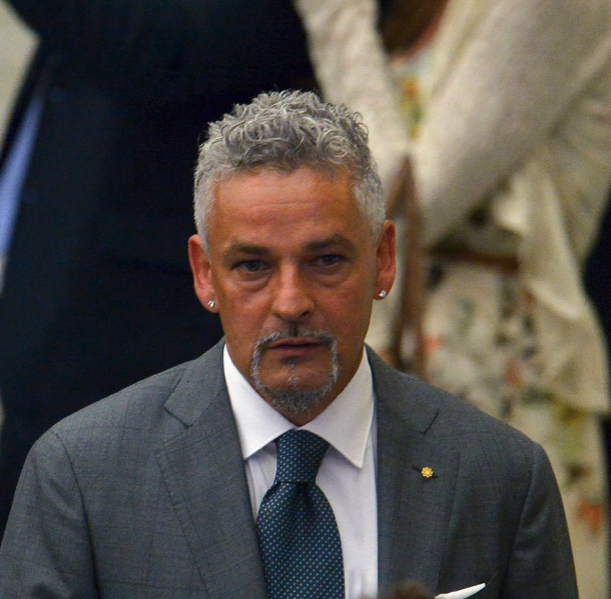
Getty
International Career and the Defining Miss
Baggio made his international debut for the Azzurri in 1988 and starred in three FIFA World Cups. At the 1990 World Cup on home soil, he scored a goal against Czechoslovakia that is still considered one of the tournament's greatest.
His most heroic and heartbreaking chapter came during the 1994 World Cup in the United States. After a slow start to the tournament, Baggio single-handedly carried a struggling Italian side through the knockout stages, scoring five crucial goals: two against Nigeria (including the match-winner in extra time), a late winner against Spain, and two against Bulgaria in the semi-finals. For his phenomenal performance, he was awarded the World Cup Silver Ball.
However, the final against Brazil was a goalless draw decided by a penalty shootout. With Italy needing to score their final kick to stay alive after two previous misses, Baggio stepped up, exhausted and injured, only to send his shot sailing over the crossbar. The image of the "Divine Ponytail" standing head bowed in the California sun became one of football's most iconic moments of agony. True to his character, he later used the pain as motivation, going on to score in the 1998 World Cup, making him the only Italian to score in three different World Cup tournaments.
Contracts, Salaries & Career Earnings
Roberto Baggio played during an era when transfer fees and player salaries were rapidly inflating, securing his financial future as one of the world's elite athletes. His career was defined by massive transfer fees, beginning with his 1990 move from Fiorentina to Juventus, which set a new world record at the time (reported as £8 million or approximately €12.9 million).
His top-tier contracts during the early to mid-1990s at Juventus, AC Milan, and Inter Milan placed him among the highest-paid players in the world, with annual salaries often reaching several million euros. While exact annual salary figures varied greatly and were less publicized than today, his overall career earnings from club wages alone are estimated to have been significantly over €50 million. His later contract with Brescia saw him take a lower, more performance-incentivized salary, demonstrating his commitment to playing rather than maximizing income toward the end of his career.
Legacy and Post-Playing Career
Roberto Baggio's legacy extends beyond his goals and trophies (which include two Serie A titles and a UEFA Cup). He is remembered as much for his perseverance through severe injuries as he is for his artistry. His conversion to Buddhism during a difficult period of injury rehabilitation in the late 1980s provided him with the inner peace and focus needed to navigate the pressures of Italian football. Following his retirement in 2004, Baggio was recognized for his humanitarian efforts, being appointed a Goodwill Ambassador for the Food and Agriculture Organization (FAO) of the United Nations in 2005. He was also the inaugural inductee into the Italian Football Hall of Fame in 2011 and served as the technical director of the Italian Football Federation (FIGC) from 2010 to 2013, continuing to contribute his unique vision to the beautiful game.
/2014/10/Roberto-Baggio.png)
/2013/11/GettyImages-141894778.jpg)
/2010/03/GettyImages-467880924.jpg)
/2019/12/Paulo-Dybala.jpg)
/2010/05/Andrea-Pirlo.jpg)
/2014/09/michel.jpg)
/2014/06/Jay-Jay-Okocha.jpg)
/2010/06/GettyImages-459417904.jpg)
/2020/04/Megan-Fox.jpg)
/2009/11/George-Clooney.jpg)
/2019/04/rr.jpg)