












What Is Alexis Sánchez's Net Worth?
Alexis Sánchez is a Chilean professional soccer player who has a net worth of $50 million.
Widely regarded as one of the greatest players in Chilean history, Sánchez has enjoyed a distinguished career with Udinese, Barcelona, Arsenal, Manchester United, Inter Milan, Marseille, Sevilla, and CF Montréal. Known for his explosive acceleration, dribbling, creativity, and relentless work rate, he became one of Europe's most exciting attacking players during his peak years. Nicknamed "El Niño Maravilla," or "The Wonder Boy," Sánchez emerged from humble beginnings in northern Chile to become one of the highest-paid soccer players in the world.
Sánchez achieved international prominence after joining Barcelona in 2011, where he played alongside Lionel Messi and helped the club win La Liga. His move to Arsenal in 2014 established him as a Premier League superstar. He scored 80 goals in 166 appearances for the London club, won two FA Cups, and was twice named Arsenal's Player of the Season. In January 2018, he joined Manchester United in a blockbuster exchange deal that reportedly paid him as much as £400,000 per week before additional bonuses and commercial payments. Although his Manchester United career was disappointing, he subsequently rebuilt his reputation at Inter Milan, winning two Serie A championships.
Internationally, Sánchez has been even more influential. He helped Chile win consecutive Copa América championships in 2015 and 2016, converting the decisive penalty in the 2015 final against Argentina and earning the tournament's best player award in 2016. He became Chile's all-time leading scorer and most-capped player, recording 51 goals in 168 international appearances. After returning to Udinese in 2024 and spending the following season with Sevilla, Sánchez joined Major League Soccer's CF Montréal as a Designated Player in August 2026.
Early Life
Alexis Alejandro Sánchez Sánchez was born on December 19, 1988, in Tocopilla, a small coastal city in northern Chile near the Atacama Desert. He grew up in a working-class family with limited financial resources. His mother, Martina Sánchez, worked cleaning houses and selling fish to support Alexis and his siblings after his father left the family.
Sánchez developed his love of soccer playing barefoot in the streets and makeshift fields of Tocopilla. He spent much of his childhood practicing with friends, frequently playing against older children. To help his family financially, he washed cars and watched over vehicles parked near a local cemetery.
His mother supported his ambition to become a professional player, while his uncle José Delaigue became an important paternal influence. Despite the family's limited income, Sánchez continued developing his skills, displaying the speed, determination, and close ball control that would eventually make him famous.
As a young teenager, he moved to Calama to join the youth system of Cobreloa, one of the most established professional clubs in northern Chile. The opportunity allowed him to receive more structured training and compete against stronger opposition.
Early Career and South American Success
Sánchez made his professional debut for Cobreloa in 2005 at just 16 years old. His performances quickly attracted attention from scouts, particularly because of his ability to accelerate past defenders and create scoring opportunities.
Italian club Udinese signed him in 2006 but initially decided that he would benefit from additional playing experience in South America.
He was loaned to Colo-Colo, one of Chile's most successful clubs, for the 2006–07 period. Playing alongside established domestic stars, Sánchez helped Colo-Colo win the 2006 Clausura and 2007 Apertura championships.
His performances attracted interest from Argentina, and he subsequently joined River Plate on loan for the 2007–08 season. Under manager Diego Simeone, Sánchez contributed to River Plate's victory in the 2008 Clausura tournament.
Winning league championships in Chile and Argentina before turning 20 established Sánchez as one of South America's most promising young players. By the time he returned to Udinese, he had already experienced considerable success at the professional level.
Udinese and European Breakthrough
Sánchez joined Udinese's first-team squad for the 2008–09 season, beginning the European phase of his career.
The transition to Italian soccer initially required adjustment. Serie A was known for its tactical organization and demanding defensive play, but Sánchez gradually developed into an effective attacking winger.
He formed a productive partnership with veteran striker Antonio Di Natale, combining his speed and creativity with Di Natale's finishing ability. Their performances helped Udinese become one of Italy's more entertaining attacking teams.
Sánchez enjoyed a breakthrough season in 2010–11, scoring 12 Serie A goals and helping Udinese finish fourth, securing qualification for the Champions League playoffs.
His combination of dribbling, acceleration, and versatility attracted interest from major European clubs, including Manchester United, Manchester City, and Barcelona.
By the summer of 2011, Barcelona had emerged as his preferred destination, setting up the biggest transfer of his career to that point.

Getty Images
Barcelona
In July 2011, Barcelona acquired Sánchez from Udinese for an initial transfer fee of €26 million, with an additional €11.5 million in potential performance-related payments. The agreement made him the first Chilean player to represent Barcelona.
He joined a team managed by Pep Guardiola and featuring some of the world's finest players, including Lionel Messi, Xavi Hernández, Andrés Iniesta, and Gerard Piqué.
Although injuries disrupted portions of his first season, Sánchez demonstrated his ability to contribute within Barcelona's demanding possession-oriented system. His movement, pressing, and willingness to attack defenders provided an additional dimension to the team's offense.
During his three seasons in Spain, Sánchez helped Barcelona win the 2012–13 La Liga championship, the 2011–12 Copa del Rey, two Spanish Super Cups, the UEFA Super Cup, and the FIFA Club World Cup.
He enjoyed his most productive Barcelona season in 2013–14, scoring 19 La Liga goals. The campaign included a memorable chipped finish against Real Madrid in a 2–1 victory at Camp Nou.
Sánchez finished his Barcelona career with 47 goals in 141 official appearances across three seasons.
Despite his success, competition for attacking positions remained intense. Barcelona's 2014 acquisition of Luis Suárez contributed to a restructuring of the forward line, which also included Messi and Neymar.
In July 2014, Sánchez transferred to Arsenal for approximately £30 million.
Arsenal
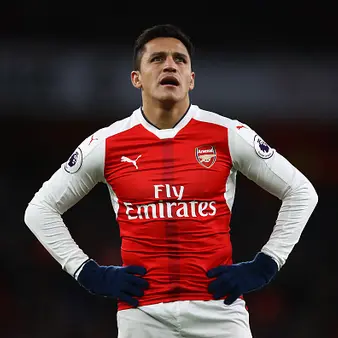
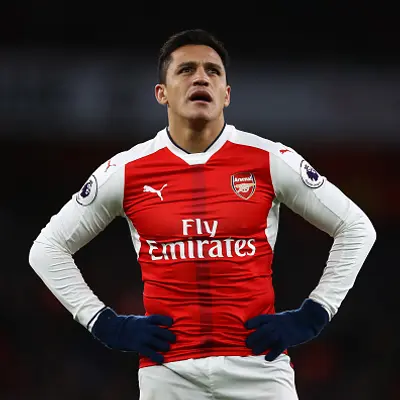
Sánchez reached the peak of his individual club career during his three-and-a-half seasons at Arsenal.
Manager Arsène Wenger identified Sánchez as an ideal addition to Arsenal's attacking system, valuing his versatility, movement, and exceptional work rate.
Wearing the number 17 shirt, Sánchez immediately became one of the team's most important players. He scored 25 goals across all competitions during his debut season in 2014–15, helping Arsenal win the FA Cup.
He scored a spectacular long-range goal in Arsenal's 4–0 victory over Aston Villa in the 2015 FA Cup final. His performances earned him the PFA Fans' Player of the Year award and a place in the Premier League Team of the Year.
During the 2015–16 season, Sánchez continued delivering important goals while developing a productive attacking partnership with midfielder Mesut Özil.
His best individual campaign came in 2016–17, when he scored 30 goals across all competitions, including 24 in the Premier League. He also supplied 10 league assists, establishing himself among the competition's most productive players.
Arsenal won another FA Cup that season, defeating Chelsea 2–1 in the final. Sánchez opened the scoring and was again instrumental in securing the trophy.
He was named Arsenal's Player of the Season in both 2014–15 and 2016–17. His performances made him one of the most recognizable stars in the Premier League and attracted interest from Europe's wealthiest clubs.
Although Arsenal remained competitive in domestic cup competitions, the club struggled to mount consistent Premier League title challenges. As his contract approached its expiration, Sánchez became increasingly linked with a transfer.
He eventually left Arsenal in January 2018, having scored 80 goals in 166 appearances across all competitions, including 60 Premier League goals. His 2014–17 performances remain among the most productive extended stretches by an Arsenal attacker during the Premier League era.
Manchester United and Record-Breaking Contract
In January 2018, Sánchez joined Manchester United in one of the most heavily publicized transfers in Premier League history.
The move was completed through an exchange agreement that sent Armenian midfielder Henrikh Mkhitaryan from Manchester United to Arsenal.
Sánchez signed a four-and-a-half-year contract and was given Manchester United's prestigious number seven shirt, previously worn by club legends including George Best, Eric Cantona, David Beckham, and Cristiano Ronaldo.
The financial terms were extraordinary. Sánchez reportedly received a base salary of approximately £350,000 per week, with image-rights payments increasing the package to roughly £450,000 per week. Additional bonuses and incentives could push his compensation even higher.
Some reports estimated that the overall arrangement, including various performance payments, could reach £500,000 to £600,000 per week. The agreement made Sánchez one of the highest-paid players in English soccer history.
However, the move proved disappointing on the field.
Despite high expectations, Sánchez struggled to reproduce the explosive performances that had made him a superstar at Arsenal. Injuries, inconsistent form, and tactical adjustments limited his effectiveness.
He initially played under manager José Mourinho before Ole Gunnar Solskjær took charge in December 2018.
Sánchez scored just five goals in 45 competitive appearances for Manchester United. His limited production became a frequent subject of criticism, particularly given the enormous salary attached to his contract.
In August 2019, Manchester United sent him on loan to Inter Milan. The English club continued covering a substantial portion of his wages during the arrangement.
His Manchester United contract was eventually terminated by mutual agreement in August 2020, allowing him to join Inter permanently.
Inter Milan and Marseille
Sánchez's move to Inter Milan helped revitalize his career after the difficulties he experienced in Manchester.
He initially joined Inter on loan in 2019, reuniting with former Manchester United teammate Romelu Lukaku.
Under manager Antonio Conte, Sánchez gradually became an important attacking option. Although he did not always start, his creativity, experience, and energy made him a valuable contributor.
Inter reached the UEFA Europa League final in 2020, losing to Sevilla. The following season, the team won the 2020–21 Serie A championship, ending Juventus' nine-year dominance of Italian league soccer.
Sánchez contributed seven league goals during the championship campaign, playing alongside Lukaku and fellow Chilean international Arturo Vidal.
He produced another memorable moment in January 2022, scoring a dramatic goal in the final seconds of extra time against Juventus to secure the Supercoppa Italiana.
After helping Inter win the 2021–22 Coppa Italia, Sánchez left the club and joined Marseille in August 2022.
His single season in France proved successful. Sánchez scored 18 goals in 44 appearances across all competitions, helping Marseille finish third in Ligue 1. He became one of the team's most reliable attacking players and demonstrated that he could remain effective at the highest level despite advancing into his mid-30s.
In August 2023, Sánchez returned to Inter Milan on a one-year contract. He contributed to the club's 2023–24 Serie A championship, his second league title with Inter.
Across his two spells with the Italian club, Sánchez scored 24 goals in 142 appearances and won five trophies.
Return to Udinese, Sevilla, and CF Montréal
After his second departure from Inter Milan in 2024, Sánchez returned to Udinese, the Italian club where he had first established himself as a major European talent.
The homecoming generated enthusiasm among supporters, but injuries limited his availability during the 2024–25 season. He appeared in 13 Serie A matches without scoring, making the campaign one of the least productive of his career.
In September 2025, Sánchez joined Sevilla on a one-year agreement, returning to Spain more than a decade after leaving Barcelona.
The move reunited him with La Liga and provided another opportunity to compete in one of Europe's major leagues. He appeared in 30 matches across all competitions during the 2025–26 season, scoring four goals and recording two assists.
In August 2026, Sánchez signed with CF Montréal of Major League Soccer as a Designated Player. The agreement runs through the conclusion of the league's 2027 sprint season and includes a club option for the 2027–28 campaign.
His move to Montréal marked the first North American chapter of a professional career that had already spanned more than two decades and included league championships in Chile, Argentina, Spain, and Italy.
Chile National Team and Copa América Championships
Sánchez's international career represents one of the most important chapters in Chilean soccer history.
He made his senior national team debut in 2006 at age 17 and gradually developed into one of the country's most influential players. His speed, technical ability, and attacking versatility made him a central figure in the Chilean teams managed by Marcelo Bielsa, Jorge Sampaoli, and Juan Antonio Pizzi.
Sánchez represented Chile at the 2010 FIFA World Cup in South Africa, where the team advanced to the round of 16 before losing to Brazil.
He returned for the 2014 World Cup in Brazil, scoring against Australia during the group stage and against Brazil in the round of 16. Chile's match against the host nation ended in a penalty shootout defeat after a 1–1 draw, with Sánchez among the players whose attempts were saved.
The most important achievements of his international career came in 2015 and 2016, when Chile won consecutive Copa América championships.
In 2015, Chile hosted the tournament and advanced to the final against Argentina. The match finished scoreless after extra time, sending the championship to a penalty shootout.
Sánchez converted the decisive penalty with a delicate Panenka-style chip, securing a 4–1 shootout victory and delivering Chile's first Copa América title.
The triumph became one of the most celebrated moments in the country's sporting history.
One year later, Chile repeated the achievement at the 2016 Copa América Centenario in the United States. The team again faced Argentina in the final, winning another penalty shootout after a scoreless draw.
Sánchez was named the tournament's best player, receiving the Golden Ball award for his performances.
He was part of an outstanding Chilean generation that included Arturo Vidal, Eduardo Vargas, Gary Medel, Charles Aránguiz, and goalkeeper Claudio Bravo. Their success transformed Chile from a competitive South American team into a continental champion.
In 2017, Sánchez helped Chile reach the FIFA Confederations Cup final in Russia, where the team lost 1–0 to Germany.
He also became Chile's all-time leading international goal scorer, surpassing Marcelo Salas' previous record of 37 goals. With 51 goals in 168 appearances, Sánchez is both the country's leading scorer and most-capped international player.
His international achievements, particularly the back-to-back Copa América victories, secured his reputation as one of the greatest athletes in Chilean history.
Salary and Career Earnings
Sánchez has earned enormous salaries throughout his professional career, particularly during his years at Barcelona, Arsenal, Manchester United, and Inter Milan.
His early European contracts were relatively modest compared with the agreements he would eventually receive, but his earnings increased dramatically as he established himself among the most productive attacking players in Europe.
Arsenal awarded him a lucrative contract following his arrival from Barcelona in 2014. His success in the Premier League made him the subject of intense competition among major English clubs, ultimately leading to his extraordinarily profitable Manchester United transfer.
The four-and-a-half-year contract he signed with Manchester United in January 2018 reportedly paid a base salary of approximately £350,000 per week. That represented £18.2 million annually before taxes, even without accounting for image rights, signing incentives, and other bonuses.
When image-rights payments were included, his compensation was widely reported at approximately £450,000 per week, equivalent to £23.4 million annually. Contemporary reporting placed the potential package even higher when performance incentives were factored in.
During the peak of his Manchester United contract, Sánchez ranked among the highest-paid professional athletes in the world.
In 2019, Forbes estimated his annual earnings from salary and endorsements at $30.8 million, placing him sixth among the world's highest-paid soccer players.
After moving to Inter Milan, Sánchez accepted a smaller contract. During the 2021–22 season, his reported salary was approximately €7 million after taxes, or roughly €9.2 million before taxes under the applicable Italian tax rules.
His move to Marseille in 2022 brought another reduction in compensation, with reports estimating his annual earnings at approximately €3 million after taxes.
These enormous contracts, combined with endorsement income from international brands, made Sánchez one of the most financially successful Chilean athletes of his generation.
Endorsements and Commercial Ventures
Sánchez has supplemented his playing income through endorsement agreements with major international companies.
His most important long-term commercial relationship has been with Nike, which has supplied his soccer boots and featured him in advertising campaigns.
He has also participated in promotions for companies including Gatorade, Huawei, Gillette, Movistar, and Master Dog, a Chilean pet food brand.
His commercial appeal increased substantially during his peak years at Arsenal and Manchester United, when he became one of the most recognizable Chilean athletes in the world.
Sánchez's relationship with Master Dog was particularly distinctive because the advertising campaigns featured his beloved golden retrievers, Atom and Humber. The dogs became social media celebrities in their own right and developed a substantial following among soccer fans.
In 2019, Sánchez also appeared as himself in the Chilean film "Mi Amigo Alexis," which follows a young soccer fan who develops an unexpected friendship with his sporting idol. The movie was directed by Alejandro Fernández Almendras and produced through the Chilean production company Fábula.
Philanthropy
Despite his international success, Sánchez has maintained a strong connection to Tocopilla, the city where he grew up.
He has repeatedly returned to the community to support youth sports programs and provide opportunities for children from disadvantaged backgrounds.
One of his most notable charitable projects involved financing the construction and renovation of soccer fields in Tocopilla. The facilities were designed to give young players access to better playing surfaces and equipment than Sánchez had available during his childhood.
He has also organized Christmas gift distributions, supported youth activities, and encouraged local businesses to invest in recreational opportunities for children.
Sánchez has frequently emphasized that his modest upbringing influenced his charitable activities. Having experienced poverty firsthand, he has sought to create opportunities for young people who might otherwise lack access to organized sports.
Personal Life
Sánchez has generally kept his personal relationships private, although his celebrity status has attracted substantial media attention in Chile and Europe.
He previously had a widely publicized relationship with Chilean actress Mayte Rodríguez, which ended in 2018.
Away from professional soccer, Sánchez is an enthusiastic animal lover. His golden retrievers, Atom and Humber, became closely associated with his public image during his Arsenal and Manchester United years.
He named Atom after a robot character in the film "Real Steel," while Humber was named in honor of his brother Humberto.
Sánchez has regularly spoken about the importance of family, loyalty, and remembering his roots. Despite spending much of his adult life living and working in Europe, he has maintained close ties to Chile and the community that helped launch his remarkable career.