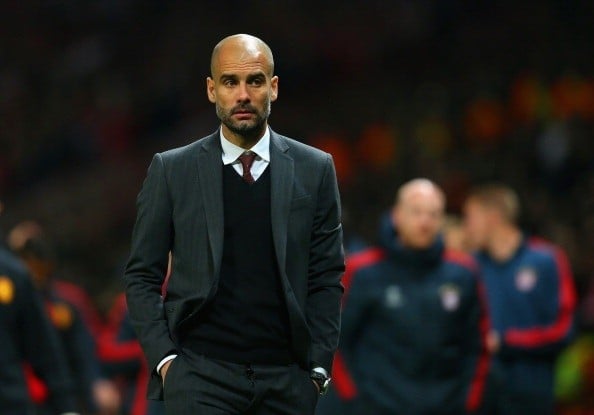
What is Pep Guardiola's net worth and salary?
Pep Guardiola is a Spanish soccer coach and former professional soccer player who has a net worth of $160 million.
Josep "Pep" Guardiola Sala is widely regarded as one of the greatest coaches in the history of the sport. After first making his name as the intelligent midfield conductor of Johan Cruyff's Barcelona "Dream Team," Guardiola became even more influential from the touchline, where he built some of the most dominant and tactically sophisticated teams of the modern era. His managerial career has included trophy-laden spells at Barcelona, Bayern Munich, and Manchester City, with his teams known for positional play, relentless pressing, technical control, and an almost obsessive command of space. At Barcelona, he helped Lionel Messi, Xavi, Andres Iniesta, and Sergio Busquets form the core of one of the most celebrated club teams ever assembled. At Manchester City, he reshaped English football, won a historic treble, and became the first manager to lead a club to four consecutive English top-flight league titles. Across Spain, Germany, and England, Guardiola's career has been defined by extraordinary winning, tactical innovation, and massive earning power.
Contracts, Salaries & Career Earnings
Before becoming one of the highest-paid managers in sports, Pep Guardiola earned a strong living as an elite player. A La Masia graduate, Guardiola spent the bulk of his playing career with Barcelona from 1990 to 2001, where he became the deep-lying midfield brain of Johan Cruyff's legendary "Dream Team." Player salaries in the 1990s were a fraction of today's football wages, but Guardiola was still among the better-paid players in Spain during his prime.
After leaving Barcelona, Guardiola had shorter stints with Brescia and Roma in Italy before signing with Al-Ahli in Qatar from 2003 to 2005. That move likely represented one of the more lucrative contracts of his playing career, as Middle Eastern clubs were already paying premium salaries to established European stars. He finished his playing career with Dorados de Sinaloa in Mexico. In total, Guardiola's gross earnings from his 16-year playing career are estimated to have landed in the $15 million to $25 million range.
His financial trajectory changed dramatically after he moved into management. Guardiola was promoted from Barcelona B to the first team in 2008. His initial salary was relatively modest for a manager of a club that size, but his success was immediate and historic. In his first season, Barcelona won the 2009 sextuple, capturing La Liga, the Copa del Rey, the Champions League, the Spanish Super Cup, the UEFA Super Cup, and the FIFA Club World Cup. That run triggered major bonuses and contract increases. By the time he left Barcelona in 2012, Guardiola was reportedly earning close to €10 million per year. His total gross earnings from his four seasons managing Barcelona are estimated in the €30 million to €40 million range.
After a year-long sabbatical, Guardiola joined Bayern Munich in 2013 on a three-year contract that made him the highest-paid manager in the world. His Bayern salary was widely reported at roughly £15 million to £18 million per year, meaning he earned an estimated £45 million to £54 million during his three seasons in Germany.
Guardiola's biggest payday came at Manchester City. When he arrived in 2016, he reportedly signed an initial contract worth around £15 million per year. Through multiple extensions, his base salary eventually climbed to nearly £26 million annually, or roughly £385,000 per week. Over a decade at City, his base wages alone eclipsed £200 million, before accounting for the substantial bonuses he earned for winning multiple Premier League titles, domestic cups, and the Champions League.
When his managerial salaries from Barcelona, Bayern Munich, and Manchester City are combined, Guardiola's gross coaching earnings likely fall somewhere in the £250 million to £300 million range. That figure dwarfs what he earned as a player and places him among the highest-paid coaches in the history of sports. Including his playing contracts, bonuses, endorsements, and other football-related income, Guardiola's total career earnings likely exceed $350 million before taxes and expenses.
Early Years & Playing Career
Pep Guardiola was born on January 18, 1971, in Santpedor, Spain, a small town in Catalonia. He joined Barcelona's famed La Masia academy as a teenager and developed into a technically gifted midfielder with a rare understanding of tempo, spacing, and passing angles. Though he was never the most physically imposing player, his intelligence and composure made him an ideal fit for Barcelona's possession-based identity.
Playing Career
Guardiola broke into Barcelona's first team in 1990 under Johan Cruyff, whose ideas would profoundly shape his entire football life. As a player, Guardiola operated as a deep-lying midfielder, often dictating the rhythm of games from in front of the defense. He became a central figure in Cruyff's "Dream Team," which won four consecutive La Liga titles from 1991 to 1994 and captured the club's first European Cup in 1992.
Guardiola remained with Barcelona until 2001, serving as both a tactical anchor and, eventually, team captain. His playing career at the club included six La Liga titles, multiple domestic trophies, and major European honors. After leaving Barcelona, he had stints with Brescia and Roma in Italy, then moved to Al-Ahli in Qatar, where he played from 2003 to 2005. He finished his playing career with Dorados de Sinaloa in Mexico before retiring.
Although injuries affected parts of his playing career, Guardiola's influence as a midfielder was enormous. He was not a prolific scorer or a traditional star built around speed and power. Instead, he was a thinker, organizer, and distributor, the type of player who seemed to see the next pass before everyone else. Those qualities became the foundation of his managerial philosophy.
Barcelona Manager
After retiring as a player, Guardiola moved quickly into coaching. He began with Barcelona B, where he impressed club leadership by combining academy development with a clear tactical identity. In 2008, Barcelona made the bold decision to promote him to first-team manager despite his lack of top-level coaching experience.
The move became one of the most successful appointments in football history. In his first season, Guardiola led Barcelona to a treble, winning La Liga, the Copa del Rey, and the UEFA Champions League. Later in 2009, the club added the Spanish Super Cup, UEFA Super Cup, and FIFA Club World Cup, completing an unprecedented sextuple.
Guardiola's Barcelona was built around a breathtaking core of homegrown and world-class talent, including Lionel Messi, Xavi, Andres Iniesta, Sergio Busquets, Carles Puyol, Gerard Pique, and Dani Alves. The team became famous for its intricate passing, high pressing, and suffocating control of possession. Messi, in particular, reached new heights under Guardiola, evolving into a central attacking force and one of the greatest players in the history of the sport.
Between 2008 and 2012, Guardiola won three La Liga titles, two Champions League titles, two Copa del Rey trophies, and several other domestic and international honors. By the time he stepped away from the job in 2012, his Barcelona team was already being discussed as one of the greatest club sides ever.

Alex Livesey/Getty Images
Bayern Munich
After a sabbatical, Guardiola returned to management in 2013 with Bayern Munich. He inherited a team that had just won the treble under Jupp Heynckes, which created enormous expectations from the start. Guardiola did not win the Champions League in Germany, but his Bayern teams dominated domestically and continued to refine his tactical ideas.
During his three seasons in Munich, Guardiola won three consecutive Bundesliga titles, two DFB-Pokal trophies, the UEFA Super Cup, and the FIFA Club World Cup. He also experimented with different formations, inverted fullbacks, and positional rotations that would later become familiar features of his Manchester City teams.
His Bayern tenure was sometimes judged harshly because the club fell short in the Champions League semifinals, but his domestic record was outstanding. More importantly, the experience helped him adapt his ideas outside the Barcelona ecosystem and prepared him for the next challenge in England.
Manchester City
Guardiola joined Manchester City in 2016, bringing his methods to the Premier League. His first season was trophyless, and skeptics questioned whether his possession-heavy style could work in English football. That doubt did not last long.
In 2017-18, City produced one of the greatest seasons in Premier League history, winning the title with a record 100 points. Guardiola's team combined technical control with explosive attacking play, led by stars such as Kevin De Bruyne, David Silva, Sergio Aguero, Raheem Sterling, and Fernandinho. The following season, City won another Premier League title, the FA Cup, and the League Cup, completing a domestic treble.
Guardiola's City continued to evolve through different eras. Players such as Bernardo Silva, Ilkay Gundogan, Phil Foden, Rodri, Ruben Dias, Jack Grealish, and Erling Haaland became central to later versions of the team. In 2022-23, Guardiola finally delivered the club's long-awaited Champions League title, completing a historic treble that also included the Premier League and FA Cup. That achievement made him one of the few managers to win the European treble with two different clubs.
City then won a fourth consecutive Premier League title from 2020-21 through 2023-24, something no club had previously achieved in the history of England's top flight. In May 2026, The Athletic reported that Guardiola was preparing to leave Manchester City at the end of the season after a 10-year spell in which he had won 20 major trophies with the club. The report also stated that Enzo Maresca was expected to succeed him.
/2014/06/GettyImages-855956732.jpg)
/2014/05/GettyImages-180701892.jpg)
/2010/06/GettyImages-459417904.jpg)
/2020/01/Sadio-Mane.jpg)
/2015/09/Jurgen-Klopp.png)
/2019/04/rr.jpg)
/2020/02/Angelina-Jolie.png)
:strip_exif()/2015/09/GettyImages-476575299.jpg)
/2009/09/Brad-Pitt.jpg)
/2020/01/lopez3.jpg)
:strip_exif()/2009/09/P-Diddy.jpg)
/2009/09/Cristiano-Ronaldo.jpg)
/2019/10/denzel-washington-1.jpg)
/2017/02/GettyImages-528215436.jpg)
/2020/06/taylor.png)
/2019/11/GettyImages-1094653148.jpg)
/2015/08/Pep-Guardiola.jpg)
/2015/09/Jurgen-Klopp.png)
/2014/05/GettyImages-180701892.jpg)
/2010/06/GettyImages-459417904.jpg)
/2025/02/missing_profile.jpg)
/2015/10/Diego-Simeone.jpg)
/2014/06/GettyImages-101985404.jpg)
/2018/03/GettyImages-821622848.jpg)
/2020/04/Megan-Fox.jpg)
/2009/09/Jennifer-Aniston.jpg)