
/2016/12/Don-Nelson.jpg)
/2011/02/Chris-Mullin1.jpg)
/2021/07/jerry-west.jpg)
/2014/06/GettyImages-474901506.jpg)
/2014/06/GettyImages-98338043.jpg)
/2009/11/Jason-Kidd.jpg)
/2009/09/Cristiano-Ronaldo.jpg)
/2020/04/Megan-Fox.jpg)
/2009/09/Jennifer-Aniston.jpg)
/2020/01/lopez3.jpg)
/2017/02/GettyImages-528215436.jpg)
/2019/11/GettyImages-1094653148.jpg)
/2018/03/GettyImages-821622848.jpg)
/2020/06/taylor.png)
/2009/11/George-Clooney.jpg)
/2019/04/rr.jpg)
:strip_exif()/2015/09/GettyImages-476575299.jpg)
What is Don Nelson's Net Worth?
Don Nelson is an American former professional basketball player, coach, and manager who has a net worth of $40 million. As a player, Don Nelson won five NBA championships with the Boston Celtics between 1966 and 1976, and as a coach for various teams from 1976 to 2010, he set a record for all-time regular-season NBA wins, with 1,335. Renowned as an innovator in coaching, Nelson created the offensive strategy known as Nellie Ball and pioneered the concept of the point forward.
As we detail at the end of this article, Don is somewhat of a real estate mogul in Hawaii. In mid-2023, he sold a 5-acre property on the island of Kauai for $18 million. In Maui, he owns a multi-structure oceanfront compound, several commercial properties, and more than 20 acres of farmland.
Early Life and High School
Don Nelson was born on May 15, 1940, in Muskegon, Michigan, to Agnes and Arvid. He was raised with his two sisters on his grandfather's farm near the small rural town of Sherrard, Illinois. The family eventually lost the farm and moved to nearby Rock Island. There, Nelson attended Rock Island High School, where he was a star basketball player. In his last two years of high school, he led the Rocks to a combined 47-7 record. Nelson graduated in 1958.
Collegiate Career
Following his graduation from high school, Nelson was recruited by University of Iowa basketball coach Sharm Scheuerman, a fellow Rock Island alum. Nelson had his best season with the Iowa Hawkeyes as a junior in 1960-61, when he led the team to an 18-6 record and a second-place finish in the Big Ten Conference. He left Iowa in 1962 as the all-time leading scorer in its basketball program, with 1,522 points across 72 games. However, he didn't initially graduate, as he instead joined the NBA. Nelson would later return to Iowa to receive his degree in physical education in 2012.
Professional Playing Career
In the 1962 NBA draft, Nelson was chosen by the Chicago Zephyrs. He played one season with the team, averaging 6.8 points and 4.5 rebounds. Nelson was subsequently acquired by the Los Angeles Lakers in 1963. In his first season with the team, he averaged 5.2 points and 4 rebounds in 80 games, and made his debut in the playoffs. Nelson saw much less playing time in his second season with the Lakers, appearing in just 39 games and averaging 2.4 points and 1.9 rebounds. However, he had more of a presence in the 1965 playoffs, where the Lakers made it to the NBA Finals. Ultimately, they lost to the Boston Celtics.
Nelson left the Lakers after two seasons and signed as a free agent with the Boston Celtics in late 1965. He had success with the team right off the bat, averaging 10.2 points and 5.4 rebounds per game en route to the 1966 NBA championship title. Nelson would go on to win four more NBA championships with the Celtics in 1968, 1969, 1974, and 1976. He had his best statistical season, however, in 1969-70, when he averaged 15.4 points and 7.3 rebounds per game. After winning his fifth NBA championship in 1976, Nelson retired as a player. He finished his 15-year professional playing career with 10,898 points.
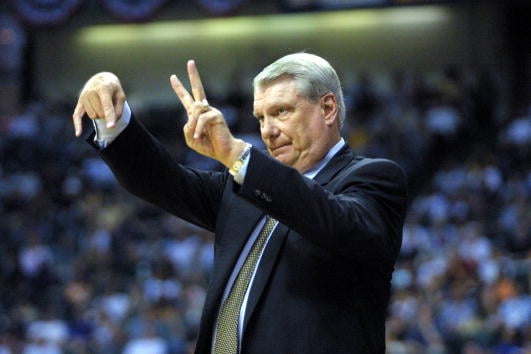
Ronald Martinez/Allsport
Coaching and Executive Career
Nelson began his coaching career as an assistant coach for the Milwaukee Bucks in 1976. He was soon named the new head coach and a year later was made the team's general manager. In late 1977, Nelson managed the greatest fourth-quarter comeback in NBA history when the Bucks went on a 35-4 run with under nine minutes remaining in a game against Atlanta, winning 117-115 in regulation. He continued to see strong results in Milwaukee over the subsequent years, in part due to a fast-paced offensive strategy he created known as Nellie Ball. Nelson also pioneered the concept of the point forward, particularly by using small forward Paul Pressey to direct the offense. With his system, he led the Bucks to seven consecutive division titles from 1980 to 1986. During that period, in both 1983 and 1985, Nelson was named NBA Coach of the Year. He stepped down as head coach of the Bucks in 1987, having recorded a 540-344 record across 11 seasons.
In 1987, Nelson became vice president of the Golden State Warriors, and in 1988, he was named the team's head coach and general manager. Again employing his Nellie Ball offensive strategy, he oversaw a successful Warriors team that included the high-scoring trio known as Run TMC: Tim Hardaway, Mitch Richmond, and Chris Mullin. In 1992, Nelson received his third career NBA Coach of the Year award. He remained with the Warriors until his resignation in early 1995. Meanwhile, in 1994, Nelson coached the United States men's national basketball team at the FIBA World Championship in Toronto. Dubbed "Dream Team II," the team won the gold medal. Nelson went on to coach the New York Knicks from July 1995 until he was fired in March 1996. During that time, his fast-paced offensive style clashed with the Knicks' predominantly defensive style.
Nelson moved to the Dallas Mavericks in 1997, becoming the team's head coach and general manager. He quickly turned around the sagging fortunes of the Mavericks, using the trio of Steve Nash, Michael Finley, and Dirk Nowitzki to steer the team to four consecutive 50-win seasons. The Mavericks had their best season under Nelson in 2002-03, when they tied with the San Antonio Spurs for first place in the Western Conference, with 60 wins. Ultimately, they lost to the Spurs in the conference finals. Nelson resigned as head coach of the Mavericks in March 2005. He would go on to return to the Warriors in 2006, serving a second stint as the team's head coach through 2010. Toward the end of his tenure, Nelson recorded his 1,333rd career win as coach, which was a new NBA record. He finished his career with a total of 1,335 regular-season wins.
Personal Life
In 1991, Nelson married Joy Wolfgram at the Oakland Coliseum. Combined with offspring from their previous marriages, they have a total of six children and over 15 grandchildren. Nelson resides in Maui, Hawaii, where he grows flowers, coffee, and cannabis and hosts poker games with other pot-loving celebrities.
In 2012, Nelson was inducted into the Naismith Memorial Basketball Hall of Fame, and in 2025, he received the NBCA's Chuck Daly Lifetime Achievement Award in honor of his coaching career.
Real Estate
In 1998, Don bought a 5-acre property on the Hawaiian island of Kauai for an undisclosed price. He proceeded to build a 2,800-square-foot home on the property. He listed this estate for sale in November 2017 for $15 million. He appears to have sold the property in 2023 for $18 million. His primary home is an oceanfront property in the town of Paia on Maui, where in 2012, he constructed a multi-structure compound. In the town of Paia, he owns several rental properties and a commercial building that houses an art gallery, several shops, and a yoga studio. He also owns 22 acres of farmland in the hillside area of Haleakala.
/2016/12/Don-Nelson.jpg)
/2009/11/Jason-Kidd.jpg)
/2011/02/Chris-Mullin1.jpg)
/2017/02/GettyImages-503527844.jpg)
/2009/11/Chauncey-Billups-2.jpg)
/2023/09/david-lee.jpg)
/2014/06/GettyImages-98338043.jpg)
/2015/01/bs.jpg)
/2019/10/denzel-washington-1.jpg)
/2009/09/Brad-Pitt.jpg)
/2020/02/Angelina-Jolie.png)
:strip_exif()/2009/09/P-Diddy.jpg)