
/2026/01/Curt-Cignetti.jpg)
/2026/01/Mario-Cristobal.jpg)
/2013/12/GettyImages-878587402.jpg)
/2014/12/GettyImages-499075172.jpg)
/2014/12/Charlie-Strong.jpg)
/2020/06/taylor.png)
/2019/10/denzel-washington-1.jpg)
/2009/09/Brad-Pitt.jpg)
:strip_exif()/2009/09/P-Diddy.jpg)
/2020/02/Angelina-Jolie.png)
/2009/11/George-Clooney.jpg)
/2020/01/lopez3.jpg)
/2009/09/Jennifer-Aniston.jpg)
/2019/04/rr.jpg)
/2017/02/GettyImages-528215436.jpg)
:strip_exif()/2015/09/GettyImages-476575299.jpg)
/2019/11/GettyImages-1094653148.jpg)
What is Curt Cignetti's net worth and salary?
Curt Cignetti is an American college football coach who has a net worth of $10 million.
Curt Cignetti has pulled off one of the most dramatic and improbable transformations in the history of college football. After decades spent in relative anonymity as an assistant and small-school head coach, Cignetti emerged in his 60s as the architect of a modern powerhouse. His ascent was not fueled by hype, gimmicks, or splashy recruiting rankings. It was built on discipline, precision, and a ruthless emphasis on execution. At Indiana, a program that had existed since 1887 without ever winning 10 games in a season, Cignetti delivered an undefeated 15-0 campaign, a Big Ten championship, and a berth in the national title game within two years of his arrival. The Hoosiers did not stumble into relevance. They imposed themselves, steamrolling traditional powers and producing one of the most dominant postseason runs the sport has seen. Indiana's rise reshaped the national landscape and elevated Cignetti from late-career curiosity to one of the most powerful figures in the sport, both competitively and financially.
Early Life and Coaching Foundation
Curt Cignetti was born on June 19, 1961, into a football household. His father, Frank Cignetti Sr., was a longtime college coach, and Curt grew up immersed in film rooms, practice fields, and game-planning sessions. He played quarterback at West Virginia, where he developed a deep understanding of offensive structure and game management.
Rather than chasing a professional playing career, Cignetti moved directly into coaching. His early years were spent grinding through assistant roles, learning the profession from the bottom up. Those experiences shaped a coach who valued preparation, accountability, and clarity over personality-driven leadership.
Assistant Coaching Years and Alabama Influence
Cignetti's assistant coaching career included several stops, but his most formative experience came at Alabama, where he served as wide receivers coach during the early phase of Nick Saban's dynasty. Inside that environment, Cignetti absorbed the importance of structure, repetition, and demanding standards. The emphasis on every detail, from practice tempo to role definition, left a lasting impression.
While he was never marketed as a future Power Five head coach during those years, his reputation inside coaching circles steadily grew. He was viewed as demanding, dependable, and intensely prepared, traits that would later define his programs.
Head Coaching Breakthrough at IUP and James Madison
Cignetti's first head coaching opportunity came at Indiana University of Pennsylvania. Though the job came with limited resources and modest pay, it provided a proving ground. He learned how to manage an entire program, set culture, and enforce standards without shortcuts.
His national breakthrough arrived at James Madison. There, Cignetti built a disciplined, physical team that won immediately and consistently. He successfully guided the program through its transition to the FBS level, defeating established opponents and proving his methods scaled upward. By the time he left, James Madison was not just competitive. It was dominant.
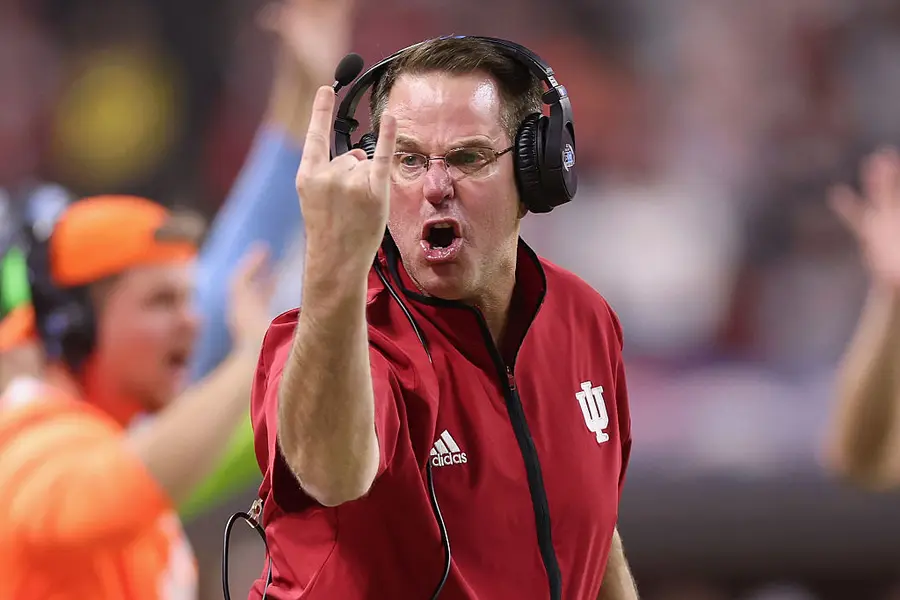
(Photo by Michael Reaves/Getty Images)
The Indiana Transformation
Indiana hired Cignetti with cautious optimism. The program had long been defined by losing seasons and low expectations. Before his arrival, Indiana needed four full seasons to accumulate 15 wins. Under Cignetti, they went 15-0 in a single year.
In his first season, Indiana went 11-2 and reached the College Football Playoff for the first time in school history. The follow-up was even more staggering. Indiana completed an undefeated regular season, defeated Ohio State to win the Big Ten championship, and stormed through the playoff. The Hoosiers crushed Alabama 38-3 in the Rose Bowl quarterfinal, then obliterated Oregon 56-22 in the Peach Bowl semifinal to reach the national championship game.
The Oregon win epitomized Cignetti's Indiana teams. Indiana scored eight touchdowns, forced turnovers, committed few penalties, dominated the line of scrimmage, and never let up. After the game, Cignetti briefly cracked a smile, a rare sight for a coach known for his stoic sideline demeanor. Asked when he would stop to appreciate the moment, he deflected, joking that he was more interested in cracking open a beer than reflecting. The comment underscored his mentality. Celebrate briefly, then move on.
"DYJ": The Program Identity
The defining philosophy of Cignetti's Indiana teams can be summed up in three letters posted throughout the facility and repeated constantly by players: DYJ. Do your job.
Indiana's rise was not built on miracle plays or reckless aggression. It was built on consistency. Quarterbacks protected the ball. Linemen won their assignments. Defensive backs trusted technique. The Hoosiers became one of the least-penalized teams in the nation and led the country in turnover margin. They did not beat themselves, while relentlessly beating opponents.
Cignetti distilled football to its fundamentals. Win the line of scrimmage. Run the ball. Stop the run. Protect the quarterback. Affect the quarterback. Win the turnover battle. Indiana did all of it, week after week, with mechanical efficiency.
Contracts, Salaries & Career Earnings
Cignetti's financial rise mirrors his professional journey. For much of his career, he earned modest coaching salaries. In 2007, he made $170,000 as Alabama's wide receivers coach. That figure rose to $200,000 in 2009 and $250,000 in 2010. In 2011, he took a significant pay cut to become head coach at IUP, earning roughly $125,000 in exchange for leadership opportunity.
His earnings climbed at James Madison, where he earned $425,000 in 2022 and $677,000 in 2023. The leap at Indiana was seismic. In 2024, his first season as head coach, Cignetti earned approximately $4.5 million. In October 2025, Indiana rewarded his historic turnaround with an eight-year, $93 million contract extension through the 2033 season, averaging $11.6 million per year. The deal places him among the highest-paid coaches in college football.
/2026/01/Curt-Cignetti.jpg)
/2026/01/Mario-Cristobal.jpg)
/2025/10/GettyImages-2211297293.jpg)
/2026/01/college-salaries.png)
/2013/01/John-Harbaugh.jpg)
/2015/07/Lane-Kiffin.jpg)
/2023/10/GettyImages-902208650.jpg)
/2009/09/Cristiano-Ronaldo.jpg)
/2020/04/Megan-Fox.jpg)
/2018/03/GettyImages-821622848.jpg)