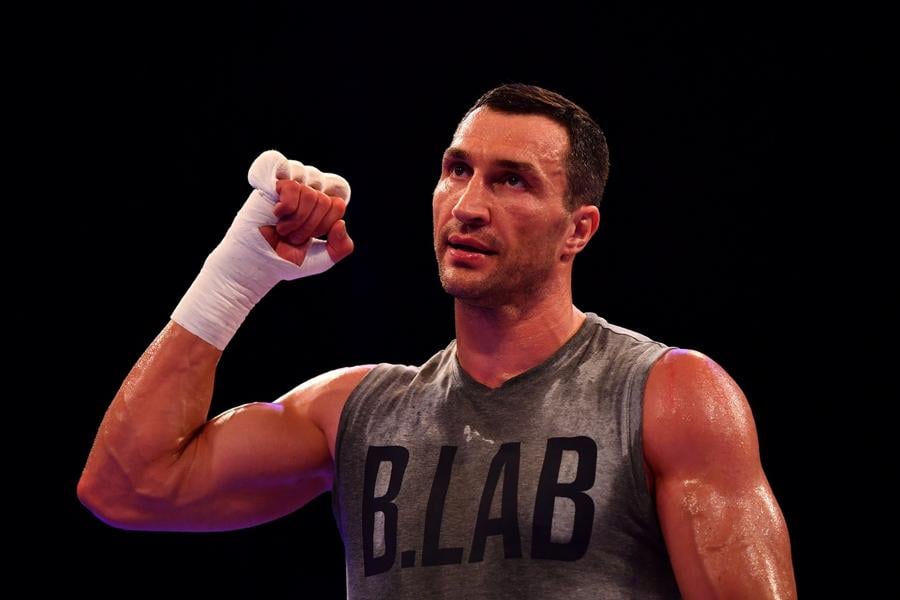
What Is Wladimir Klitschko's Net Worth?
Wladimir Klitschko is a Ukrainian former professional boxer who has a net worth of $90 million. One of the most dominant heavyweight champions of his generation, Klitschko held multiple versions of the world heavyweight championship and spent nearly a decade atop the division during his second title reign. He finished his professional career with a record of 64 wins and five losses, including 53 victories by knockout.
Before turning professional, Klitschko won the super-heavyweight gold medal for Ukraine at the 1996 Summer Olympics. As a professional, he became a two-time heavyweight world champion and ultimately unified the WBA, IBF, WBO, IBO, and Ring heavyweight championships. Along with his older brother, Vitali Klitschko, he helped define an extended period of heavyweight boxing that became known as the "Klitschko Era."
Wladimir's combination of size, athleticism, knockout power, a powerful jab, and an increasingly disciplined defensive style made him extraordinarily difficult to beat. His second championship reign lasted more than nine years, during which he made 18 consecutive title defenses. Klitschko fought in 29 heavyweight world title fights during his career.
His success also made him one of boxing's highest-paid athletes. Klitschko earned hundreds of millions of dollars from fight purses, television rights, sponsorships, and other income over his 21-year professional career. His biggest paydays included roughly $17.5 million against Alexander Povetkin, around $23 million from his fight with Tyson Fury, and potentially close to $20 million for his final fight against Anthony Joshua.
Early Life
Wladimir Wladimirovich Klitschko was born on March 25, 1976, in Semipalatinsk, Kazakh SSR, Soviet Union, now known as Semey, Kazakhstan. He grew up in a military family with his older brother, Vitali.
Their father, Volodymyr Rodionovych Klitschko, was a Soviet Air Force officer who eventually reached the rank of major general. His military assignments caused the family to move frequently during Wladimir's childhood. Their father was also involved in the cleanup following the 1986 Chernobyl nuclear disaster.
Both Klitschko brothers gravitated toward combat sports. Wladimir eventually earned a doctorate in sports science, contributing to the nickname he used throughout his professional career: "Dr. Steelhammer."
Vitali also became a heavyweight boxing champion before moving into Ukrainian politics and eventually becoming mayor of Kyiv. Despite both brothers spending years near the top of the heavyweight division, they never fought one another. They said they had promised their mother that they would never meet in a professional boxing match.

Epsilon/Getty Images
Amateur Career and Olympic Gold Medal
Klitschko began serious boxing training at the Brovary Olympic Reserve School and developed into one of Europe's leading amateur heavyweights. He won the Junior European Championships in 1993, finished second at the Junior World Championships in 1994, and continued collecting international experience over the following years.
His amateur career culminated at the 1996 Summer Olympics in Atlanta, where he represented Ukraine in the super-heavyweight division. Klitschko defeated Paea Wolfgramm of Tonga in the final to win the gold medal.
He finished his amateur career with a reported record of 134 wins and six losses and turned professional later in 1996.
Early Professional Career and First World Championship
Klitschko began his professional career fighting primarily in Germany and quickly established himself as a major heavyweight prospect. He won his first 24 professional fights, 21 of them by knockout, before suffering an upset loss to veteran Ross Puritty in 1998.
Rather than derail his career, the defeat became one of several early lessons that shaped Klitschko's development. He rebuilt quickly and earned his first opportunity at a major world championship in October 2000.
Facing Chris Byrd for the WBO heavyweight title, Klitschko dominated the fight and won a wide unanimous decision. He successfully defended the championship five times, including victories over Derrick Jefferson, Charles Shufford, Francois Botha, Ray Mercer, and Jameel McCline.
At this stage of his career, Klitschko was viewed as an exceptionally talented heavyweight with tremendous physical gifts and punching power. However, questions remained about his stamina, defense, and ability to respond when placed under heavy pressure.
Setbacks and Emanuel Steward
Those weaknesses became painfully apparent in 2003, when heavy underdog Corrie Sanders stopped Klitschko in the second round and took his WBO championship.
Klitschko suffered another devastating setback the following year against Lamon Brewster. Wladimir appeared to be in control early but faded badly and was stopped after the fifth round. Having now suffered three knockout defeats, he was written off by many boxing observers as a talented fighter who lacked the durability to dominate the heavyweight division.
The Brewster fight also marked the beginning of one of the most important relationships of Klitschko's career. He began working with legendary trainer Emanuel Steward, who had previously trained heavyweight champion Lennox Lewis.
Steward helped transform Klitschko's style. Instead of relying heavily on raw athleticism and knockout power, Klitschko became much more disciplined. He built his offense around one of boxing's most effective jabs, controlled distance with his size and footwork, tied opponents up when they got inside, and became far more selective with his powerful right hand and left hook.
The approach was sometimes criticized as overly cautious, but it proved extraordinarily effective.
Heavyweight Championship Dominance
After rebuilding his career with victories over fighters including DaVarryl Williamson and Samuel Peter, Klitschko received another title opportunity against Chris Byrd in 2006.
Klitschko dominated their rematch and stopped Byrd in the seventh round to win the IBF and IBO heavyweight championships. The victory began one of the longest stretches of heavyweight dominance in boxing history.
He successfully defended against Calvin Brock and Ray Austin before avenging his loss to Lamon Brewster in 2007. In 2008, Klitschko defeated previously unbeaten Sultan Ibragimov to add the WBO championship, further consolidating control of the heavyweight division.
Victories over Tony Thompson, Hasim Rahman, Ruslan Chagaev, Eddie Chambers, and Samuel Peter followed. By this point, Klitschko's size, conditioning, jab, defense, and right hand had turned him into an extraordinarily difficult stylistic puzzle.
His most commercially important unification fight came against British star David Haye in July 2011. Haye held the WBA heavyweight championship and had spent years publicly calling out the Klitschko brothers. Wladimir controlled the highly anticipated fight behind his jab and won a unanimous decision, adding the WBA title to his collection.
The Klitschko Era
Wladimir's dominance overlapped with the championship career of his brother Vitali, creating what boxing fans and writers dubbed the "Klitschko Era."
For several years, the brothers controlled nearly every meaningful heavyweight championship. Wladimir held the WBA, IBF, WBO, IBO, and Ring championships, while Vitali held the WBC belt. Because they refused to fight each other, complete unification of the four major sanctioning-body titles was effectively impossible.
Wladimir continued defeating leading contenders, including Mariusz Wach, Francesco Pianeta, Alexander Povetkin, Kubrat Pulev, and Bryant Jennings.
The 2013 fight against unbeaten Povetkin in Moscow was particularly lucrative. A Russian promoter won the purse bid with an enormous $23.3 million offer. As champion, Klitschko was entitled to 75% of the purse, giving him a guaranteed payday of just under $17.5 million.
By the end of his championship run, Klitschko had become a major television attraction throughout Europe and regularly filled large arenas and soccer stadiums, particularly in Germany. His second world-title reign lasted nine years, seven months, and seven days, during which he made 18 consecutive successful defenses.
Tyson Fury Loss
Klitschko's remarkable reign finally ended in November 2015 when he faced undefeated British heavyweight Tyson Fury in Düsseldorf, Germany.
Fury's unusual combination of size, movement, reach, and awkwardness prevented Klitschko from establishing his normal rhythm. Wladimir struggled to land consistently and lost by unanimous decision, suffering his first defeat in more than 11 years.
The loss ended Klitschko's long run as unified heavyweight champion.
A contractual rematch was planned, but the fight was repeatedly postponed and ultimately never occurred. The delays kept Klitschko out of the ring for more than a year and left him searching for another route back to the heavyweight championship.
Anthony Joshua Fight and Retirement
Klitschko returned in April 2017 to face undefeated Olympic gold medalist Anthony Joshua at Wembley Stadium in London.
The fight became one of the most memorable heavyweight bouts of the modern era. In front of 90,000 spectators, Joshua knocked Klitschko down in the fifth round before Klitschko recovered and dropped Joshua with a right hand in the sixth.
The fight remained competitive until the 11th round, when Joshua badly hurt Klitschko, scored two more knockdowns, and forced the referee to stop the bout.
Although Klitschko lost, his performance at age 41 earned widespread praise and gave him one of the most exciting fights of his career. A lucrative rematch was available, but Wladimir instead announced his retirement in August 2017.
He ended his professional career with 64 victories and five defeats, including 53 knockout wins. He had competed in 29 heavyweight world championship fights during a professional career that lasted more than two decades.
Klitschko was elected to the International Boxing Hall of Fame's Class of 2021 in his first year of eligibility.
(Photo by Dan Mullan/Getty Images)
Career Earnings
Wladimir Klitschko earned hundreds of millions of dollars during his professional boxing career. His enormous popularity in Germany and other European markets was especially important financially because his compensation extended beyond traditional fight purses to television rights, sponsorships, and promotional revenue.
Forbes regularly ranked Klitschko among the world's highest-paid athletes. The publication estimated that he earned $28 million in its 2012 reporting period, including $24 million from boxing and $4 million from endorsements. Forbes estimated another $24 million in 2013, $28 million in 2014, $22.5 million in 2015, and $21.5 million in 2017.
Those five Forbes estimates alone total approximately $124 million, despite excluding most of Klitschko's lucrative championship career before 2012.
Several individual paydays illustrate the scale of his earnings. Klitschko's purse for his 2013 fight with Alexander Povetkin was $17,499,997. His 2015 fight against Tyson Fury reportedly generated around £15 million for Klitschko from his purse, sponsorships, and pay-per-view participation, which was roughly $23 million at the exchange rate at the time.
For his final fight against Anthony Joshua in 2017, estimates placed each fighter's payday in the range of £10-15 million, or roughly $13-19 million.
Klitschko also benefited from an unusually lucrative television arrangement in Germany. Forbes reported that broadcaster RTL paid him more than $3 million to televise each of his fights. His endorsement portfolio included major European brands and companies such as SAP, Porsche, Deutsche Telekom, and McFit.
Taking his purses, broadcast revenue, endorsements, and other boxing income together, Wladimir earned well over $200 million before taxes and expenses during his professional career.
Business Ventures
Klitschko was unusually involved in the business side of his career. In 2003, Wladimir and Vitali founded K2 Promotions, allowing the brothers to participate in the promotional economics surrounding their fights rather than functioning solely as athletes collecting purses.
Wladimir also became involved in sports marketing, investing, education, and entrepreneurship. Following retirement, he increasingly focused on business and leadership projects, drawing on lessons from his boxing career to teach management, resilience, and personal development.
Ukraine and Military Service
Wladimir and Vitali Klitschko have long been prominent public figures in Ukraine. Wladimir appeared with Vitali during the Euromaidan demonstrations in Kyiv in 2013, while Vitali subsequently pursued a political career and became mayor of Kyiv.
In February 2022, shortly before Russia launched its full-scale invasion of Ukraine, Wladimir enlisted in Ukraine's reserve army. Following the invasion, both brothers became highly visible advocates for Ukraine, with Wladimir participating in the country's defense efforts while also using his international profile to seek humanitarian, financial, and political support abroad.
Relationship With Hayden Panettiere
Klitschko began dating American actress Hayden Panettiere in 2009. The couple separated in 2011 before reconciling in 2013. Later that year, they announced their engagement.
In December 2014, Wladimir and Hayden welcomed a daughter, Kaya. Klitschko and Panettiere ultimately ended their relationship in 2018. Following their separation, Kaya came to live primarily with Klitschko in Europe, while Panettiere remained involved in her daughter's life.
Panettiere died in August 2026 at the age of 36. She and Klitschko had remained connected through their daughter following the end of their romantic relationship.
$1 Million Olympic Gold Medal Auction
In 2012, Klitschko put his 1996 Olympic gold medal up for auction at a charity event in Kyiv.
An anonymous bidder agreed to pay $1 million for the medal, with Klitschko announcing that the proceeds would benefit children's charitable programs.
The winning bidder then surprised Klitschko by returning the medal to him, explaining that the Olympic gold belonged with Wladimir and his family. As a result, Klitschko was able to raise $1 million for charity while retaining one of the most important trophies of his athletic career.
/2011/07/Vitali-Klitschko.jpg)
/2024/02/Oleksandr-Usyk.jpg)
/2014/08/sn.jpg)
/2017/05/Anthony-Joshua.jpg)
/2009/09/Hayden-Panettiere.jpg)
/2018/03/GettyImages-821622848.jpg)
/2009/09/Jennifer-Aniston.jpg)
/2009/11/George-Clooney.jpg)
/2009/09/Cristiano-Ronaldo.jpg)
:strip_exif()/2009/09/P-Diddy.jpg)
/2020/04/Megan-Fox.jpg)
/2020/02/Angelina-Jolie.png)
/2019/10/denzel-washington-1.jpg)
/2009/09/Brad-Pitt.jpg)
/2020/01/lopez3.jpg)
:strip_exif()/2015/09/GettyImages-476575299.jpg)
/2010/03/Wladimir-Klitschko.jpg)
/2011/07/Vitali-Klitschko.jpg)
/2024/02/Oleksandr-Usyk.jpg)
/2025/07/Daniel-Dubois.jpg)
/2017/05/Anthony-Joshua.jpg)
/2019/12/GettyImages-1172727337.jpg)
/2014/09/GettyImages-2659801.jpg)
/2017/02/GettyImages-528215436.jpg)
/2019/11/GettyImages-1094653148.jpg)
/2019/04/rr.jpg)