
/2020/01/oscar2.jpg)
/2011/10/sa.jpg)
/2014/06/Richard-Schaefer.jpg)
:strip_exif()/2009/11/Manny-Pacquiao.jpg)
/2021/10/shane.png)
/2023/10/Shanna-Moakler.jpg)
:strip_exif()/2015/09/GettyImages-476575299.jpg)
/2020/04/Megan-Fox.jpg)
/2018/03/GettyImages-821622848.jpg)
/2009/09/Brad-Pitt.jpg)
/2019/10/denzel-washington-1.jpg)
/2020/02/Angelina-Jolie.png)
/2020/01/lopez3.jpg)
/2019/11/GettyImages-1094653148.jpg)
/2020/06/taylor.png)
:strip_exif()/2009/09/P-Diddy.jpg)
/2009/09/Jennifer-Aniston.jpg)
What Is Oscar De La Hoya's Net Worth?
Oscar De La Hoya is a retired American professional boxer, Olympic gold medalist, and influential boxing promoter who has a net worth of $100 million. Nicknamed "The Golden Boy," Oscar De La Hoya rose to fame in the early 1990s and became one of the most popular and successful fighters of his era, both inside and outside the ring.
De La Hoya first gained national attention when he won the gold medal in the lightweight division at the 1992 Barcelona Olympics. He turned professional later that year and quickly became a pay-per-view sensation thanks to his clean-cut image, Mexican-American heritage, and aggressive but technical fighting style. Over the course of his 16-year career, De La Hoya won 10 world titles across six different weight classes, from super featherweight to middleweight—an achievement matched by very few in the sport's history.
He fought many of the best boxers of his generation, including Julio César Chávez, Félix Trinidad, Shane Mosley, Bernard Hopkins, and Floyd Mayweather Jr. De La Hoya's bouts consistently drew massive audiences, making him one of boxing's top draws. He retired in 2009 with a professional record of 39 wins (30 by knockout) and six losses.
Following his retirement, De La Hoya found continued success as the founder of Golden Boy Promotions, one of boxing's most prominent promotional companies. His influence helped shape the careers of many major fighters, and he played a key role in modernizing the business side of boxing.
The Golden Boy's Financial Legacy
Career Earnings & Business Impact | Updated Feb 2026
| Key Milestone / Opponent | Value |
|---|---|
| Total Career Cash Ring purses & promoter dividends | $510 Million+ |
| PPV Revenue Generated Across 14M+ career buys | $700 Million |
| Floyd Mayweather Jr. Record Purse (2007) | $52.0 Million |
| Bernard Hopkins Middleweight Unification (2004) | $30.0 Million |
| Félix Trinidad "Fight of the Millennium" (1999) | $21.0 Million |
| Manny Pacquiao Final Professional Bout (2008) | $20.0 Million |
| Shane Mosley I Welterweight Title (2000) | $15.0 Million |
Early Life
Oscar De La Hoya was born on February 4, 1973, in East Los Angeles, California, into a family deeply rooted in boxing. His grandfather was an amateur fighter in Mexico, his father boxed professionally, and from an early age Oscar was groomed for the sport. He quickly distinguished himself as a prodigy, winning the national Junior Olympics at just 15 years old and compiling a dominant amateur record that made him one of the most promising young boxers in the country.
De La Hoya's rise was shaped by personal tragedy. His mother, Cecilia González De La Hoya, was battling terminal breast cancer during his teenage years and died before she could see him achieve international success. Motivated by a promise he made to her, Oscar qualified for the 1992 Summer Olympic Games shortly after graduating from James A. Garfield High School. At the Barcelona Olympics, he won the gold medal in the lightweight division, becoming a national hero and earning the nickname "The Golden Boy," a moniker that would follow him throughout his career.
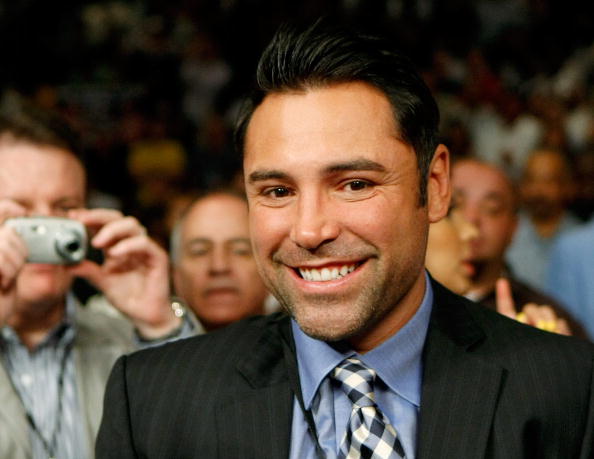
Ethan Miller/Getty Images
Professional Debut and Rapid Rise
De La Hoya turned professional in December 1992 and made an immediate impact, scoring a first-round knockout in his debut. Over the next year, he built an impressive undefeated record while drawing strong television ratings and fan interest, a rare combination for a young non-heavyweight fighter.
On March 5, 1994, he won his first world title by defeating Jimmi Bredahl to capture the WBO junior lightweight championship. Just four months later, he moved up in weight and knocked out Jorge Páez to win the WBO lightweight title. In February 1995, De La Hoya added the IBF junior lightweight championship with a victory over John Molina, improving his record to 18–0 and establishing himself as boxing's fastest-rising star.
Superstardom and Defining Fights
De La Hoya reached a new level of prominence in June 1996 when he faced Mexican boxing icon Julio César Chávez. He dominated Chávez, silencing critics who questioned whether his early success had peaked too soon. The victory solidified his crossover appeal, attracting both English- and Spanish-speaking audiences and turning him into a rare boxing figure with mainstream celebrity status.
In April 1997, De La Hoya defeated Olympic gold medalist Pernell "Sweet Pea" Whittaker in a highly anticipated bout, further strengthening his reputation as the best pound-for-pound fighter in the sport. He continued as a dominant welterweight champion through the late 1990s, becoming one of HBO's most reliable pay-per-view attractions.
Rivalries, Setbacks, and Comebacks
On September 18, 1999, De La Hoya faced Félix Trinidad in one of the most controversial and talked-about fights of the decade. Despite leading on many scorecards early, De La Hoya lost a close decision, suffering the first defeat of his career. A second loss followed in 2000 against Shane Mosley, prompting Oscar to step away from the sport briefly.
He returned in March 2001 with a decisive fifth-round victory over Arturo Gatti, reasserting himself as an elite fighter. By age 28, De La Hoya had become the youngest boxer in history to win five world titles across multiple weight classes. Although his performances became more inconsistent in later years, he remained one of the sport's biggest draws.
De La Hoya's final fight came in 2008, a loss to Manny Pacquiao that signaled the end of his time in the ring. He officially announced his retirement in April 2009, closing the door on a 17-year professional career.
Career Legacy
Over the course of his career, De La Hoya won 11 world titles in six different weight classes and defeated 17 world champions. More than just a dominant fighter, he became one of the most commercially successful boxers of all time, helping redefine the earning potential of non-heavyweight fighters. His ability to attract massive pay-per-view audiences made him a cornerstone of HBO's boxing programming and a defining figure of his era.
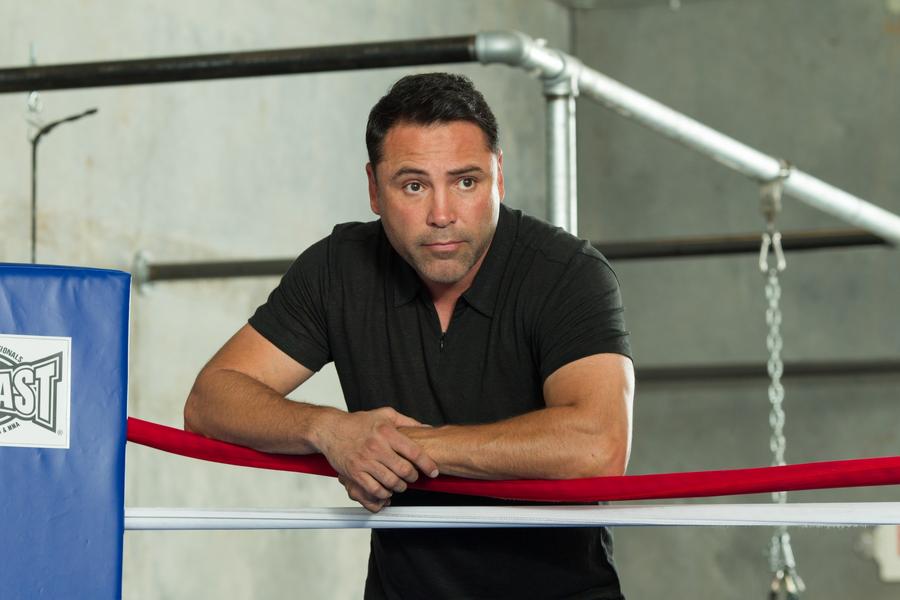
Alexis Cuarezma/Getty Images
Golden Boy Promotions and Business Leadership
Even before retiring as a fighter, De La Hoya began preparing for life outside the ring. In 2002, he co-founded Golden Boy Promotions, partnering with Swiss banker-turned-boxing executive Richard Schaefer. While De La Hoya served as the company's public face, Schaefer handled its financial and operational strategy, bringing corporate discipline to boxing promotion.
Under their leadership, Golden Boy Promotions became the most powerful promotional company in the sport, staging record-breaking events and representing elite fighters. The company played a central role in some of the highest-grossing fights in boxing history, including De La Hoya's own bout with Floyd Mayweather, which set new pay-per-view records. Golden Boy's success transformed De La Hoya from athlete to influential power broker in the sport.
Other Ventures
Beyond boxing promotion, De La Hoya pursued a wide range of business and entertainment ventures. He hosted the Spanish-language boxing program "Boxeo de Oro" on HBO and launched a clothing line alongside extensive merchandising partnerships. His brand affiliations included collaborations tied to PlayStation platforms such as PS3, Xbox 360, and PSP.
De La Hoya also explored music, releasing a bilingual English and Spanish album titled "Oscar," which earned a Grammy Award nomination. In 2006, he authored the children's picture book "Super Oscar," which received positive reviews, followed by his autobiography "American Son: My Story," published in 2008.
Real Estate, Civic Interests, and Public Profile
De La Hoya expanded into real estate through Golden Boy Partners, a development company focused on building retail and residential projects in urban Latino communities. The initiative reflected his interest in reinvesting in neighborhoods similar to those where he was raised.
He has also periodically expressed interest in public service and politics, briefly discussing the possibility of entering national politics during the late 2010s, though no formal campaign materialized.
Philanthropy
De La Hoya and his siblings opened the Cecilia Gonzalez De La Hoya Cancer Center in honor of their mother at the White Memorial Medical Center. The family donated $350,000 to the center. He also started a charity to help educate underprivileged youth. In 2008, he donated $3.5 million to the De La Hoya Animo Charter High School.
Personal Life
In 1997, Oscar began dating Shanna Moakler, the winner of Miss USA in 1995. They became engaged in 1998 and welcomed a daughter, Atiana de la Hoya, in 1999. Their relationship reportedly ended in 2000 when Shanna saw Oscar on television, attending the Latin Grammy Awards with another woman. In December 2000, Shanna filed a $62.5 million palimony suit, in which she claimed he was abusive and an alcoholic. In 2001, they settled with an out-of-court agreement.
In October 2001, De La Hoya married singer Millie Corretjer. They had three children together. De La Hoya and Corretjer separated in 2016. He has two children from other relationships.
More recently, Oscar has been dating Holly Saunders. She is 15 years his junior.
Real Estate
In October 1997, Oscar paid $3.35 million for a home in Los Angeles. He sold this home in 2002 for $3.75 million.
In November 2001, Oscar paid $5.2 million for an 11,500-square-foot mansion in Pasadena, California. He appears to still own this home today, and it is worth around $18 million.
In mid-2022, Oscar paid $14.6 million for an unfinished home in Henderson, Nevada. He then spent millions finishing and customizing what became a 9,000-square-foot mansion. He even spent an estimated $500,000 converting what was planned to be a second garage into a man cave, complete with a golf simulator and arcade. After all that work, for whatever reason, Oscar listed this home for sale in June 2025 for $19.5 million.
Controversies
In December 2001, actress and former Miss USA Shanna Moakler filed a $62.5 million palimony suit (because they were not legally married, it was not an alimony suit) to help obtain support from De La Hoya for the couple's daughter, Antiana (b. 1999). Their relationship had ended abruptly the year before when Moakler saw De La Hoya with another woman at the Latin Grammy Awards (she had been at home watching it on television). The case was settled out of court for an undisclosed amount.
In 1998, De La Hoya was accused of sexual assault of a 15-year-old in Cabo San Lucas, Mexico. Mexican authorities investigated, but no charges were filed. The suit was settled out of court in 2001.
De La Hoya was arrested for a DUI in Pasadena in 2017. He pled not guilty, and the charges were dismissed in 2018. He has publicly acknowledged that he has a substance abuse problem and underwent treatment at the Betty Ford Center, mainly for alcohol and cocaine abuse.
/2020/01/oscar2.jpg)
/2023/10/Shanna-Moakler.jpg)
/2011/10/sa.jpg)
/2019/10/rg.jpg)
/2014/06/Richard-Schaefer.jpg)
/2009/11/Manny-Pacquiao.jpg)
/2010/01/Juan-Manuel-Marquez.jpg)
/2021/10/shane.png)
/2009/11/George-Clooney.jpg)
/2017/02/GettyImages-528215436.jpg)
/2019/04/rr.jpg)