











What Is Mike Tyson's Net Worth, Salary & Career Earnings?
Mike Tyson is an American former professional boxer, undisputed heavyweight champion, actor, and entrepreneur who has a net worth of $30 million.
Mike Tyson became one of the most recognizable athletes in the world during the 1980s, combining extraordinary punching power with a fearsome public persona. In 1986, he became the youngest heavyweight champion in boxing history at age 20, and he later unified the division before suffering a stunning upset against Buster Douglas. His career encompassed enormous pay-per-view events, a prison sentence, a championship comeback, and the infamous 1997 rematch in which he bit Evander Holyfield's ear. At his financial peak, Tyson's net worth reached $300 million, but extravagant spending, taxes, divorce, and conflicts with promoter Don King contributed to his 2003 bankruptcy.
Mike later rebuilt his finances through entertainment work, live appearances, licensing, cannabis businesses, and high-profile returns to the ring. His November 2024 Netflix fight against Jake Paul paid him $20 million, and he subsequently purchased a $13 million Florida mansion. He also helped build Tyson 2.0, a cannabis brand within Carma HoldCo, whose 2024 revenue Forbes placed at $200 million. Tyson generated hundreds of millions of dollars in boxing purses, alongside endorsement and business income. CNW's reconstructed fight-by-fight earnings, including the Roy Jones Jr. exhibition and the Jake Paul fight, total $370 million.
Bankruptcy and Financial Comeback
Tyson was among the highest-paid athletes of the late 1980s and 1990s. His biggest fights delivered eight-figure purses, and his fortune eventually reached $300 million. But taxes, lavish living expenses, payments to promoters and managers, divorce obligations, and other debts steadily eroded his wealth.
By 2003, Tyson had filed for Chapter 11 bankruptcy protection with $23 million in debt. At the time, he was also pursuing a $100 million lawsuit against Don King, accusing his former promoter of improperly taking tens of millions of dollars. They settled the case in 2004 for $14 million, but that money went to creditors rather than into Tyson's pocket. Bankruptcy records and the proposed reorganization also revealed the extent of his tax liabilities and obligations to former wife Monica Turner.
During a 2010 appearance on "The View," Tyson offered a candid description of his circumstances:
"I'm totally destitute and broke. But I have an awesome life. I have an awesome wife who cares about me. … I'm totally broke. I had a lot of fun. It just happened. I'm very grateful."
Acting roles, a stage show, paid appearances, product licensing, business partnerships, and two comeback events eventually restored him to multimillionaire status.
Spending a Fortune
Mike lived a famously lavish lifestyle when money was rolling in. He spent millions on mansions, luxury vehicles, jewelry, exotic animals, extravagant gifts, and an entourage whose expenses could rival those of a small business.
Tyson owned Bengal and Siberian tigers that cost as much as $70,000 each and maintained a custom habitat at his home. He employed an animal trainer for $125,000 a year. One member of his entourage earned $300,000 annually largely to wear army fatigues and shout "guerrilla warfare" at press conferences.
In the three years after Tyson was released from prison in 1995, his spending included:
- $4.5 million on cars and motorcycles, including 19 vehicles purchased for friends
- $400,000 on pigeons and big cats
- $300,000 on lawn and garden maintenance
- $240,000 per month in general spending money
- $230,000 on cell phones, pagers, and phone bills
- $125,000 per year for an animal trainer
- $100,000 per month on jewelry and clothing
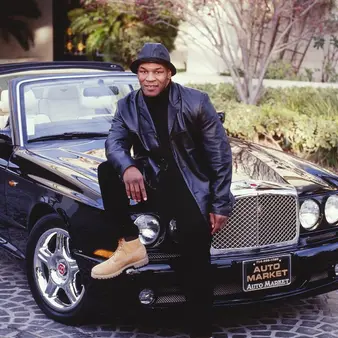
Tyson accumulated homes in Connecticut, Las Vegas, Ohio, and Maryland. His Ohio estate was known for its gold-plated furnishings and lavish recreational facilities, while a Las Vegas property he purchased for $4 million contained an 11,000-square-foot mansion that he extensively remodeled. Real estate was only one part of his spending: at one point he owned more than 100 cars, including a $500,000 Bentley Continental SC, one of only 73 produced.
He bought 20 cars from a single Las Vegas dealership and once spent $1.5 million in a matter of minutes on five Bentley Azures. Another frequently retold story describes a $2 million gold bathtub purchased for his first wife, Robin Givens. Alongside these splurges, he regularly gave costly gifts to friends and acquaintances.
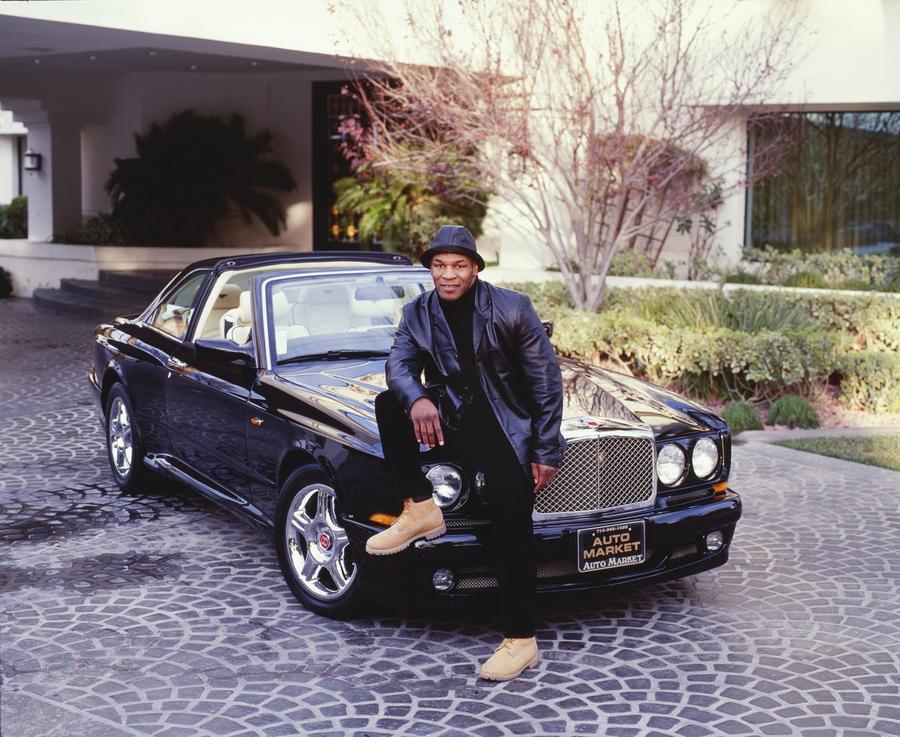
(Photo by Gregory Bojorquez/Getty Images)
Career Earnings and the Showtime/MGM Deals
In 1987, Tyson signed an eight-fight HBO agreement valued at $27 million that concluded with his 1990 bout against Alex Stewart. After that fight, Don King announced a new Showtime arrangement valued at $120 million for eight to ten bouts, although Showtime did not publicly confirm King's figure. It was one indication of how dramatically Tyson had changed the economics of heavyweight boxing.
After Tyson left prison in March 1995, King arranged another set of lucrative deals involving Showtime and MGM Grand. Under an agreement reviewed in federal court, Showtime obtained rights to distribute Tyson fights over three years, a period intended to encompass ten bouts, and agreed to pay a $43 million signing bonus to Don King Productions. A separate MGM Grand agreement gave the Las Vegas casino exclusive hosting rights to six Tyson fights within that broader schedule. MGM advanced King's company $15 million and arranged a $15 million stock purchase backed by a guarantee that the shares would eventually be worth at least $30 million.
The Showtime and MGM contracts involved overlapping fights, not sixteen separate paydays. Nor were the $43 million Showtime bonus and MGM's $30 million stock guarantee sums Tyson personally received in cash. A 1998 Associated Press investigation put Tyson's share of the signing bonuses at $35 million and his combined share of purses and the television and casino contracts from six post-prison fights at $106 million. Later accounts have characterized the broader package as a $395 million deal, but the underlying agreements do not establish that amount as a guaranteed personal payment to Tyson.
Just as important was the way the revenue was divided. Under the "Team Tyson" arrangement, Tyson assigned 30% of his fight purses to King and 10% apiece to managers John Horne and Rory Holloway. In exchange, Tyson was assigned a 50% share of certain signing bonuses and promotional proceeds controlled by King. In practice, this meant immense sums could flow through a Tyson event without becoming money Tyson could keep. Tyson later accused King of imposing additional fees and payments. King's wife collected $100,000 in consulting fees on individual fights, while King's sons received $50,000 consulting payments.
A substantial portion of Tyson's later earnings also went straight to creditors. When he received an $8 million purse for the 2004 Danny Williams fight, the IRS garnished $6 million, leaving him $2 million. This combination of enormous gross paydays, expensive management arrangements, and accumulated liabilities helps explain why his financial collapse was possible despite the millions generated by his fights.

Rich Polk/Getty Images
Fight Earnings History
The following table lists CNW's reconstructed fight-by-fight paydays, beginning with Tyson's heavyweight title victory over Trevor Berbick and extending through his returns against Roy Jones Jr. and Jake Paul. The total is $370 million, including a $30 million reported payday for his 2002 fight with Lennox Lewis. The amounts reflect reported purses and pay-per-view participation, not post-tax take-home pay. For more on the bouts and their historical rankings, see "Mike Tyson's Biggest Career Paydays In The Ring."
| Opponent | Purse |
|---|---|
| Trevor Berbick | $1,500,000 |
| James Smith | $2,000,000 |
| Pinklon Thomas | $2,500,000 |
| Tony Tucker | $2,500,000 |
| Tyrell Biggs | $2,500,000 |
| Larry Holmes | $5,000,000 |
| Tony Tubbs | $10,000,000 |
| Michael Spinks | $20,000,000 |
| Frank Bruno I | $8,000,000 |
| Carl Williams | $4,000,000 |
| Buster Douglas | $6,000,000 |
| Henry Tillman | $2,000,000 |
| Alex Stewart | $3,000,000 |
| Donovan Ruddock I | $6,000,000 |
| Donovan Ruddock II | $10,000,000 |
| Peter McNeeley | $25,000,000 |
| Buster Mathis | $10,000,000 |
| Frank Bruno II | $30,000,000 |
| Bruce Seldon | $30,000,000 |
| Evander Holyfield I | $30,000,000 |
| Evander Holyfield II | $30,000,000 |
| Francois Botha | $10,000,000 |
| Orlin Norris | $9,000,000 |
| Julius Francis | $10,000,000 |
| Lou Savarese | $8,000,000 |
| Andrew Golota | $10,000,000 |
| Brian Nielsen | $5,000,000 |
| Lennox Lewis | $30,000,000 |
| Clifford Etienne | $5,000,000 |
| Danny Williams | $8,000,000 |
| Kevin McBride | $5,000,000 |
| Roy Jones Jr | $10,000,000 |
| Jake Paul | $20,000,000 |
| Total: | $370,000,000 |

Phillip Faraone/Getty Images
Early Life
Michael Gerard Tyson was born on June 30, 1966, in Brooklyn, New York, and grew up in Brownsville, a neighborhood struggling with poverty and violent crime. His father was largely absent, and his mother, Lorna, raised him amid considerable financial hardship. Tyson later described being bullied because of his voice, appearance, and insecurity, experiences that helped fuel his fascination with fighting.
By his early teens, Tyson was involved in street crime and had been arrested dozens of times. He was eventually sent to the Tryon School for Boys in upstate New York, where counselor and former boxer Bobby Stewart recognized his potential and introduced him to legendary trainer Cus D'Amato. The relationship transformed Tyson's life. D'Amato brought him into his Catskill home, became his mentor, and eventually served as his legal guardian following Tyson's mother's death.
D'Amato taught Tyson that discipline and controlled aggression could turn a frightened boy into a champion. Along with trainer Kevin Rooney, he helped develop Tyson's extraordinary combination of defense, footwork, and punching power. D'Amato died in November 1985, when Tyson was 19, just a year before Tyson captured his first world title. Tyson has continued to describe that loss as one of the defining tragedies of his life.
Rise to Heavyweight Champion
Tyson won gold medals at the Junior Olympics in 1981 and 1982 and turned professional at 18. He made his debut in March 1985, knocking out Hector Mercedes in the first round, and won his first 19 professional fights by knockout.
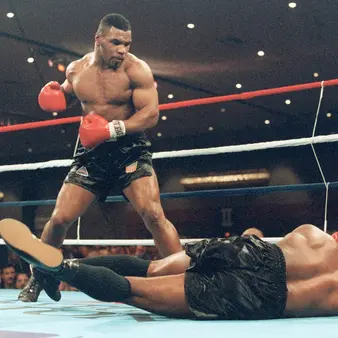
On November 22, 1986, Tyson knocked out Trevor Berbick in the second round to capture the WBC heavyweight championship. At 20 years and four months old, he became the youngest heavyweight titleholder in boxing history. He defeated James Smith in 1987 to win the WBA belt and then Tony Tucker to add the IBF championship, unifying the division.
Tyson's peak was defined by relentless aggression, exceptional head movement, and the ability to end fights in seconds. He stopped former champion Larry Holmes in 1988 and then faced undefeated lineal champion Michael Spinks in a bout promoted as one of the richest in boxing history. Tyson knocked Spinks out in just 91 seconds, earning $20 million and cementing his position as the sport's biggest attraction.
Buster Douglas Upset
By 1990, Tyson seemed nearly unbeatable, but his personal and professional life had grown increasingly chaotic. His relationship with longtime trainer Kevin Rooney had ended, and questions were mounting about his preparation and the influence of people around him.
On February 11, 1990, Tyson faced James "Buster" Douglas in Tokyo. Douglas, regarded as a massive underdog, boxed effectively throughout the fight before knocking Tyson out in the tenth round. The loss remains one of the greatest upsets in sports history and ended Tyson's reign as undisputed heavyweight champion.
Prison and Boxing Comeback
In July 1991, Tyson was accused of raping 18-year-old Desiree Washington after they met in Indianapolis. Tyson maintained that the encounter was consensual, but a jury convicted him in February 1992. He received a prison sentence of six years and was released in March 1995 after serving three years. Tyson converted to Islam while incarcerated.
His release triggered one of the most lucrative comebacks in boxing history. On August 19, 1995, he faced Peter McNeeley in Las Vegas in a bout billed as "He's Back." Tyson earned $25 million for a fight that ended after just 89 seconds when McNeeley's corner entered the ring, resulting in a disqualification. The event demonstrated that Tyson remained an extraordinary commercial draw despite his years outside the sport.
Tyson regained heavyweight championships in 1996, stopping Frank Bruno to win the WBC title and defeating Bruce Seldon to capture the WBA belt. The Seldon fight was also the event Tupac Shakur attended hours before the rapper was fatally shot in Las Vegas.
Evander Holyfield Fights
Tyson faced Evander Holyfield in November 1996. Holyfield, widely dismissed as past his prime, absorbed Tyson's early pressure and eventually stopped him in the 11th round to win the WBA heavyweight title.
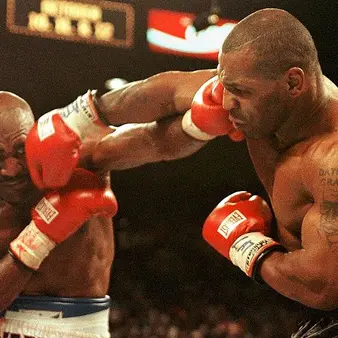
Their June 1997 rematch became one of the most infamous events in sports history. During the third round, Tyson bit Holyfield on both ears, removing a piece of his right ear. He was disqualified, fined, and stripped of his boxing license. The rematch nevertheless generated record pay-per-view interest and paid Tyson $30 million, while Holyfield received $35 million.
Tyson's boxing license was eventually restored. Years later, the former rivals reconciled, and they even collaborated on an ear-shaped cannabis edible referencing the incident. In subsequent interviews and documentaries, Tyson has expressed embarrassment about the episode while acknowledging that it remains inseparable from his public identity.
Later Boxing Career
Tyson returned to professional boxing in 1999, defeating Francois Botha, Julius Francis, Lou Savarese, and other opponents. In June 2002, he challenged Lennox Lewis for the heavyweight championship in Memphis. Tyson and Lewis were each guaranteed $17.5 million, with additional money tied to pay-per-view sales. Contemporary reporting based on Tyson's divorce proceedings placed his total compensation as high as $30 million. The fight generated $103 million in U.S. pay-per-view revenue, but that figure represented the event's gross receipts, not Tyson's personal payday. Lewis dominated much of the fight and knocked Tyson out in the eighth round.
Tyson's last professional victory came against Clifford Etienne in 2003. He subsequently lost to Danny Williams in 2004 and Kevin McBride in 2005, after which he retired. By then, the financial pressures that once seemed impossible for a superstar of his stature had become an inescapable part of his final years in the ring.
Roy Jones Jr. Fight
In November 2020, Tyson returned to the ring at 54 for an exhibition against Roy Jones Jr. at Staples Center in Los Angeles. The eight-round event was declared a draw, but it attracted considerable pay-per-view interest and introduced Tyson's boxing persona to a new generation of viewers.
Tyson's compensation was structured to reach $10 million based on the event's commercial performance, and CNW's career earnings table credits him with that amount. Tyson initially said he planned to donate all of his earnings to charity; his representatives later clarified that he would make a substantial donation, with the final amount dependent on the event's finances.

(VALERIE MACON/AFP/Getty Images)
Jake Paul Fight
In November 2024, Tyson returned for his first sanctioned professional fight in nearly 20 years, facing YouTuber-turned-boxer Jake Paul at AT&T Stadium in Arlington, Texas. Initially scheduled for July, the bout was postponed because of Tyson's ulcer flare-up. It eventually took place on November 15 under modified rules, with eight two-minute rounds and 14-ounce gloves.
Paul won by unanimous decision. More than 72,000 spectators attended, and Netflix reported more than 108 million live viewers worldwide. Tyson earned $20 million from the event, while Paul earned $40 million. The loss left Tyson with a professional record of 50 wins, seven losses, and two no contests, including 44 knockout victories.
In a 2026 interview, Tyson admitted that money was not the whole reason he remained attracted to fighting. Although he could explain another comeback as a financial opportunity, he said his deeper motivation was ego and an enduring desire to prove himself. He also acknowledged how badly his body felt the morning after facing Paul, even as he left open the possibility of returning again.
Tyson 2.0 and Carma HoldCo
Cannabis and consumer products have become an important part of Tyson's financial comeback. In 2021, he launched Tyson 2.0, lending his name and image to products that included flower, vapes, pre-rolls, edibles, and smoking accessories. He later co-founded Carma HoldCo with entrepreneur Adam Wilks and other partners, using a licensing model that allows outside manufacturers and distributors to sell branded products.
Carma expanded beyond Tyson 2.0 to include brands associated with wrestler Ric Flair and rapper Future. One of Tyson 2.0's best-known products, "Holy Ears," was developed in collaboration with Evander Holyfield and shaped like an ear with a bite missing. The company's products reached markets in the United States and overseas.
Forbes placed Carma's 2024 revenue at $200 million, with Tyson 2.0 accounting for most of its sales, and the company had raised $15 million from investors. Tyson became Carma's CEO in April 2025. The revenue figure belongs to the company rather than to Tyson personally; his exact ownership percentage and the value of his individual stake have not been disclosed.
Planned Floyd Mayweather Exhibition
Tyson and Floyd Mayweather signed on for an exhibition originally planned for 2026. The proposed bout was postponed after Tyson fractured his hand during training, and disagreements involving the promoter and Mayweather became the subject of federal litigation.
The contract dispute raised questions about scheduling, exclusivity, the availability of a venue, and whether the exhibition could take place as planned. The original event dates passed without a fight.
Boxing Style
Under Cus D'Amato, Tyson mastered the "peek-a-boo" boxing style, which emphasizes a tight guard, constant head movement, explosive footwork, and powerful counterpunching. His relatively short height for a heavyweight helped him get beneath taller opponents' punches while closing the distance quickly.
Tyson combined body shots and uppercuts with devastating speed. His favorite combinations included a right hook to the body followed by a rising uppercut, and his attacks often began from unexpected angles. Although his knockout power attracted the most attention, his balance, defensive movement, and timing were equally important to the dominance of his early career.

Getty
Movies, Television and Personal Appearance Fees
Tyson turned his fame and notoriety into a second entertainment career. He appeared as a version of himself in the 2009 comedy "The Hangover," delivering one of the film's most memorable celebrity cameos, and returned for "The Hangover Part II." He also appeared in television shows, commercials, podcasts, and international film productions, including the 2022 Indian sports drama "Liger."
He starred in the autobiographical one-man stage production "Mike Tyson: Undisputed Truth," which was directed for the stage and screen by Spike Lee. Tyson also voiced a fictionalized version of himself in the Adult Swim animated comedy "Mike Tyson Mysteries" and hosted the interview podcast "Hotboxin' with Mike Tyson."
Tyson's name became a valuable asset outside traditional acting. During his post-boxing years in Las Vegas, he charged $75,000 for a two-hour appearance at parties and corporate events, supplementing his income with speaking engagements and promotional work.
2026 Netflix Documentary
In October 2026, Netflix released "TYSON," a four-part documentary directed by Floyd Russ. The series follows Tyson through the most consequential and painful chapters of his life, including his impoverished childhood, the death of Cus D'Amato, his rise to the heavyweight championship, his prison sentence, his turbulent relationships, and his struggles with addiction. It also features contributions from people close to him, including members of his family.
Tyson is visibly emotional while revisiting events he once treated with bravado. He discusses the Holyfield ear-biting incident, acknowledges responsibility for his actions in the ring, and again maintains his innocence regarding his rape conviction. He also confronts the insecurities that accompanied his fame, explaining that the desire to be feared was rooted partly in low self-esteem.
Speaking with The Athletic in connection with the documentary, Tyson reflected on how different he feels from the volatile young fighter he once was. He described revisiting his past as uncomfortable but accepted that both his successes and his destructive behavior helped shape the person he became.
Personal Life and Sobriety
Tyson has been married three times. His first marriage, to actress Robin Givens, lasted from 1988 to 1989. He married Monica Turner in 1997, and the couple divorced in 2003. In 2009, Tyson married Lakiha "Kiki" Spicer, who has remained an important figure in his personal and business life.
Tyson is the father of seven children, including daughter Exodus, who died in 2009 at age four after her neck became entangled in a treadmill cord at the family home in Phoenix. Her death was a devastating loss for Tyson and his family, and he has continued to speak about it in interviews and documentaries.
Tyson has described years of cocaine and alcohol addiction, including episodes in which he feared for his life. In 2026, he said he had gone ten years without either substance, while continuing to use cannabis. He has also credited experiences with 5-MeO-DMT, a powerful psychedelic associated with the Sonoran Desert toad, with helping him stop using cocaine and alcohol. That is Tyson's account of his recovery, not a medically established treatment outcome.
In an interview accompanying his Netflix documentary, Tyson acknowledged that he previously used the psychedelic excessively, sometimes several times in a single day. He said he had subsequently gone more than a year without it. Tyson has described the experience in spiritual terms, but has also acknowledged that frequent use was harmful. He remains a practicing Muslim.
In April 2022, Tyson repeatedly struck a passenger aboard a JetBlue flight after a confrontation. Prosecutors declined to pursue criminal charges. In 2023, a woman filed a $5 million civil lawsuit alleging that Tyson raped her in a limousine in 1991. Tyson denied the allegation, and the plaintiff voluntarily discontinued the lawsuit in 2025 after a court declined to allow amendments to her pleadings.
Former Connecticut Mansion
In 1996, Tyson paid $2.8 million for a mansion on 17 acres in Farmington, Connecticut. The vast property, commonly described as 50,000 square feet, contained dozens of rooms, and Tyson spent millions on improvements, including a nightclub, indoor gym, indoor shooting range, extensive telephone system, and regulation-size basketball court.
Amid his 2003 divorce and bankruptcy, ownership of the estate was transferred to Monica Turner. She sold it later that year to rapper 50 Cent for $4.1 million. 50 Cent spent millions renovating the house, eventually listed it for $18.5 million, and reduced the price repeatedly before selling it in 2019 for $2.9 million. The saga is also discussed in CNW's coverage of 50 Cent's financial problems.
Las Vegas Real Estate
Tyson has lived in the Las Vegas area for many years. In late 2015, he and Kiki paid $2.5 million for a mansion in Henderson, Nevada. The property offers more than 10,000 square feet of living space, six bedrooms, multiple fireplaces, a swimming pool, detached casitas, a wine cellar, and large outdoor entertaining areas.
The purchase represented an upgrade from a nearby Henderson home Tyson already owned. He listed the earlier property for $1.5 million in 2016.
Florida Mansion
In January 2025, Tyson and Kiki paid $13 million for a newly built waterfront estate in Delray Beach, Florida. The six-bedroom residence spans more than 12,000 square feet on 2.7 acres and includes an 80-foot swimming pool and spa, a gym, theater, four-car garage, guest accommodations, and a private bass pond with a waterfall.
The couple also purchased a 2.2-acre property in the nearby Antiquers Aerodrome community for $1.7 million, gaining access to an airstrip in the private aviation development. The purchases were a striking contrast to Tyson's circumstances less than 15 years earlier, when he had publicly described himself as completely broke.
Car Collection and Ferrari F50
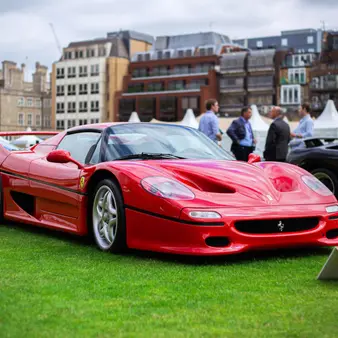
At the height of his wealth, Tyson owned more than 100 cars, including Bentleys, Lamborghinis, Ferraris, Rolls-Royces, Range Rovers, and Mercedes-Benz models. Few vehicles from his collection have drawn as much attention as the 1996 Ferrari F50 he once owned.
Ferrari manufactured just 349 F50s worldwide, with only 55 originally sent to the United States. Tyson's Ferrari F50, chassis #104220, was sold by the boxer in 2001, two years before his bankruptcy filing. It passed through several subsequent owners and sold at auction in August 2022 for $4.625 million.

(Photo by Martyn Lucy/Getty Images)
Net Worth Unpacked Mike Tyson
Explore the figures, comparisons, and money moments in this profile.
Read the text version 15 cards
Mike Tyson’s $30 million second act
CNW estimated net worth $30M
CNW snapshot: 2026-11-04
SourcesTyson’s reconstructed fight paydays total $370 million
CNW reconstructed fight-by-fight earnings, including comeback bouts $370M
SourcesTyson collected $30 million for three separate fights
CNW reconstructed Tyson fight paydays, nominal USD
- Michael Spinks, 1988$20M
- Peter McNeeley, 1995 · 1995-08-19$25M
- Frank Bruno II, 1996 · 1996-03-16$30M
- Evander Holyfield I, 1996 · 1996-11-09$30M
- Evander Holyfield II, 1997 · 1997-06-28$30M
CNW snapshot: 2026-11-04
Tyson’s peak fortune beside today’s estimate
Historical peak; date unspecified compared with Current CNW estimate 10×
CNW estimated personal net worth, historical peak vs current estimate
- Historical peak; date unspecified$300M
- Current CNW estimate$30M
CNW snapshot: 2026-11-04
SourcesTyson ranks #24 in CNW’s Boxers category
of 180 CNW profiles #24
CNW profiles in Boxers
Population: 180 covered profiles. 6 profiles share this rank.
CNW snapshot: 2026-11-04
Top five · Boxers
CNW estimates · Boxers
- #1 · Michael Buffer$400M
- #2 · Saul Alvarez$350M
- Tied #3 · George ForemanCNW estimated net worth at death$300M
- Tied #3 · Bob Arum$300M
- #5 · Anthony Joshua$250M
Mike Tyson · Tied #24 · $30M
CNW snapshot: 2026-11-04
What share of Tyson’s comeback purses went to his team?
Total · Fight-purse assignments under the post-prison Team Tyson arrangement 50%
Fight-purse assignments under the post-prison Team Tyson arrangement
- Promoter Don King30%
- Manager John Horne10%
- Manager Rory Holloway10%
CNW snapshot: 2026-11-04
Cars dominated Tyson’s post-prison splurges
CNW-reported spending in the first three years after his 1995 release
- Cars and motorcycles$4.5M
- Pigeons and big cats$400K
- Lawn and garden care$300K
- Phones, pagers and bills$230K
CNW snapshot: 2026-11-04
The collapse reached bankruptcy in 2003
Debt when Tyson filed for Chapter 11, 2003 $23M
The IRS took most of Tyson’s 2004 fight purse
Tyson’s $8 million Danny Williams purse: garnishment and remainder, 2004
- IRS garnishment$6M
- Remaining for Tyson$2M
CNW snapshot: 2026-11-04
SourcesTyson’s former mansion later sold for less than he paid
Farmington, Connecticut mansion transaction prices, nominal USD
- Tyson buys, 1996$2.8M
- Monica Turner sells to 50 Cent, 2003$4.1M
- 50 Cent sells, 2019$2.9M
CNW snapshot: 2026-11-04
Two returns to the ring brought Tyson two more paydays
Tyson’s CNW-credited fight earnings, 2020 and 2024
- Roy Jones Jr. exhibition, 2020$10M
- Jake Paul fight, 2024 · 2024-11-15$20M
CNW snapshot: 2026-11-04
SourcesTyson and the opponents from his two comeback fights
CNW estimated net worth · Tyson, Roy Jones Jr. and Jake Paul
- Mike Tyson$30M
- Roy Jones Jr$7M
- Jake Paul$200M
CNW snapshot: 2026-11-04
Tyson’s cannabis venture reached a bigger scale
Tyson 2.0 generated most of Carma’s sales. Tyson became its CEO in April 2025.
Carma HoldCo revenue, 2024 · Forbes estimate $200M
The comeback included a new Florida home
They also bought a nearby $1.7 million property with access to a private airstrip.
Tyson and Kiki’s Delray Beach waterfront home, January 2025 $13M