
/2009/12/Lenny-Dykstra.jpg)
/2022/05/Cutter-Dykstra.png)
/2009/12/wayne-gretzky.jpg)
/2010/02/Darryl-Strawberry-1.jpg)
/2010/01/Barry-Bonds.jpg)
/2015/07/John-Kruk.jpg)
/2009/11/George-Clooney.jpg)
/2019/10/denzel-washington-1.jpg)
/2017/02/GettyImages-528215436.jpg)
/2018/03/GettyImages-821622848.jpg)
/2009/09/Brad-Pitt.jpg)
/2009/09/Cristiano-Ronaldo.jpg)
/2019/04/rr.jpg)
/2020/01/lopez3.jpg)
/2019/11/GettyImages-1094653148.jpg)
:strip_exif()/2009/09/P-Diddy.jpg)
/2020/02/Angelina-Jolie.png)
What Is Lenny Dykstra's Net Worth and Career Earnings?
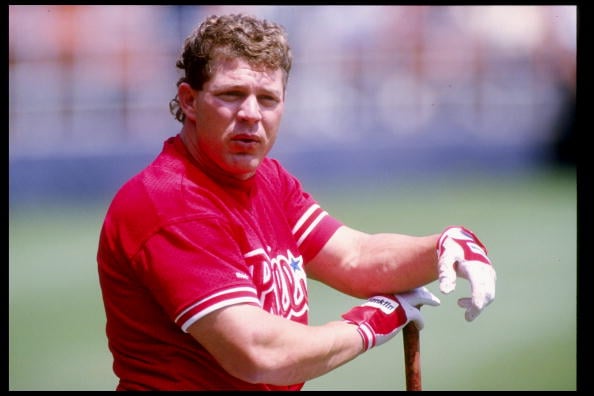
Lenny Dykstra is an American retired professional baseball player who has a net worth of -$25 million. As we detail later in this article, after a brief high-flying post-baseball career as a financial guru, Lenny filed for Chapter 11 bankruptcy in 2009. In his filing, he listed $50,000 in assets and as much as $50 million in debt. While most people file for bankruptcy to have their debts "discharged" (legally forgiven), Dykstra's case did not end this way. In 2012, a bankruptcy trustee and federal judges determined that Dykstra had committed bankruptcy fraud and therefore could not have his debts discharged.
Lenny Dykstra had one of the most distinctive and turbulent careers in modern Major League Baseball, defined as much by his relentless on-field style as by his dramatic post-career collapse. Nicknamed "Nails," Dykstra rose from a low-profile draft pick into a central figure on two iconic teams, becoming a symbol of grit, aggression, and refusal to back down.
Dykstra broke into the majors with the New York Mets in 1985 and quickly earned a reputation as a fearless competitor. His defining early moment came during the 1986 National League Championship Series, when he hit a walk-off home run that helped propel the Mets toward a World Series title. That championship team cemented his place in baseball history and showcased his ability to thrive under pressure.
In 1989, Dykstra was traded to the Philadelphia Phillies, where he reached the peak of his career. As a leadoff hitter, he became one of the game's most effective on-base threats, combining plate discipline with constant physical and psychological pressure on opponents. In 1993, he finished second in National League MVP voting while helping lead the Phillies to a World Series appearance. Over a 12-year career, he was selected to three All-Star teams and became widely known for playing through pain and injuries.
Dykstra earned roughly $36 million during his playing days, but chronic injuries forced him to retire in the mid-1990s. His post-baseball life proved far more chaotic. After a brief period in which he was publicly viewed as a successful businessman and stock picker, his finances collapsed under heavy debt and leverage. Bankruptcy filings, fraud convictions, and multiple prison sentences followed, along with repeated arrests in later years.
Today, Dykstra's legacy is deeply conflicted. He remains remembered as a key contributor to championship teams and one of the most relentless players of his era, but his achievements on the field have been largely overshadowed by one of the most complete financial and legal implosions in professional sports history.
Early Life
Lenny Kyle Dykstra was born on February 10, 1963, in Santa Ana, California. He grew up without the physical profile typically associated with star outfielders, but coaches quickly noticed his intensity and fearlessness. Those traits would become his calling card.
He was selected by the New York Mets in the 13th round of the 1981 MLB Draft, a late-round pick with modest expectations. Few players drafted that late develop into everyday major leaguers, let alone championship contributors.
Major League Career
Dykstra made his major league debut in 1985 and became a key contributor to the Mets' dominant mid-1980s run. His defining early moment came during the 1986 National League Championship Series, when he hit a walk-off home run in Game 3 that helped propel the Mets toward a World Series title.
In 1989, Dykstra was traded to the Philadelphia Phillies, where he enjoyed the most productive stretch of his career. As the Phillies' leadoff hitter, he developed into one of baseball's best on-base threats. In 1993, he finished second in National League MVP voting while leading the Phillies to a surprise World Series appearance.
Over 12 seasons from 1985 to 1996, Dykstra was named to three All-Star teams and became synonymous with gritty, confrontational baseball. Chronic back, knee, and head injuries ultimately shortened his career, forcing him to retire in the mid-1990s.
Steroid Use and the Mitchell Report
In 2007, Dykstra was named in the Mitchell Report, which investigated the use of performance-enhancing drugs in Major League Baseball. Multiple sources alleged that Dykstra used steroids during his playing career, particularly as injuries mounted and roster competition intensified.
Dykstra never formally admitted steroid use to investigators, but he later acknowledged privately that he felt pressure to keep his roster spot as his body broke down. The revelations further complicated the legacy of his late-career success.
Contracts, Salaries & Career Earnings
During his MLB career, Dykstra earned approximately $36 million in salary. Adjusted for inflation, that total is equivalent to roughly $65 million today. His highest earnings came in the early 1990s, when player salaries were rising rapidly but financial safeguards for athletes were far less common.
Despite those earnings, Dykstra would later claim that aggressive borrowing, failed business ventures, and collapsing real estate values erased his fortune. By 2009, he reported more than $31 million in liabilities, leaving him effectively insolvent.
Getty
Post-Baseball Business Ventures
After retiring, Dykstra attempted to reinvent himself as an entrepreneur and financial commentator. He launched a stock-picking newsletter, appeared regularly in the media, and portrayed himself as a market outsider who had cracked Wall Street.
For a short time, the image worked. Dykstra lived lavishly, owned multiple luxury properties, and cultivated the appearance of financial success. Behind the scenes, however, his finances were increasingly unstable, built on leverage rather than sustainable income.
Bankruptcy and Fraud Convictions
In 2009, Dykstra filed for Chapter 11 bankruptcy, later converting the case to Chapter 7. Court filings revealed a staggering financial collapse; he claimed to possess as little as $50,000 in assets while facing debts estimated between $31 million and $50 million. Investigators later proved that after filing for protection, Dykstra engaged in a systematic effort to "loot" his own estate by illegally selling, destroying, and concealing assets that should have gone to his creditors.
Federal prosecutors detailed how Dykstra stripped valuable fixtures from his $18.5 million mansion—a property he had purchased from hockey legend Wayne Gretzky. He was caught removing and selling high-end chandeliers, sconces, and even industrial ovens for cash. He also concealed and sold a cache of sports memorabilia, including his own baseball gloves and bats. Because of this fraudulent behavior, the court took the rare step of denying his discharge. This is the most severe civil penalty in bankruptcy; it meant his case was closed, but he remained legally liable for every penny of the tens of millions he owed.
In 2012, Dykstra pleaded guilty to bankruptcy fraud, concealment of assets, and money laundering. He was sentenced to six and a half months in federal prison, ordered to pay $200,000 in restitution, and required to complete 500 hours of community service. That sentence ran concurrently with a three-year California state prison sentence for grand theft auto and false financial statements related to a fraudulent luxury car leasing scheme. As of early 2026, his financial situation remains dire; following a 2024 stroke and a January 2026 arrest for drug possession in Pennsylvania, Dykstra continues to reside in the Scranton area while the mountain of debt from his 2009 filing remains legally undischarged.
Later Arrests and Legal Issues
Dykstra was released from prison in 2013, but his legal troubles continued. In 2018, he was arrested in New Jersey following an incident involving an Uber driver and drug possession allegations. He later pleaded guilty to a reduced disorderly conduct charge.
Subsequent police encounters and arrests reinforced the perception of a prolonged downward spiral rather than isolated lapses in judgment.
Real Estate
Dykstra's financial collapse is inseparable from his real estate decisions. In the mid-2000s, he acquired a lavish estate inside the exclusive Sherwood Country Club community in Thousand Oaks, California. The home had been custom-built in 2007 by Wayne and Janet Gretzky and designed by famed architect Richard Landry.
The main residence spans 10,815 square feet on 6.5 acres and includes six bedrooms, seven and a half bathrooms, two guest houses, a full gym, a home theater, a pool, a sunken tennis court, and an outdoor wood-burning pizza oven.
After the housing market collapsed, Dykstra attempted to sell the property for as much as $18.5 million, repeatedly lowering the price. He ultimately lost the home in foreclosure after declaring bankruptcy and facing fraud charges.
In a striking full-circle moment, Wayne and Janet Gretzky re-acquired the property in 2018 for $13.5 million. They later listed it for $22.9 million in October 2020 before taking it off the market. They still own the home today.
Personal Life
Lenny and his wife, Terri, were married from 1985 to 2009. They have three children. Their son, Cutter Dykstra, has been married to "The Sopranos" actress Jamie-Lynn Sigler since 2016. Cutter and Jamie-Lynn have produced two grandsons for Lenny and Terri.
/2009/12/Lenny-Dykstra.jpg)
/2022/05/Cutter-Dykstra.png)
/2010/01/Barry-Bonds.jpg)
/2010/02/Darryl-Strawberry-1.jpg)
/2009/12/vick-thumb.jpg)
/2020/10/wayne.jpg)
/2020/10/pete-rose.png)
/2020/04/Megan-Fox.jpg)
/2009/09/Jennifer-Aniston.jpg)
/2020/06/taylor.png)