
/2009/09/Derek-Jeter.jpg)
/2012/10/Robinson-Cano.jpg)
/2014/10/GettyImages-922259852.jpg)
/2025/01/Anthony-Volpe.jpg)
/2010/04/Carlos-Beltran.jpg)
/2019/12/as.jpg)
/2009/09/Cristiano-Ronaldo.jpg)
/2009/09/Jennifer-Aniston.jpg)
/2020/06/taylor.png)
/2019/04/rr.jpg)
/2019/10/denzel-washington-1.jpg)
:strip_exif()/2015/09/GettyImages-476575299.jpg)
/2020/01/lopez3.jpg)
/2019/11/GettyImages-1094653148.jpg)
/2020/02/Angelina-Jolie.png)
/2017/02/GettyImages-528215436.jpg)
:strip_exif()/2009/09/P-Diddy.jpg)
What is Derek Jeter's Net Worth?
Derek Jeter is an American former professional baseball player, businessman, and baseball executive who has a net worth of $200 million. Derek Jeter, a legendary shortstop, spent his entire 20-year MLB career with the New York Yankees. Drafted sixth overall in 1992, Jeter made his debut in 1995 and quickly became a cornerstone of the Yankees' success. He was named AL Rookie of the Year in 1996 and helped lead the team to five World Series championships (1996, 1998-2000, 2009). Jeter was a 14-time All-Star and won five Gold Glove Awards and five Silver Slugger Awards. He was the Yankees' captain from 2003 until his retirement in 2014. Jeter's 3,465 hits rank sixth all-time in MLB history, and he is the Yankees' all-time leader in hits, doubles, games played, stolen bases, and at-bats. His postseason accomplishments are equally impressive, with a .308 batting average, 200 hits, and 20 stolen bases in 158 playoff games. Known for his clutch performances, leadership, and professionalism, Jeter earned the nickname "Captain Clutch." He was a central figure in the Yankees' dynasty of the late 1990s and early 2000s. After retirement, Jeter became a part-owner and CEO of the Miami Marlins. In 2020, he was inducted into the Baseball Hall of Fame in his first year of eligibility. He was an All-Star 14 times and won the Silver Slugger and Gold Glove awards five times each. He is the only player in history to win both the All-Star Game MVP award and the World Series MVP award in the same season. He also holds the Yankee record for the most hits, beating Lou Gehrig's existing record back in 2009.
During his career, Derek Jeter earned $265 million in baseball salary alone. He earned at least $150 million from endorsements for a total of $415 million in career earnings.
In August 2017, Derek and a group of investors purchased the Miami Marlins for $1.2 billion. Derek owned 4% of the team and served as CEO of the organization until he sold his shares for $44.8 million in 2022.
Early Life
Derek Sanderson Jeter was born in Pequannock Township, New Jersey, on June 26, 1974. His parents met in Germany while serving in the United States Army. The family moved to Kalamazoo, Michigan, when he was four, and he began playing little league baseball there when he was five. Growing up, Jeter spent summers with his grandparents in New Jersey and became a passionate fan of the New York Yankees team after attending games with his grandparents.
He graduated from Kalamazoo Central High School, where he won multiple awards for his athletic performance, including the 1992 High School Player of the Year Award from the American Baseball Coaches Association, the 1992 Gatorade High School Player of the Year Award, and USA Today's High School Player of the Year. He also earned a baseball scholarship to the University of Michigan.
Professional Baseball Career
Jeter was a highly-regarded candidate in the 1992 MLB draft, and he chose to turn pro when the Yankees, who had the sixth pick, drafted him. He signed with them for $800,000. Jeter played four seasons in minor league baseball from 1992 to 1995, initially playing with the Gulf Coast Yankees in the Rookie-level Gulf Coast League, based in Tampa, Florida. Eventually, he was promoted to the Greensboro Hornets of the Class A South Atlantic League, where he played his first full season of professional baseball. There, he was honored with the Minor League Player of the Year Award by the magazine Baseball America. While in the minor leagues, he also played for the Tampa Yankees of the Class A-Advanced Florida State League, the Albany-Colonie Yankees of the Class AA Eastern League, and the Columbus Clippers of the Class AAA International League.
Jeter made his Major League Baseball (MLB) debut on May 29, 1995, after starting shortstop Tony Fernandez and infielder Pat Kelly were both injured. He was assigned uniform number 2, most recently worn by Mike Gallego from 1992 to 1994. He was the first Yankee rookie to start as shortstop for the team since Tom Tresh did in 1962 when he started for the Yankees on Opening Day in the 1996 season. He also hit his first MLB home run that day. He went on to win both Rookie of the Year and the World Series that year. He also played on Series-winning Yankee teams in 1996, 1998, 1999, 2000, and 2009.
He played his last season in 2014. The average ticket price for his final home game on September 25, 2014, reached $830 on the secondary market. Over his career, he averaged 204 hits, 113 runs scored, and 21 stolen bases per 162 games. He was the 28th player to reach 3,000 hits and finished his career ranked number six in MLB history for career hits. He is one of the most highly-regarded athletes not only for his on-field performances, but his off-field conduct as well, managing to avoid major controversy throughout his long career. He spent his entire 20-year career with the New York Yankees and was elected to the Baseball Hall of Fame in 2020, during his first year of eligibility. Furthermore, his uniform number, 2, was retired by the Yankees in 2017.
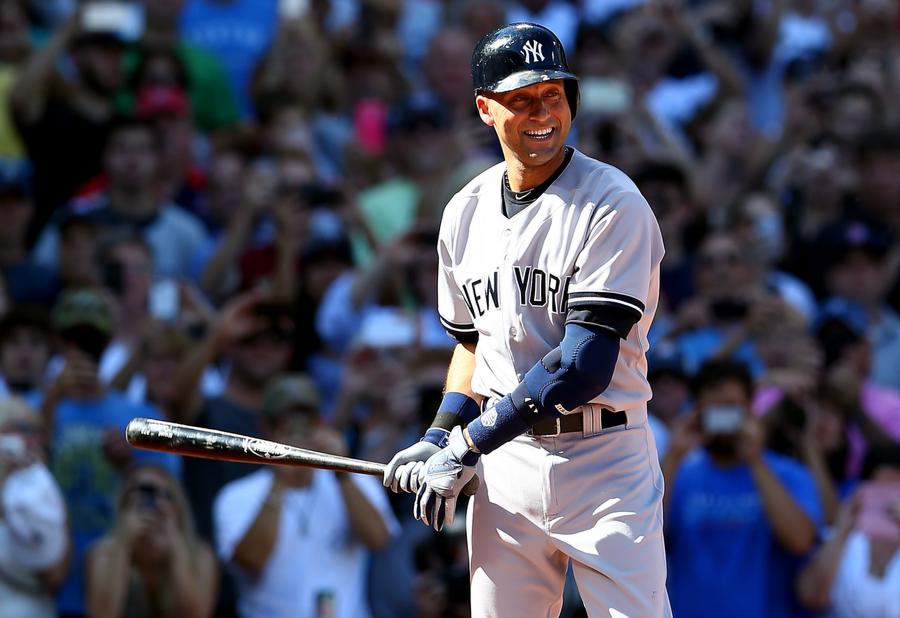
(Photo by Elsa/Getty Images)
Business Interests
In 2013, after an injury cut his season short, Jeter formed an imprint with Simon & Schuster called Jeter Publishing. He referred to it as "the blueprint for postcareer." He also created the website ThePlayersTribune.com in 2014, which publishes daily sports-related content. In 2017, Jeter became the chief executive officer and part owner of the Major League Baseball team, the Miami Marlins. He owned a 4% stake in the franchise, with partner Bruce Sherman acting as controlling owner, with Jeter overseeing the day-to-day operations of the team. In February 2022, Jeter stepped down as CEO and sold his shares in the club.
In September 2022, Jeter teamed up with entrepreneur Brian Lee and several capital venture firms to launch the card grading, storage vault, and marketplace platform Arena Club.
Personal Life
Due to his high-profile status, Jeter's personal life has been much-scrutinized by the media. He was previously in a well-publicized relationship with singer Mariah Carey from 1997 to 1998, and he has since gone on to date several other famous models and actresses, including Vida Guerra, Joy Enriquez, Jordana Brewster, Jessica Biel, and Minka Kelly. He began dating model Hannah Davis in 2012, and the couple became engaged in 2015. They married in July 2016 and have four children together: three daughters and a son.
In July 2022, The Captain documentary series about Jeter's life and career premiered on ESPN.
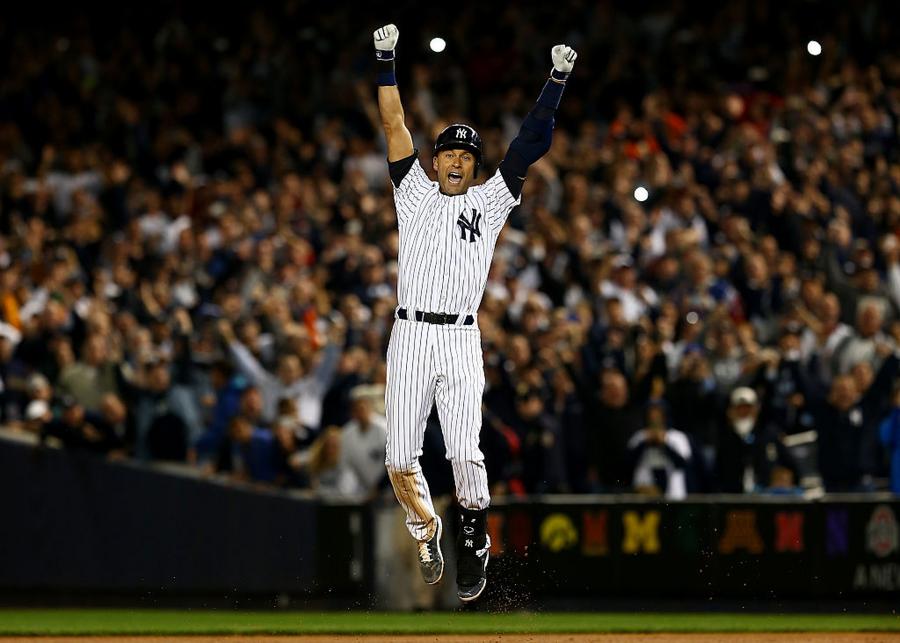
Elsa/Getty Images
Contracts and Income
As we stated previously, Derek Jeter earned $265 million in salary and $150 million from endorsements.
In 2001, Jeter signed a ten-year, $189 million contract to remain with the Yankees. In the 1995 season, he earned $5 million. In 2000, he earned $10 million. By the time that 10-year contract really kicked in, he was earning $20 million per season. His peak earnings came in 2010 when he earned $22.6 million.
In 2010, Derek signed a three-year $51 million deal with the Yankees. Ahead of the 2014 season he signed a one-year $12 million contract for his final MLB season.
At the peak of his career, between salary and endorsements, Derek Jeter earned $30 – $35 million.
Derek's success and clean-cut image attracted a number of very lucrative endorsement deals with companies like Nike, Gatorade, Discover Card, Fleet Bank, VISA, Ford, and XM Satellite Radio. He is considered one of the most marketable players in the history of baseball. He designed a cologne in collaboration with Avon named "Driven," which he also endorses.
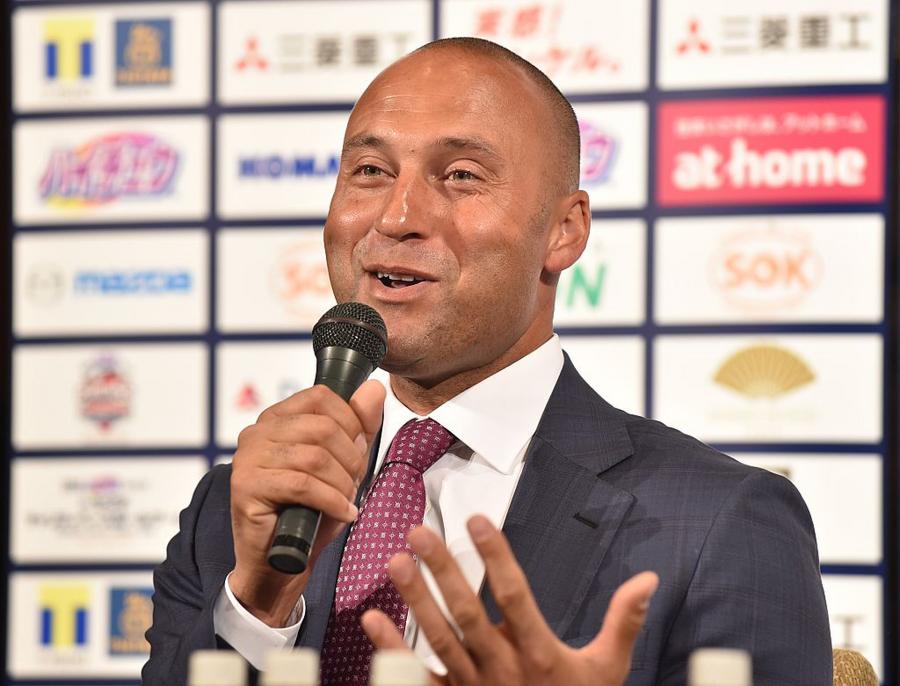
(KAZUHIRO NOGI/AFP/Getty Images)
Miami Marlins
In August 2017, Derek and a group of partners, notably Bruce Sherman, finalized a deal to acquire the Miami Marlins for $1.2 billion. Jeter reportedly paid $25 million, a discounted rate, for a 4% in the team.
Unfortunately, by 2021, the team's valuation had dropped to $990 million. At that level, Derek's 4% stake was worth $40 million. Still a gain over his $25 million investment, but not a great sign of things to come. In late February 2022 it was announced that Derek had severed his relationship with the Marlins and had sold his 4% stake back to his partners at a $1.12 billion valuation, the lowest team value in the entire league. When it was all said and done, Jeter paid $25 million for a stake that he sold five years later for $44.8 million.
Real Estate
Greenwood, New York: In 2005, Derek paid $1.2 million for a 4-acre historic property in the upstate town of Greenwood, New York. He proceeded to fully restore the property, which sits on 700 feet of lakefront. Derek's maternal grandfather actually grew up on the property. In 2018 Derek listed the property for sale for $14.75 million. The home went up for auction starting at $6.5 million in November 2022.
New York City: In 2001, Derek paid $12.72 million for an 88th-floor penthouse apartment in Trump World Tower on the East Side of Manhattan. He listed his apartment for sale in 2010 for $20 million. In October 2012, he sold it for $15.5 million. Here is a video tour of Derek's apartment, as it looked in December 2021 when the person he sold to listed it for $16.5 million:
Tampa, Florida: In 2011, Derek custom-built a 22,000-square-foot waterfront mansion in Tampa, Florida. To make room for the mansion, Derek bought three lots that had previously been apartments and smaller, modest single-family homes. The three lots combined total 1.26 acres of land. The two-story mansion has seven bedrooms, nine bathrooms, an entertainment room, a billiard room, a memorabilia room, and two three-car garages. The home became nicknamed "St. Jetersburg." When Tom Brady moved to Tampa to play for the Buccaneers, he and wife, Gisele Bundchen rented the home for $75,000 a month before they purchased their own mansion for $17 million.
Here's a video tour of St. Jetersburg:
In September 2020, Derek listed the home for $29 million. In May 2021, he sold the home for $22.5 million.
Miami, Florida: In April 2021, Derek paid $16.6 million for a 2-acre waterfront undeveloped lot in Coral Gables, Florida. The parcel has 325 linear feet of waterfront. While this mansion was being constructed, the Jeters lived in a different Coral Gables mansion, which he purchased in 2018 for $6.5 million.
/2009/09/Derek-Jeter.jpg)
/2019/12/as.jpg)
/2020/09/2020-09-21-4.jpg)
/2023/12/derek-jeter-bedroom.jpg)
/2017/08/GettyImages-598898034.jpg)
/2022/11/Screenshot-2022-11-16-092335.jpg)
/2020/04/2020-04-03.jpg)
/2017/04/GettyImages-464656278.jpg)
/2009/11/George-Clooney.jpg)
/2018/03/GettyImages-821622848.jpg)
/2009/09/Brad-Pitt.jpg)