
/2026/02/Ilia-Malinin.jpg)
/2010/02/GettyImages-168444963-e1733792727510.jpg)
/2016/04/GettyImages-453726155.jpg)
/2024/01/Alysa-Liu.jpg)
/2022/04/kamila.jpg)
/2020/06/taylor.png)
/2019/10/denzel-washington-1.jpg)
/2017/02/GettyImages-528215436.jpg)
/2009/09/Cristiano-Ronaldo.jpg)
/2020/02/Angelina-Jolie.png)
/2009/11/George-Clooney.jpg)
/2020/04/Megan-Fox.jpg)
/2020/01/lopez3.jpg)
/2009/09/Brad-Pitt.jpg)
/2019/04/rr.jpg)
/2018/03/GettyImages-821622848.jpg)
/2009/09/Jennifer-Aniston.jpg)
What is Ilia Malinin's net worth?
Ilia Malinin is an American Olympian who has a net worth of $1 million.
Ilia Malinin has become one of the most consequential figures in the history of men's figure skating, not only because of what he wins, but because of how completely he has altered the sport's ceiling. Universally known by his self-coined nickname "Quad God," Malinin has pushed technical difficulty to a place once considered theoretical, pairing unprecedented jump content with crowd-pleasing flair and rapidly improving artistry. His competitive dominance has been striking. He has assembled multi-year unbeaten streaks, captured consecutive world championships, and regularly separated himself from elite peers by margins that recall the peak of the Nathan Chen era. Yet Malinin's significance extends beyond the score sheet. He has shown an unusual awareness of skating as entertainment, deliberately adding non-scoring elements like backflips and signature transitions to energize audiences and broaden the sport's appeal. That blend of innovation, consistency, and showmanship has positioned him not just as the best skater of his generation, but as a potential crossover star whose influence could reshape figure skating's relevance for a younger, more global audience.
Early Life and Skating Pedigree
Ilia Malinin was born on December 2, 2004, in Fairfax, Virginia, into a family where elite skating was the norm rather than the exception. His mother, Tatiana Malinina, competed at the 1998 Winter Olympics for Uzbekistan and later won the Grand Prix Final. His father, Roman Skorniakov, represented Uzbekistan at the 1998 and 2002 Winter Games. His grandfather, Valery Malinin, competed for the Soviet Union and went on to coach for decades.
Despite that lineage, Malinin did not immediately gravitate toward skating. As a child, he preferred soccer and other activities, spending time at the rink largely because his parents were there. His commitment shifted once his jumping ability began to stand out. The moment skating became a vehicle for self-expression rather than inheritance, his trajectory accelerated rapidly.
Junior Success and Olympic Motivation
Malinin's first major international breakthrough came with his victory at the 2022 World Junior Championships. That triumph followed a controversial disappointment earlier that year, when he was left off the U.S. Olympic team. The decision was largely attributed to his youth and limited senior experience, not a lack of ability.
Rather than derailing him, the omission became fuel. Over the following quadrennial, Malinin focused on transforming his raw athleticism into a complete competitive arsenal, improving consistency while continuing to raise his technical ceiling.
Senior Dominance and World Titles
The transition to senior competition was swift. Malinin captured his first senior U.S. national title and quickly became a fixture atop the podium on the Grand Prix circuit. He went on to win multiple world championships, often by commanding margins, and built an extended unbeaten streak across international competition.
His scores began to approach and rival the highest marks ever recorded, signaling a generational shift. By this point, Malinin was no longer merely winning events. He was redefining what was considered competitive separation at the highest level of men's skating.
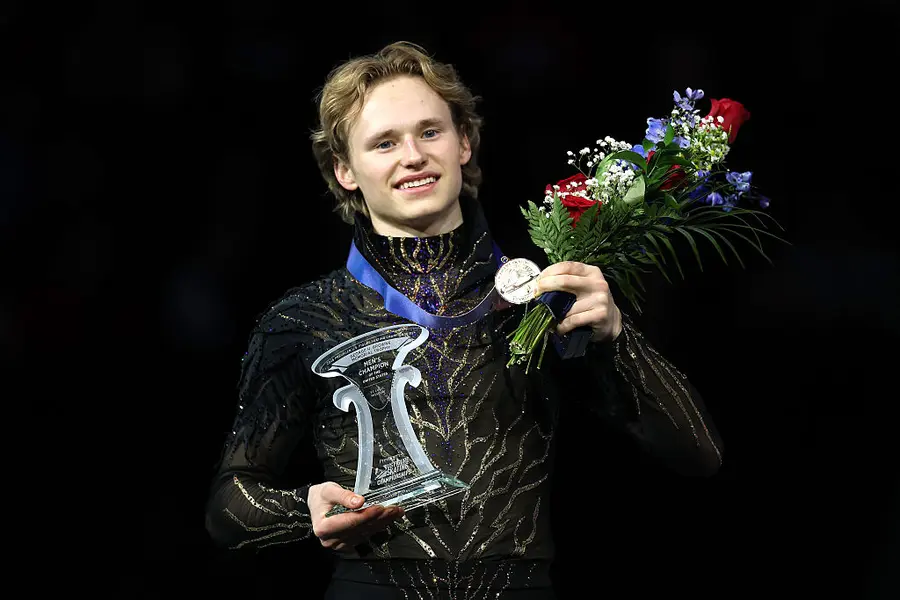
(Photo by Jamie Squire/Getty Images)
Technical Innovation and Signature Elements
Malinin's defining contribution to the sport has been his willingness to attempt elements others avoided. He became the first skater to land a quad axel in competition, a 4½-rotation jump long viewed as unattainable under pressure. He also became the only skater to land seven quadruple jumps in a single free skate, giving him a scoring ceiling far above his rivals.
Beyond jumps, Malinin introduced signature flourishes such as the "raspberry twist," a horizontal spin jump named after the translation of his Russian surname, and dramatic backflips that do not earn points but reliably electrify crowds. These choices reflect his stated goal of modernizing the sport and making skating a spectacle rather than a purely technical exercise.
Coaching and Artistic Development
A key evolution in Malinin's career came when he added Hall of Fame coach Rafael Arutyunyan to his team. Under Arutyunyan's guidance, Malinin refined his efficiency and competitive strategy while maintaining his aggressive technical identity. Choreographer Shae-Lynn Bourne helped develop his musicality and performance quality, ensuring that his programs carried sustained emotional engagement beyond the jumps.
Teammates and coaches consistently note his work ethic. Malinin is known for extended training sessions and a constant appetite for new challenges, rarely content to rely on what he has already mastered.
Endorsements and Earnings
By the time he reached his early twenties, Malinin had also become the most commercially valuable figure skater at the Winter Olympics. He earned roughly $700,000 over a 12-month span leading up to the 2026 Olympics, making him the highest-paid skater at the Games. His income has largely come from official Olympic sponsors, including Coca-Cola and Xfinity, with deals structured to limit overexposure and protect long-term value.
Central to his marketability is the "Quad God" nickname, which Malinin coined at age 13 after landing his first quadruple jump and later adopted as his social media identity. Marketing experts have described the nickname as instantly legible branding, offering casual viewers immediate context for what makes him special.
Incentive clauses tied to Olympic performance are expected to push his annual income past $1 million, with the potential for significantly larger endorsement growth if his Olympic performances resonate culturally. Comparisons have been drawn to athletes like Chloe Kim and Lindsey Vonn, who leveraged Olympic success into multimillion-dollar annual earnings.
Legacy in Progress
Still early in his career, Ilia Malinin has already altered the expectations of men's figure skating. His blend of extreme technical ambition, competitive consistency, and conscious showmanship has expanded both the sport's limits and its commercial possibilities. Whether measured by medals, innovation, or cultural impact, Malinin is no longer simply chasing history. He is actively writing it.
/2026/02/Ilia-Malinin.jpg)
/2010/02/GettyImages-168444963-e1733792727510.jpg)
/2016/04/GettyImages-453726155.jpg)
/2024/01/Alysa-Liu.jpg)
/2022/04/kamila.jpg)
/2014/03/GettyImages-893872736.jpg)
/2025/02/missing_profile.jpg)
/2013/03/Dorothy-Hamill-1.jpg)
:strip_exif()/2009/09/P-Diddy.jpg)
/2019/11/GettyImages-1094653148.jpg)