













What Is Jack Lambert's Net Worth?
Jack Lambert is a retired American professional football player who has a net worth of $2.5 million.
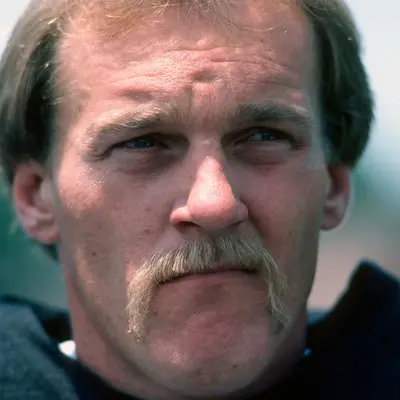
Jack Lambert is one of the greatest middle linebackers in NFL history and a defining figure of the Pittsburgh Steelers' 1970s dynasty. He spent his entire 11-season career with Pittsburgh, winning four Super Bowls as the fiercely competitive leader of its legendary "Steel Curtain" defense. Famous for his missing front teeth, intimidating stare, and relentless tackling, Lambert was also an exceptionally intelligent player whose speed and instincts allowed him to dominate against both the run and the pass. He was named NFL Defensive Rookie of the Year in 1974 and Defensive Player of the Year in 1976, earned nine consecutive Pro Bowl selections, and entered the Pro Football Hall of Fame in 1990. After retiring, he largely stepped away from the spotlight, choosing a private life in rural Pennsylvania over coaching or broadcasting.
Early Life
John Harold Lambert was born on July 8, 1952, in Mantua, Ohio. His parents divorced when he was young, and he spent much of his childhood working on his grandfather's farm. The experience helped develop his work ethic and physical toughness.
At Crestwood High School, Lambert played football, basketball, and baseball. He was a quarterback and defensive back on the football team, and during his senior basketball season he averaged 17.9 points and 13 rebounds. His famous toothless appearance also originated on the basketball court: a collision with a teammate during practice knocked out several upper front teeth. Lambert wore a dental bridge off the field but removed it for football games, creating the snarl that would become his trademark.
Kent State
Lambert attended Kent State University, where he began as a defensive end before moving to middle linebacker under coach Don James. At 6 feet 4 inches and 220 pounds, he was considered relatively light for the position, but his quickness and ability to anticipate plays made him an outstanding defender.
He helped Kent State win the 1972 Mid-American Conference championship, recording 233 tackles and earning MAC Defensive Player of the Year honors. The team reached the Tangerine Bowl, where Lambert was named its Most Valuable Player despite a loss. His Kent State teammates included future coaches Nick Saban and Gary Pinkel. Although major football programs had overlooked Lambert as a high school prospect, his college performance convinced professional scouts that his unusually tall, fast style could work at the NFL level. Lambert earned first-team All-MAC honors twice and finished college with 593 tackles. Kent State retired his No. 99 jersey in 1977.
Pittsburgh Steelers and Four Super Bowls
The Steelers selected Lambert in the second round of the 1974 NFL Draft, 46th overall. It was one of the greatest draft classes in league history: Pittsburgh also picked future Hall of Famers Lynn Swann, John Stallworth, and Mike Webster, while signing Donnie Shell as an undrafted free agent.
Lambert quickly won the starting middle linebacker job under coach Chuck Noll. Playing alongside defenders such as "Mean" Joe Greene, Jack Ham, and Mel Blount, he helped turn the Steelers into the NFL's dominant defensive team. Pittsburgh defeated the Minnesota Vikings in Super Bowl IX following the 1974 season, and Lambert was named Defensive Rookie of the Year.
The Steelers repeated as champions the following season, beating the Dallas Cowboys in Super Bowl X. That game produced one of Lambert's best-known moments. When Cowboys safety Cliff Harris mockingly patted Steelers kicker Roy Gerela on the helmet after a missed field goal, Lambert grabbed Harris and threw him to the ground. The confrontation came to symbolize the ferocity with which he defended his teammates.
In 1976, the Steelers started 1-4 before their defense produced one of the most remarkable stretches in NFL history. Over the final nine regular-season games, Pittsburgh surrendered just 28 points, recorded five shutouts, and won all nine contests. Lambert was named the NFL's Defensive Player of the Year.
Pittsburgh added two more championships following the 1978 and 1979 seasons, defeating Dallas in Super Bowl XIII and the Los Angeles Rams in Super Bowl XIV. Lambert's fourth-quarter interception against the Rams helped protect the Steelers' lead. Alongside offensive stars such as Terry Bradshaw and Franco Harris, Lambert became an essential part of a team that won four titles in six seasons.

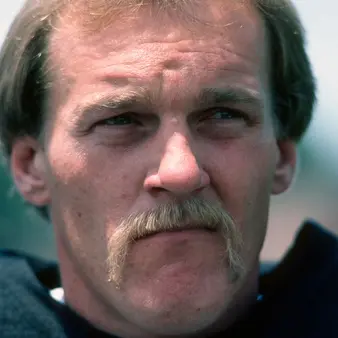
(Photo by George Gojkovich/Getty Images)
Playing Style and Career Achievements
Lambert's appearance made him instantly recognizable, but his success went far beyond intimidation. He could diagnose offensive plays before they developed, cover receivers downfield, and chase runners from sideline to sideline. Despite his lean build, he rarely backed down from bigger opponents. His ability to handle both conventional power running attacks and the NFL's expanding passing game made him particularly valuable to Pittsburgh. The Steelers relied on him not simply to deliver hits but to organize the defense and make split-second adjustments.
Across 146 regular-season games, he recorded 28 interceptions and recovered 17 fumbles. He was selected to nine consecutive Pro Bowls from 1975 through 1983, earned six first-team All-Pro honors and two second-team selections, and served as a Steelers defensive captain for eight seasons. In an era full of outstanding defensive players, Lambert became synonymous with the Steelers' hard-nosed identity.
Contracts and NFL Earnings
Lambert played at a time when even elite NFL stars earned a fraction of today's salaries. His biggest publicly documented contract came after a lengthy dispute in 1977. Having won Defensive Player of the Year the previous season, he was unhappy with his compensation and held out of training camp for 39 days, at one point requesting a trade.
The Steelers ultimately agreed to a five-year, $1.25 million deal. According to a 1984 "Sports Illustrated" profile, that agreement made Lambert the highest-paid defensive player in football at the time. A contemporary salary survey listed his 1978 earnings at $200,000, compared with $250,000 for teammate Franco Harris. The five-year agreement averaged $250,000 per season, at a time when NFL players did not receive anything approaching the salaries, endorsements, and lifetime commercial opportunities enjoyed by modern stars. Lambert's later contract details and precise career earnings have not been comprehensively disclosed.
Retirement and Life After Football
A serious injury to Lambert's left big toe during the opening game of the 1984 season effectively ended his career. The dislocation made it difficult to push off and change direction, limiting him to eight games that year. He announced his retirement in July 1985 at age 33, having spent his entire professional career with Pittsburgh. His exit came as the championship roster that had dominated the 1970s was gradually breaking apart, and he chose not to try extending his career with another team.
Unlike many retired football stars, Lambert resisted opportunities to become a broadcaster, coach, or regular television personality. He remained in western Pennsylvania, spending his time hunting, fishing, supporting youth sports, and serving as a volunteer deputy wildlife conservation officer. His desire for privacy became so pronounced that even former teammates sometimes struggled to reach him. He occasionally attended Steelers ceremonies but showed little interest in becoming a full-time celebrity or maintaining a high public profile.
Personal Life and Real Estate
Lambert married Lisa Harbison, a former Clemson University volleyball player, in the late 1980s. They have four children, and Lambert has devoted much of his post-football life to family and community activities.
His properties reflected his preference for the outdoors. During his playing career, he owned a home in Pittsburgh's Fox Chapel suburb and purchased 85 acres northeast of the city to establish a country retreat. By the 1990s, he was living with his family in a log cabin on a 125-acre property near Worthington, Pennsylvania. The wooded setting offered space for hunting and fishing and seclusion from the attention he attracted as a Steelers legend. Contemporary profiles described him as someone far more comfortable with outdoor work and time with family than with the promotional demands that followed his Hall of Fame career.
Hall of Fame and Legacy
Lambert was inducted into the Pro Football Hall of Fame in 1990, his first year of eligibility. He was selected to both the NFL's 1970s and 1980s All-Decade Teams, as well as its 75th and 100th Anniversary All-Time Teams. The Steelers inducted him into their Hall of Honor in 2017, and his high school named its football stadium in his honor.
His reputation rests on more than his missing teeth or the famous confrontation with Cliff Harris. Lambert combined exceptional football instincts, leadership, durability, and competitive intensity, helping anchor one of the greatest defenses and winningest dynasties in NFL history.