
/2011/12/Desmond-Howard.png)
/2013/01/Tony-Dorsett.jpg)
/2014/01/Doug-Williams.png)
/2015/09/Justin-Blackmon.jpg)
/2019/03/Jordy-Nelson.jpg)
/2012/10/Charles-Woodson.jpg)
/2009/09/Cristiano-Ronaldo.jpg)
/2019/10/denzel-washington-1.jpg)
/2020/01/lopez3.jpg)
/2009/11/George-Clooney.jpg)
/2020/02/Angelina-Jolie.png)
/2019/11/GettyImages-1094653148.jpg)
/2017/02/GettyImages-528215436.jpg)
/2020/06/taylor.png)
/2009/09/Brad-Pitt.jpg)
/2009/09/Jennifer-Aniston.jpg)
:strip_exif()/2009/09/P-Diddy.jpg)
What is Desmond Howard's net worth and salary?
Desmond Howard is an American football player who has a net worth of $10 million.
Desmond Howard is a former professional football player, Heisman Trophy winner, and longtime sports broadcaster whose career bridged elite college stardom, a Super Bowl–winning NFL role, and a successful second act in television. Howard first became a national name at the University of Michigan, where his electrifying playmaking ability, charisma, and signature "Heisman pose" made him one of the most recognizable athletes in college sports. Winning the Heisman Trophy in 1991 cemented his place in college football history and turned him into a high-profile NFL prospect.
Although his professional playing career never matched the dominance of his college years, Howard carved out a valuable niche in the NFL as a dynamic return specialist. His defining professional moment came with the Green Bay Packers during the 1996 season, when he delivered one of the most memorable performances in Super Bowl history and earned Super Bowl MVP honors. After retiring from football, Howard smoothly transitioned into broadcasting, becoming a prominent voice on ESPN's college football coverage. Over decades on television, he has remained a visible and influential figure in the sport, known for his insight, enthusiasm, and enduring connection to college football's biggest stages.
Early Life and College Career
Desmond Howard was born on May 15, 1970, in Cleveland, Ohio. He emerged as a standout athlete at St. Joseph High School, where his speed and versatility drew national recruiting attention. Howard chose the University of Michigan, a decision that placed him on one of college football's biggest stages at a time when the program was a perennial national contender.
At Michigan, Howard quickly developed into an elite wide receiver and return man. His junior season in 1991 became legendary. Howard scored touchdowns as a receiver, runner, and returner, consistently producing highlight-reel plays against top competition. He finished the season with 985 receiving yards, 19 total touchdowns, and countless momentum-shifting returns. His performance against Ohio State, punctuated by his end zone Heisman pose, became an enduring image of college football. Howard won the Heisman Trophy in a landslide, becoming Michigan's second winner and one of the most iconic players in program history.
NFL Career and Super Bowl Glory
Howard was selected fourth overall in the 1992 NFL Draft by the Washington Redskins. Expectations were enormous, but his early professional years were uneven. He spent time with Washington and later the Jacksonville Jaguars, contributing as a receiver and returner but struggling to establish himself as a consistent offensive star.
His career changed dramatically after signing with the Green Bay Packers in 1996. Used primarily as a kick and punt returner, Howard delivered one of the greatest special teams seasons in NFL history. He scored six return touchdowns during the regular season and remained a constant threat every time he touched the ball.
Howard's defining moment came in Super Bowl XXXI against the New England Patriots. He returned a kickoff 99 yards for a touchdown, becoming the first and only special teams player to win Super Bowl MVP. The performance transformed his legacy, elevating him from Heisman winner with an uneven pro career to a Super Bowl hero whose impact transcended traditional offensive statistics.
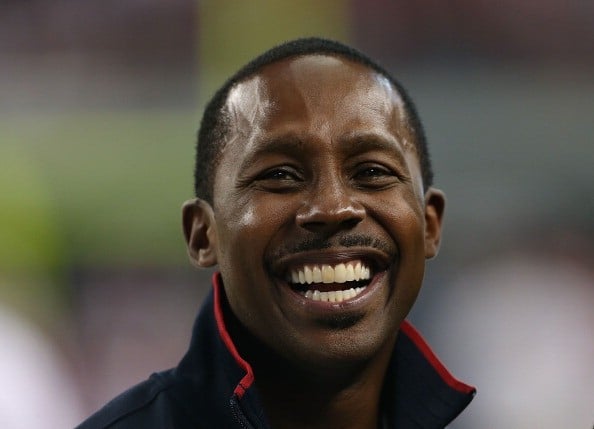
Leon Halip/Getty Images
Contracts, Salaries & Career Earnings
As the fourth overall pick in 1992, Howard signed a four-year, $5.9 million rookie contract with Washington—a significant sum for the era, highlighted by a $2.85 million signing bonus. While his offensive production struggled to meet high expectations, his elite return skills maintained his value.
In 1996, Howard signed a modest $300,000 one-year deal with the Green Bay Packers. His subsequent Super Bowl MVP performance is arguably the greatest single-season return on investment for a team in the 1990s. This breakout led to a four-year, $6 million free-agent contract with the Oakland Raiders in 1997.
Though his time in Oakland was short-lived, a late-career $5.7 million deal with the Detroit Lions helped bring his total NFL earnings to an estimated $12.25 million. While special teams players rarely saw such figures in that era, Howard's dual-threat capability and postseason heroics secured him a top-tier financial legacy, which has since been eclipsed by his long-standing success as a premier college football analyst.
Broadcasting Career and Media Presence
After retiring from professional football in 2002, Howard transitioned into television with remarkable ease. He joined ESPN and became a fixture on "College GameDay," serving as an analyst and commentator for major college football broadcasts. His role allowed him to reconnect with the sport where he first became famous, offering perspective shaped by both elite collegiate success and professional experience.
Howard's television persona blends enthusiasm, nostalgia, and institutional knowledge. He has covered national championship games, Heisman Trophy ceremonies, and playoff matchups, often drawing on his own experiences to contextualize modern college football. Over time, he became one of ESPN's most recognizable college football personalities, maintaining relevance across multiple generations of fans.
Legacy and Influence
Desmond Howard occupies a rare space in football history. Few players have been central figures in college football lore, delivered a Super Bowl–winning moment on the sport's biggest professional stage, and then built a decades-long media career. While his NFL statistics alone do not tell the full story, his impact on the game is undeniable.
At Michigan, he remains a symbol of excellence and swagger during one of the program's most celebrated eras. In the NFL, his Super Bowl MVP performance stands as a testament to the importance of special teams and game-changing moments. As a broadcaster, Howard has shaped how college football is discussed and presented to millions of viewers, extending his influence well beyond his playing days.
/2011/12/Desmond-Howard.png)
/2012/10/Charles-Woodson.jpg)
/2014/12/GettyImages-113458953.jpg)
/2022/02/Cooper-Kupp.png)
/2014/01/Doug-Williams.png)
/2018/08/Davante-Adams.jpg)
/2015/01/GettyImages-462415518.jpg)
/2020/04/Megan-Fox.jpg)
:strip_exif()/2015/09/GettyImages-476575299.jpg)
/2019/04/rr.jpg)
/2018/03/GettyImages-821622848.jpg)