
/2019/11/Magic-Johnson.jpg)
/2009/12/Larry-Bird.jpg)
/2018/11/Michael-Cooper.jpg)
/2013/12/cookie-johnson-1.jpg)
/2022/03/anthony-davis.png)
:strip_exif()/2020/04/michael.jpg)
/2010/01/Ina-Garten-1.jpg)
/2023/03/Matt-Cameron.jpg)
/2020/10/garten.png)
/2013/09/js.jpg)
/2010/12/GettyImages-489914609.jpg)
/2009/12/George-Strait.jpg)
/2018/01/Sid-Wilson.jpg)
/2023/05/Jelly-Roll.jpg)
/2013/03/Catherine-Zeta-Jones.jpg)
/2009/12/Denise-Richards.jpg)
/2016/12/Nico-Rosberg.jpg)
What is Magic Johnson's net worth, salary, and career earnings?
Earvin "Magic" Johnson Jr. is a retired American basketball player and entrepreneur who has a net worth of $800 million. After winning basketball championships in high school and college, he was selected the first overall player in the 1979 NBA Draft by the Los Angeles Lakers. He played point guard for the Lakers for 13 seasons. He won the NBA Championship and the NBA Finals Most Valuable Player Award in his rookie season. Johnson is the former president of basketball operations for the Lakers.
Magic Johnson's NBA career began when he was drafted as the first overall pick by the Los Angeles Lakers in the 1979 NBA Draft. Over his 13-year career with the Lakers, he played in 12 All-Star Games, won five NBA championships, and was awarded the NBA Most Valuable Player (MVP) title three times. Known for his incredible versatility, Johnson played all five positions during the NBA Finals and helped to redefine the point guard role with his unique blend of size and court vision. His on-court rivalry with Larry Bird is considered one of the greatest in basketball history, elevating the popularity of the sport during the 1980s.
After retiring from basketball in 1991 due to his HIV diagnosis (though he did make a brief comeback in 1996), Johnson did not step away from the spotlight. Instead, he redirected his focus towards business and entrepreneurship. He founded Magic Johnson Enterprises, a conglomerate that invests in various industries such as entertainment, real estate, and healthcare.
One of Johnson's most significant entrepreneurial successes was his partnership with Starbucks CEO Howard Schultz to open Starbucks stores in underserved urban areas. This venture not only proved profitable but also provided jobs and increased investment in communities often overlooked by major corporations.
Johnson's involvement in sports did not end with his playing career. He has been part of ownership groups for several sports franchises, including a significant stake in the Los Angeles Dodgers and the Los Angeles Sparks of the WNBA. His influence also extends to his work as an ambassador for HIV/AIDS awareness and prevention.
Did Magic Johnson Turn Down A $5 Billion Nike Deal?
There is a popular legend, which was repeated in a season 2 episode of the HBO series "Winning Time: The Rise of the Lakers Dynasty," that Magic Johnson turned down an offer from Nike in the late 1970s that would have made him a multi-billionaire.
According to the legend, in mid-1979, hot off winning the NCAA Final with Michigan State (he defeated Larry Bird and Indiana State), Magic was approached by all the big-name shoe companies with lucrative offers. The most obvious choice was Converse, which offered to pay Magic $100,000 per year. That's the same as around $420,000 today.
As Magic has reported in a number of interviews over the years, he claims Nike founder Phil Knight approached him to wear the upstart company's sneakers in a deal that would not have included much cash (because Nike didn't have much cash back then).
"When I first came out of college, all the shoe companies came after me. There was this guy, Phil Knight, who just started Nike. So he said something about stocks. 'I'm gonna give you a lot of stocks.' I didn't know nothing about stocks."
According to the latest version of the legend, the deal would ultimately award Magic 100,000 shares of Nike. And when this story was repeated in the episode of "Winning Time," it was stated that by 2023, those shares would have been worth $5.2 billion. The legend has positioned it as though Nike offered 100,000 shares to match Converse's $100,000 offer. Winning Time also claimed that Magic would have also earned $1 per shoe sold.
As Magic himself tells it, being from the inner city, he didn't know anything about stocks, so he rejected the offer.
"Boy, did I make a mistake. I'm still kicking myself. Every time I'm in a Nike store, I get mad. I could've been making money off of everybody buying Nikes right now…
I would have been a trillionaire by now," Magic said. "You think about in 1979 getting that stock then and what it's worth today. Yikes. That kills me every single time I think about that. And I'm like man, Michael Jordan would be making me so much money…"
But is the legend even true? Ehhh… probably not.
In reality, Magic had already signed with Converse by July 1979. That was just four months after he won the NCAA Championship and just a few weeks after his Sophomore year ended and he decided to turn professional.
Also, Nike wasn't yet a public company in mid-1979. Nike went public more than a year later, on December 12, 1980. That's not to say Magic couldn't have been offered private shares in the pro-IPO Nike, but it does seem highly unlikely that Phil Knight would have made this offer. Also, consider that today, Phil Knight is worth around $40 billion. That makes him one of the 30 richest people in the world. Does it seem realistic that Nike would have offered an amount of private shares in Nike that mathematically would have been equal to around 12.5% of the founder's stake?
Finally, it is generally known that Michael Jordan's deal with Nike a few years later was the very first time Nike had offered any athlete stock or a percentage of sales of its shoes.
All-in-all, this story is, unfortunately, likely fiction.
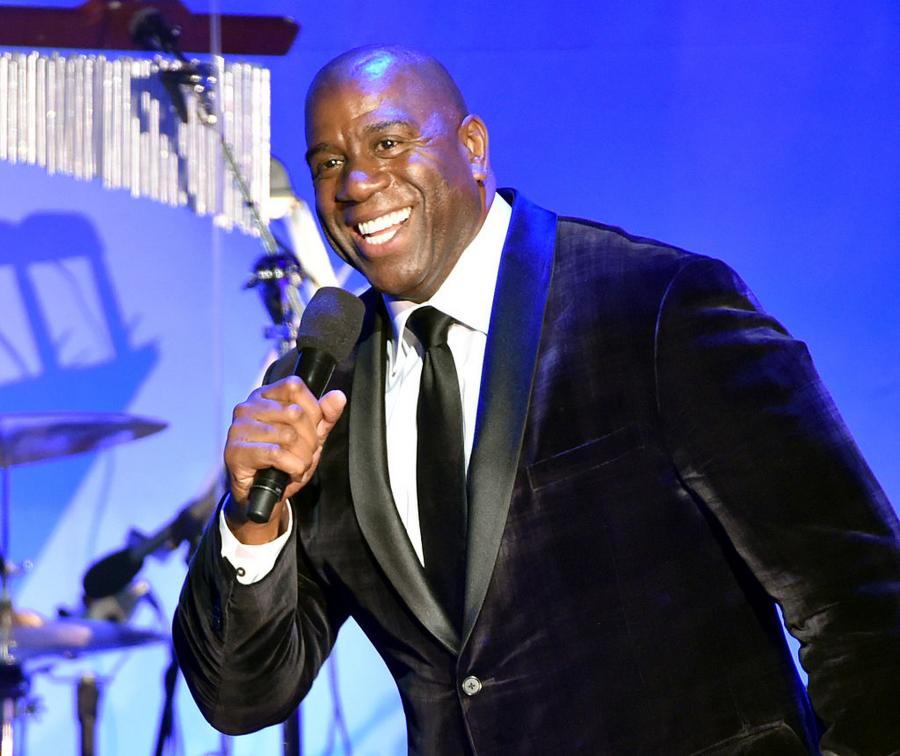
(Kevin Winter/Getty Images)
Early Life
Magic Johnson was born on August 14th, 1959, in Lansing, Michigan. His father, Earvin Sr., worked on a General Motors assembly line, and his mother, Christine, was a school janitor. Magic fell in love with basketball at an early age, watching his heroes like Earl Monroe. Johnson went to Everett High School, where he joined the basketball team as quickly as he could. A local sportswriter coined the nickname "Magic" when, at the age of 15, he scored a triple-double with 36 points, 18 rebounds, and 16 assists. The name was solidified his senior year when he led his team to the state championship.
Johnson had offers from every single high-profile college but decided to stay close to home and attend Michigan State University. In 1979, Magic led his team to the NCAA finals, where they faced Indiana State University and their star player Larry Bird. Their face-off became the most-watched college basketball game ever televised and launched one of the greatest rivalries in sports history. Michigan State went on to defeat Indiana and Johnson was named Most Outstanding Player of the Final Four.
NBA Career
Magic was the first overall pick of the 1979 draft, chosen by The Los Angeles Lakers. In his rookie season, Magic and teammate Kareem Abdul-Jabbar led the Lakers to the NBA championship, where Magic was named the MVP of the NBA Finals. Magic won five NBA Championships with the Lakers in the years 1980, 1982, 1985, 1987, and 1988. He was the three-time NBA Finals MVP in 1980, 1982, and 1987. He was the three-time NBA Most Valuable Player in 1987, 1989, and 1990. He went to the All-Star game 12 times and was a two-time MVP of the All-Star game. He is considered the greatest point guard of all time.
Magic's career was cut short by his 1991 contraction of the HIV.
Magic returned to the NBA as the coach of the Lakers near the end of the 1993-94 NBA season. He replaced Randy Pfund and Bill Bertka at the urging of team owner Jerry Buss. The Lakers played well under Johnson's coaching initially, winning five of their first six games, but after losing the next five games, Johnson announced that he was resigning as coach after the season. The Lakers finished the season on a ten-game losing streak, and Johnson's final record as a head coach was 5–11. He said that it was never his dream to coach, so instead, he purchased a 5% share of the team in June 1994.
During the 1995-96 season, then 36-year-old Magic Johnson attempted a comeback as a player and re-joined the Lakers for that season. The Lakers had a record of 22–10 in the games Johnson played, and he considered his final comeback "a success."After the Lakers lost to the Houston Rockets in the first round of the playoffs, Johnson retired permanently.
In 905 NBA games, Johnson tallied 17,707 points, 6,559 rebounds, and 10,141 assists for career averages of 19.5 points, 7.2 rebounds, and 11.2 assists per game, the highest assists per game average in NBA history. Johnson shares the single-game playoff record for assists (24), holds the Finals record for assists in a game (21), and has the most playoff assists (2,346). He is the only player to average 12 assists in an NBA Finals series, achieving it six times. He holds the All-Star Game single-game record for assists (22) and the All-Star Game record for career assists (127).
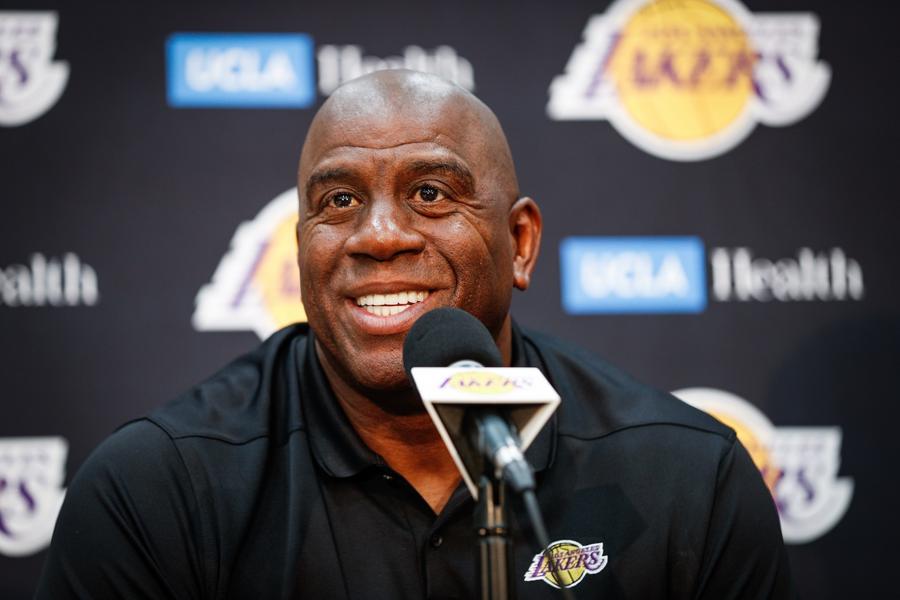
Meg Oliphant/Getty Images
Retirement
After announcing his infection in November 1991, Johnson created the Magic Johnson Foundation to help combat HIV. Johnson has been an advocate for HIV/AIDS prevention and safe sex, as well as an entrepreneur, philanthropist, and broadcaster. His public announcement of his HIV-positive status in 1991 shocked the public and went a long way toward dispelling the stereotype at the time that HIV was a "gay disease" that heterosexuals didn't have to worry about.
Magic the Entrepreneur
It has not been a quiet retirement for Magic. In retirement, he launched a business empire called Magic Johnson Enterprises that is valued at over $1 billion today and has given Magic a personal net worth of $600 million. Magic Johnson Enterprises owns Magic Johnson Theaters, a movie studio, and a promotional marketing company. In 1994, Magic paid $10 million to buy 5% of The Lakers, which he sold in 2010 to billionaire Patrick Soon-Shiong for a reported $50-60 million. In 2010 Johnson also sold his chain of Starbucks for $75 million.
On March 27, 2012, Magic and a group of partners purchased The Los Angeles Dodgers from Frank McCourt for $2 billion. More info here: Magic Johnson Buys The Dodgers for $2 Billion
In 2014, Johnson was involved in the purchase of the Los Angeles Sparks WNBA team. He also announced his co-ownership of the Major League Soccer expansion franchise, Los Angeles Football Club.
In 2015, Johnson acquired a controlling interest in EquiTrust Life Insurance Company, which manages $14.5 billion in annuities, life insurance, and other products.
In 2023, Magic was part of an investment group led by Josh Harris that bought the Washington Commanders of the NFL for $6.05 billion.
Magic Johnson is an investor in aXiomatic eSports, the ownership company of Team Liquid.
Personal Life
Johnson married Earlitha "Cookie" Kelly, today known as Cookie Johnson, in a small ceremony in Lansing, Michigan, in 1991. The couple has a son, Earvin III (aka E.J. Johnson), born in 1992. EJ appeared on the reality TV show Rich Kids of Beverly Hills. Magic and Cookie adopted their daughter Elisa in 1995. Johnson and his wife live in Dana Point, California, and Beverly Hills.
Johnson also has a son from a former relationship. In 1981, Andre Johnson was born to Melissa Mitchell. Andre was raised by his mother, but he spent time with Johnson every summer and later worked as a marketing director for Magic Johnson Enterprises.
Salary Highlights
During his playing career, Magic earned just over $18 million in salary and several million more in endorsements.
Real Estate
Magic Johnson and his wife own a home in Beverly Hills in the gated section known as Beverly Park. The couple also owns a Tuscan style beach house in Dana Point, in Orange County, California. The couple used to own a house in Napili, Hawaii, but it was too far to get to when their children were growing up, so they swapped it for the beach house located about 75 miles south of Beverly Hills.
Johnson's Bel-Air estate, which he called home from 1981 through 1990, hit the market in 2022 for $14.5 million before being reduced to $11.5 million in 2023. Magic Johnson originally bought the home for $600,000 the year after winning his first NBA championship and sold it for $2 million.
/2019/11/Magic-Johnson.jpg)
/2009/12/Larry-Bird.jpg)
/2023/09/magic-johnson-nike.jpg)
/2018/06/GettyImages-959637218.jpg)
/2012/03/GettyImages-474927319.jpg)
/2023/03/GettyImages-1474223316.jpg)
/2015/09/magic.jpg)