
Floyd Mayweather has filed one of the most explosive financial lawsuits ever brought by a professional athlete, accusing Showtime Networks and former Showtime Sports president Stephen Espinoza of helping divert hundreds of millions of dollars from his fight earnings.
The 25-page complaint, filed in California state court, alleges that Mayweather was systematically deprived of at least $340 million from his career purses through what the lawsuit describes as a long-running scheme of financial manipulation, hidden accounts, and deliberately obscured records. The filing does not name Mayweather's longtime adviser Al Haymon as a defendant, but repeatedly describes him as the architect of the alleged scheme.
We covered the lawsuit with an article earlier today. That previous coverage, which can be found here, was largely based on reporting from other outlets like TMZ that actually read the full lawsuit. Given how stunning the claims were, and given that Floyd Mayweather has probably been the most searched, debated, and controversial figure in Celebrity Net Worth history, I decided I needed to read the full complaint myself.
You might assume that would be easy. It was not.
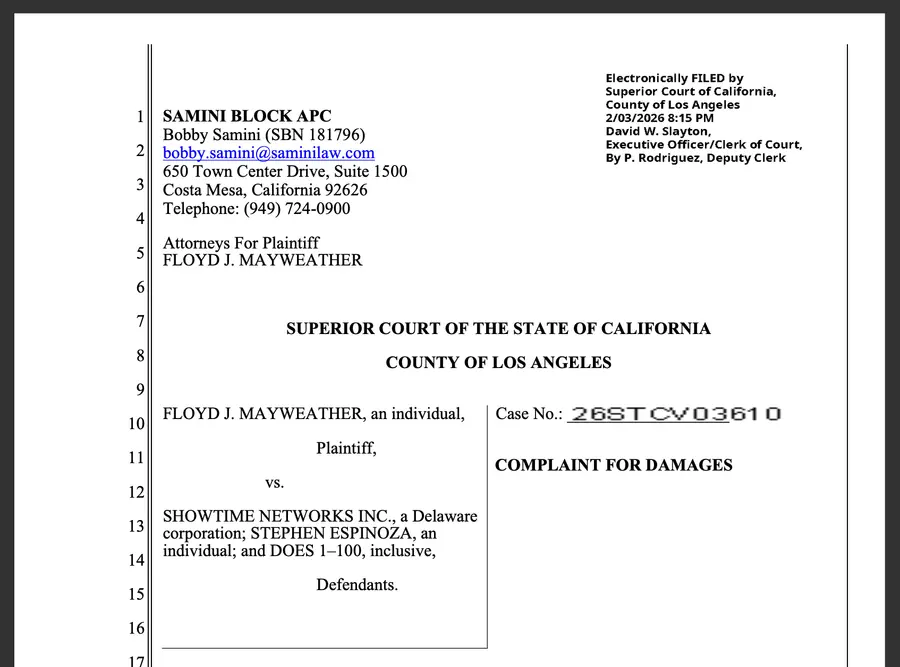
First, the Los Angeles County court system charges $5 just to search for a case. Fine. I paid the fee, got the case number, and figured I was home free. Nope. Once you locate the case, you then have to pay an additional $14 just to download the actual filing. Fourteen dollars. Nineteen dollars all-in. To download a PDF. From a government-run public court system. Someone needs to file a lawsuit over this system. Where is this money going? What is it funding? This is outrageous. I could have bought lunch at Five Guys!
But I paid it. And after reading all 25 pages of the complaint, I actually think it might have been money well spent…

Bryan Steffy/Getty Images for Clear Channel
The Core Claim: $340 Million Is "Missing"
At the heart of the lawsuit is the allegation that at least $340 million of Mayweather's fight earnings are "missing and unaccounted for" out of roughly $1.2 billion in total career purses. The complaint repeatedly emphasizes that this figure is conservative and does not include lost investment growth or interest.
From the lawsuit:
"Mayweather was systematically deprived of a significant portion of his career earnings — at least $340 million (and potentially far more when accounting for lost investment growth)."
According to the filing, Mayweather believes that if the allegedly misappropriated funds had been invested conservatively, their value today could be several times higher. He is seeking not only recovery of the principal amount, but also additional damages tied to the lost use of that money.
The lawsuit makes a point that cannot be overstated: this case is not just about money Floyd Mayweather did not receive. It is about what he lost the ability to do with that money.
According to the complaint, had Mayweather received and controlled those funds when they were earned, even a conservative investment strategy would likely have multiplied the value dramatically over the past decade.
From the lawsuit:
"Conservative investment of those funds would likely have made that sum worth several billion today."
In other words, the lawsuit treats missed investment opportunity as a central category of damages, not merely an afterthought.
How The Money Was Allegedly Routed
The lawsuit claims that instead of being paid directly to Mayweather or accounts under his sole control, large portions of his fight earnings were wired into third-party bank accounts controlled by individuals chosen by Haymon.
One account repeatedly cited in the complaint is held at First Security Bank of Nevada in the name of a tax attorney who allegedly acted at Haymon's direction. Mayweather claims he did not have meaningful access to or oversight of these accounts, even though they received revenue from some of the biggest pay-per-view events in boxing history.
From the lawsuit:
"Fight proceeds were routed into secret accounts that Mayweather did not know about or have access to."
The filing argues that this structure effectively placed control of Mayweather's earnings in the hands of others while keeping him in the dark about the true flow of funds.
The lawsuit also provides important context about Haymon's compensation. Rather than taking the roughly 33% cut common for boxing managers, Haymon allegedly entered into a verbal agreement in 2004 to receive 10% of Mayweather's earnings. That arrangement, according to the complaint, continued for more than 15 years despite never being formalized in writing, making the scale of the alleged transfers especially jarring if true.
Tens of Millions Sent To Haymon-Linked Entities
According to banking records cited in the lawsuit, tens of millions of dollars were allegedly transferred from these accounts to companies controlled by Haymon, including an entity called Alan Haymon Development.
The transfers were reportedly labeled with vague descriptions such as "repayment," "loan payoff," or "expenses." Mayweather claims he never received loans from Haymon and never authorized repayments or fees anywhere near this scale.
From the lawsuit:
"These transfers were falsely labeled as 'repayment' or 'loan payoff,' despite the fact that Mayweather never received such loans."
In addition, the complaint describes a series of one-off payments in the $3 million to $15 million range, made on dates unrelated to any fight, with little or no explanation provided to Mayweather. According to the filing, those transfers were often short tens of millions of dollars by the time the money ultimately reached Mayweather, a gap the lawsuit attributes to unauthorized deductions.
The Pacquiao Fight And The "Slush Fund" Allegation
One of the most striking allegations involves the 2015 Manny Pacquiao fight, the highest-grossing bout in boxing history. The lawsuit claims that revenue from that fight was improperly used to cover unrelated obligations, including a $20 million payout tied to the Andre Berto fight later that year.
According to the complaint, that $20 million should not have been deducted from Mayweather's Pacquiao earnings and effectively turned the Pacquiao revenue pool into a slush fund used to pay other expenses. Mayweather alleges that Showtime still owes him that $20 million.
The filing also alleges that tens of millions of dollars in expenses were charged against the Pacquiao and McGregor fights without adequate documentation.
Missing Records And The "Lost In A Flood" Explanation
When Mayweather's new management team requested detailed financial breakdowns in 2024, the lawsuit claims they were told that key records for major fights were either lost in a flood or stored off-site and inaccessible.
From the lawsuit:
"Critical financial records for Mayweather's biggest fights were claimed to be 'lost due to a flood' or otherwise inaccessible."
The complaint further alleges that Haymon intentionally avoided leaving a paper trail, conducting business largely through faxes and in-person meetings rather than electronic communication, specifically to limit documentation.
In one example cited in the filing, Mayweather's representatives point to a faxed authorization form that appears to have been manually altered to conceal wrongdoing. The document allegedly included a notation that was later crossed out before being
Showtime's Alleged Role
The lawsuit does not portray Showtime as a passive bystander. Instead, it alleges that the network acted as a financial conduit, knowingly wiring Mayweather's earnings into accounts not controlled by him, failing to provide required accounting, and ignoring red flags that should have triggered scrutiny.
The complaint also highlights that Espinoza later went on to work with Haymon after Showtime exited the boxing business, a fact Mayweather's legal team cites as evidence of aligned interests.
What Mayweather Is Asking For
Mayweather is seeking:
- compensatory damages exceeding $340 million,
- recovery of the allegedly misappropriated funds,
- a full forensic accounting,
- a constructive trust over traceable assets,
- and punitive damages that could equal or exceed the compensatory amount.
He has also demanded a jury trial.
What is Floyd Mayweather's Net Worth Today?
That's the $1.2 billion question. How rich would you be today if you were a Nevada resident (no income tax state) who has earned $1.2 billion over your career? Hopefully you'd be worth at least $500 million, right? And up until recently, we generally estimated Floyd Mayweather's net worth to be in the $300-400 million range (Floyd is a famously BIG SPENDER on cars, jewelry, private jets, and gambling. But if he did not actually receive roughly a quarter of his earnings? And combine that with Business Insider's report last month on some very alarming questions about Floyd's potentially wobbly finances… Honestly, it's almost impossible to say what kind of fortune Floyd actually has right now. Hopefully, we'll learn more in the lawsuit! Speaking of which, here's what Floyd's lawsuit had to say about rumors and allegation about his finances:
"The revelation that he was defrauded out of hundreds of millions… has fueled false rumors that he was 'broke,' causing reputational harm and mental anguish."
/2018/07/GettyImages-1000990700.jpg)
/2021/07/floyd2.jpg)
/2015/09/floyd21.jpg)
/2015/09/bert2.jpg)
/2013/09/GettyImages-171447994.jpg)
/2019/11/GettyImages-1094653148.jpg)
/2009/09/Brad-Pitt.jpg)
/2009/11/George-Clooney.jpg)
:strip_exif()/2015/09/GettyImages-476575299.jpg)
:strip_exif()/2009/09/P-Diddy.jpg)
/2020/06/taylor.png)
/2020/04/Megan-Fox.jpg)
/2020/02/Angelina-Jolie.png)
/2019/04/rr.jpg)
/2009/09/Jennifer-Aniston.jpg)
/2020/01/lopez3.jpg)
/2009/09/Cristiano-Ronaldo.jpg)
/2017/02/GettyImages-528215436.jpg)
/2018/03/GettyImages-821622848.jpg)
/2019/10/denzel-washington-1.jpg)