
When the calendar flips to March, college basketball transforms from a regional passion into a national obsession. The NCAA Tournament becomes a three-week pressure cooker where legends are made, Cinderella stories emerge, and millions of brackets are instantly thrown into chaos.
But behind the buzzer beaters and upsets, there's another high-stakes game playing out off the court: the battle to secure and retain elite coaching talent.
In today's era of the transfer portal, NIL deals, and constant roster turnover, a great head coach is no longer just a luxury. It's the single most important competitive advantage a program can have. Universities are spending more than ever to lock in leaders who can recruit, adapt, and consistently navigate the chaos of March.
As the 68-team field tips off in the 2026 NCAA Tournament, we're taking a look at the men pacing the sidelines. These are the 10 highest-paid coaches in this year's March Madness, and their salaries show exactly what it costs to compete for a national title.
One notable absence from this list is Auburn's Bruce Pearl, who earns roughly $6 million annually. In our ranking below, that would have ranked him as the 7th highest-paid coach at March Madness. Unfortunately, Auburn did not qualify for this year's NCAA Tournament 🙁
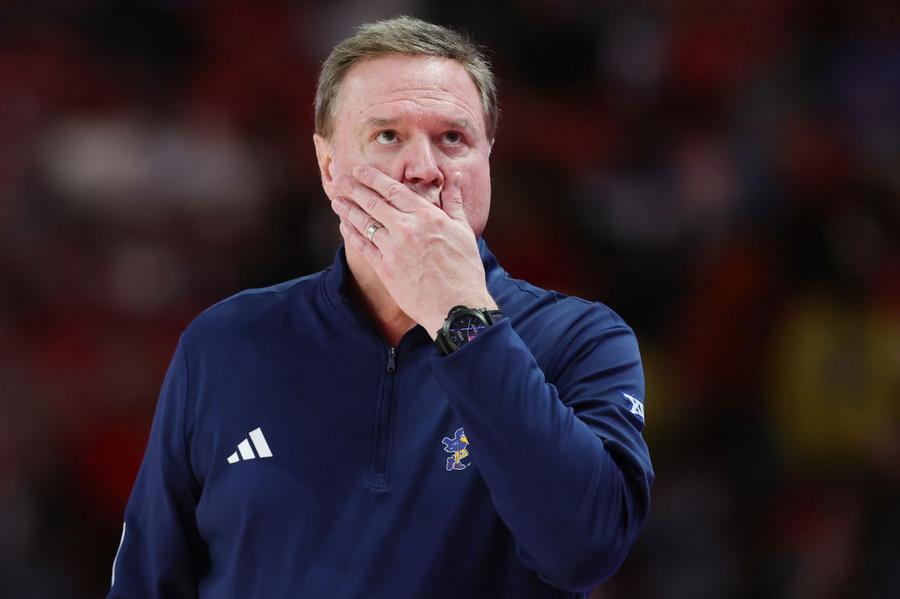
Bill Self (Alex Slitz/Getty Images)
The 10 Highest-Paid Coaches At The 2026 March Madness Tournament
1. Bill Self – Kansas ($8.8 million)
Bill Self once again sits at the top of the college basketball pay scale, thanks to a unique lifetime agreement with Kansas that functions as a rolling five-year contract. The deal was reworked in 2023 following his national championship run, and while his annual compensation dipped slightly from its peak, he remains the sport's highest earner.
Self's résumé backs up the price tag. He has won two national championships (2008, 2022), reached four Final Fours, and has never missed the NCAA Tournament during his Kansas tenure.
His $8.8 million salary is heavily incentive-driven, with significant bonuses tied to NCAA Tournament success. The contract also includes a $23.1 million buyout, making it extremely difficult for any rival program to lure him away.
2. John Calipari – Arkansas ($8.0 million)
John Calipari shook up the college basketball world in 2024 when he left Kentucky for Arkansas, one of the most surprising coaching moves in recent memory.
Calipari brings a championship pedigree with one national title (2012) and six Final Four appearances, along with a reputation as one of the most dominant recruiters in modern college basketball.
Arkansas rewarded him with a five-year deal running through 2029. His compensation includes a $500,000 base salary supplemented by $7.5 million in additional income tied to media, endorsements, and program incentives.
3. Dan Hurley – UConn ($7.78 million)
Dan Hurley has quickly become the defining coach of the current era after leading UConn to back-to-back national championships in 2023 and 2024.
During those runs, his teams dominated the tournament field with a string of double-digit victories, reinforcing his reputation as a March powerhouse.
Hurley leveraged that success into a massive contract extension running through 2031. The deal includes the largest buyout in college basketball and came after he turned down a reported $70 million offer from the Los Angeles Lakers.
4. Todd Golden – Florida ($6.75 million)
Todd Golden represents the new generation of high-priced coaches. His rapid rise culminated in Florida's 2025 national championship.
That title run validated his analytics-driven coaching style and immediately elevated his market value across the sport.
Florida responded by locking him into a lucrative extension that pushed his annual salary to $6.75 million, positioning him among the highest-paid coaches in the country.
5. Tom Izzo – Michigan State ($6.2 million)
Tom Izzo's contract reflects something rare in modern college athletics: long-term loyalty combined with sustained excellence.
Known as "Mr. March," Izzo has reached eight Final Fours and won a national championship in 2000, consistently getting his teams to peak at tournament time.
His $6.2 million salary serves as both compensation for decades of success and a retention tool to keep one of the sport's most respected coaches in East Lansing.
6. Mick Cronin – UCLA ($6.1 million)
Mick Cronin has steadily rebuilt UCLA into a consistent national contender.
His breakthrough came with a Final Four run in 2021, when the Bruins advanced from the First Four and captured national attention with their resilience.
Cronin's current $6.1 million salary reflects UCLA's commitment to maintaining that success, particularly as the program navigates the transition into the Big Ten.
7. Rick Barnes – Tennessee ($5.7 million)
Rick Barnes has quietly transformed Tennessee into a perennial contender over the past decade.
He reached the Final Four in 2003 and has consistently positioned his teams for deep tournament runs with disciplined, veteran leadership.
His contract is structured with strong performance incentives tied to SEC success and NCAA Tournament progression, bringing his annual earnings to approximately $5.7 million.
8. Scott Drew – Baylor ($5.41 million)
Scott Drew's salary reflects one of the most impressive rebuilds in modern college basketball history.
He guided Baylor from a struggling program to a dominant national championship in 2021, cementing his reputation as one of the sport's top program architects.
Baylor has repeatedly increased his compensation to fend off interest from other schools, most notably during the 2024 coaching carousel.
9. Tommy Lloyd – Arizona ($5.25 million)
Tommy Lloyd's rapid ascent has been matched by a rapidly increasing salary.
While still chasing his first Final Four appearance, he has already led Arizona to multiple Sweet 16 runs and secured several No. 1 seeds in a short span.
His current deal runs through 2030 and includes annual raises that will push his salary to $6 million by the end of the contract.
10. Nate Oats – Alabama ($5.02 million)
Nate Oats has transformed Alabama into one of the most modern and dynamic programs in college basketball.
He led the Crimson Tide to their first-ever Final Four in 2024, proving his fast-paced, analytics-driven system can succeed deep into March.
His current salary sits just above $5 million, but built-in raises will increase his annual pay to $7.55 million by the end of his deal in 2030.
The Bigger Picture
If March Madness proves anything year after year, it's that money alone can't buy a championship. A multimillion-dollar salary doesn't guarantee protection from a first-round upset or a red-hot underdog.
What these contracts do provide is something far more valuable: consistency, elite recruiting infrastructure, and a much higher probability of playing deep into the tournament.
Each of these coaches has demonstrated the ability to win at the highest level, and their schools are paying for both proven results and future potential. Over the next few weeks, those investments will be put to the test. Some will justify every dollar. Others will be heading home much earlier than expected.
/2015/12/GettyImages-866834546.jpg)
/2010/07/Bill-Self.jpg)
/2015/03/CNW-Man.png)
/2023/11/GettyImages-1472008054.jpg)
/2022/04/GettyImages-164567869.jpg)
/2021/04/GettyImages-930224924.jpg)
/2017/02/GettyImages-528215436.jpg)
:strip_exif()/2015/09/GettyImages-476575299.jpg)
/2020/01/lopez3.jpg)
:strip_exif()/2009/09/P-Diddy.jpg)
/2020/04/Megan-Fox.jpg)
/2009/09/Brad-Pitt.jpg)
/2019/11/GettyImages-1094653148.jpg)
/2009/09/Jennifer-Aniston.jpg)
/2019/04/rr.jpg)
/2018/03/GettyImages-821622848.jpg)
/2009/11/George-Clooney.jpg)
/2020/02/Angelina-Jolie.png)
/2009/09/Cristiano-Ronaldo.jpg)
/2020/06/taylor.png)
/2019/10/denzel-washington-1.jpg)