
On New Year's Day 2026, in the quiet, wooded stretches of northeastern Pennsylvania, a routine traffic stop produced a headline that felt both shocking and entirely predictable. Inside the 2015 GMC Sierra was Lenny Dykstra, once one of the most famous and ferocious players in Major League Baseball. State police said they discovered narcotics and drug paraphernalia during the stop. Charges were expected. Dykstra's attorney quickly went on the record to say the drugs were not his and emphasized that his client was merely a passenger in the car. No matter how the case ultimately resolves, the damage was already done. Another arrest. Another police report. Another reminder that one of baseball's great rise-and-fall stories is still unfolding in real time.
For most former athletes, a brush with the law in their sixties would be a stunning anomaly. For Dykstra, it fit seamlessly into a grim pattern that has defined his post-playing life for more than a decade. Bankruptcy filings. Fraud charges. Prison sentences. Drug arrests. Public meltdowns. Lawsuits were dismissed because judges ruled his reputation was already beyond repair. Each new incident feels less like an isolated mistake and more like another domino in a collapse that began long after the cheering stopped and the clubhouse doors closed for good.
What makes Dykstra's unraveling so unsettling is how far he once climbed. At his peak, he was not a fringe player or a footnote. He was a World Series champion, a three-time All-Star, an MVP runner-up, and the emotional heartbeat of two of the most iconic teams of the 1980s and 1990s. He earned tens of millions of dollars, lived in mansions owned by sports royalty, and for a brief, surreal period after retirement, convinced the world he had reinvented himself as a financial mastermind. That version of Lenny Dykstra, brash, confident, and seemingly untouchable, now feels almost fictional when contrasted with the man who keeps appearing in police blotters.
The story of Lenny Dykstra is not simply about bad luck or a few poor decisions. It is the story of an extraordinary rise fueled by obsession and fearlessness, followed by one of the most complete and public implosions professional sports has ever produced.
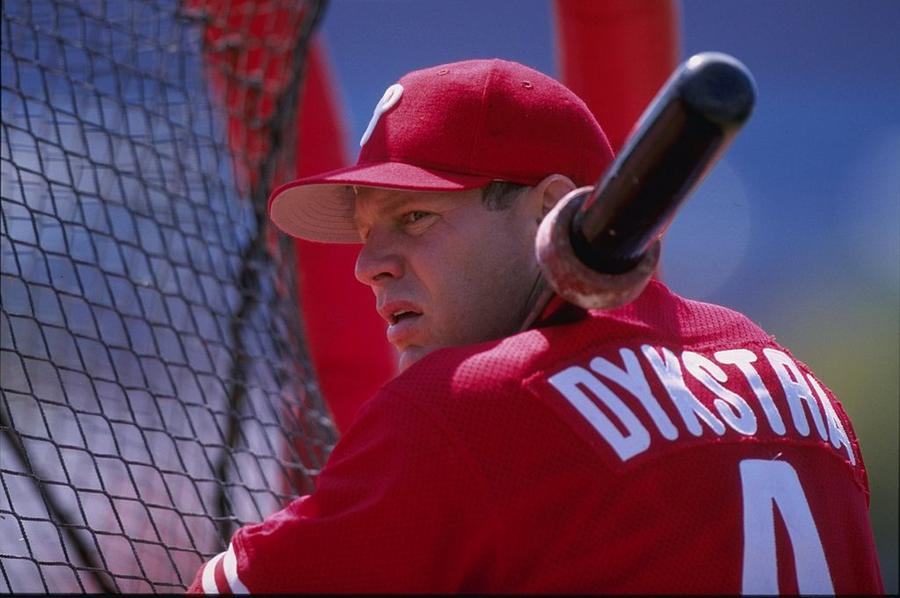
Rick Stewart /Allsport
The Rise of "Nails"
Long before police reports replaced box scores, Lenny Dykstra built his reputation on defiance. He was drafted in the 13th round by the New York Mets in 1981, a long shot with no obvious star profile. He was undersized, lacked power, and did not project as a franchise cornerstone. What he possessed instead was obsession. Dykstra did not merely compete. He attacked.
By the mid-1980s, that relentlessness made him indispensable to a Mets team overflowing with talent and chaos. The 1986 Mets are remembered as one of the most volatile champions in baseball history, equal parts brilliance and self-destruction. Dykstra fit perfectly. His most famous moment came in Game 3 of the National League Championship Series, when he hit a walk-off home run that swung the series and became an instant postseason classic. Weeks later, the Mets won the World Series, and Dykstra was no longer a long shot. He was a champion.
He earned the nickname "Nails" because he refused to concede. He fouled off pitch after pitch, took borderline balls personally, and played through injuries that would have sidelined most players. Opposing pitchers dreaded him not because he was overpowering, but because he was exhausting.
Philadelphia, Peak Performance, and Real Money
When the Mets traded Dykstra to the Philadelphia Phillies in 1989, it seemed like a reset. Instead, it unlocked the best stretch of his career. In Philadelphia, Dykstra became the embodiment of the city's sporting identity. Confrontational. Unpolished. Relentless.
As a leadoff hitter, he transformed into one of the most effective on-base threats in baseball. In 1993, he finished second in National League MVP voting while leading the Phillies to a World Series appearance. He was a three-time All-Star and, for a brief window, one of the most feared table-setters in the sport.
Over a 12-year MLB career, Dykstra earned roughly $36 million in salary. Adjusted for inflation, that figure is closer to $65 million today. At the time, it was life-altering money. For most players, it would have meant long-term security.
For Dykstra, it became leverage.
The Traits That Couldn't Turn Off
Dykstra never learned how to slow down. The same mentality that made him effective between the foul lines proved dangerous once the structure of professional baseball disappeared. He chased edges everywhere. In business, in investing, in life.
In 2007, Dykstra was named in the Mitchell Report, which detailed widespread steroid use across Major League Baseball. Multiple sources alleged he used performance-enhancing drugs during his career. While Dykstra never cooperated with investigators, the allegations fit a familiar pattern. Fear of replacement. Fear of decline. Fear of losing the edge.
When injuries finally forced his retirement in the mid-1990s, Dykstra was still young, wealthy, and unanchored. The schedule was gone. The clubhouse accountability vanished. What remained was impulse.
Post-Baseball Financial Guru
When Lenny Dykstra's baseball career ended in 1996, he did not fade quietly into retirement. At just 33 years old, he had earned more than $36 million in salary and, by any conventional standard, was set for life. Autograph signings, charity appearances, and the occasional golf outing would have been enough to sustain a comfortable existence. Dykstra wanted more.
Instead of retreating from competition, he redirected it. Using a portion of his baseball earnings, Dykstra invested aggressively in a network of car-wash and quick-lube franchises across Southern California. Unlike many athlete-run ventures, these businesses worked. They worked extremely well. At their peak, the operations generated enough profit to pay Dykstra an estimated $1 million per year in personal salary.
The success culminated in 2007, when Dykstra sold the car wash and lube empire for $51 million. Overnight, he was no longer just a former athlete with savings. He was a liquid millionaire entrepreneur.
He upgraded his lifestyle accordingly. He moved from a $4 million home into an $18 million estate inside Sherwood Country Club. The sellers were Wayne Gretzky and his wife, Janet, who had custom built the mansion a few years earlier. Here's a video tour of the STUNNING estate:
He bought a fleet of luxury cars and began flying exclusively on private jets. For a brief moment, Dykstra appeared to have pulled off one of the rarest transitions in sports, turning athletic success into genuine business wealth.
That success attracted attention far beyond baseball. CNBC personality and TheStreet.com founder Jim Cramer was so impressed by Dykstra's business instincts that he gave him a weekly stock-picking column on TheStreet.com. Subscribers paid nearly $1,000 per year for investment advice delivered with baseball metaphors and aggressive confidence. In 2008, Dykstra expanded further by launching "The Players Club," a glossy magazine marketed as a financial and lifestyle guide for wealthy professional athletes.
By 2009, Dykstra publicly estimated his personal net worth at just under $60 million.
The Collapse
Dykstra did not merely want to be rich. He wanted to live like a billionaire. Spending accelerated far faster than income. "The Players Club" became a financial disaster, bleeding millions of dollars and eventually collapsing. Dykstra continued to operate as if his wealth were infinite, chartering private jets, maintaining multiple properties, and funding ventures that never stabilized.
In July 2009, barely a year after boasting of a $60 million net worth, Dykstra stunned the financial world by filing for Chapter 11 bankruptcy. Court documents told a radically different story. He claimed to have less than $50,000 in assets and between $30 million and $50 million in liabilities.
What followed was not a sudden accident but a rapid unraveling. Dykstra stopped paying bills. He harassed employees at all hours, pressuring them to hand over personal credit cards with promises of repayment. One employee's card was charged tens of thousands of dollars, including a $32,000 private jet flight. He allegedly used similar tactics with family members. A $700,000 signing bonus earned by his son, Cutter, went missing, later claimed to have been invested and lost by Dykstra.
As creditors closed in, Dykstra tried to unload the Gretzky mansion, listing it for as much as $18.5 million. The timing could not have been worse. The housing market was in free fall, and the property failed to sell despite repeated price cuts. Eventually, the house was lost to foreclosure, stripping Dykstra of the crown jewel of his post-baseball wealth.
By August 2009, he was living out of his car. A month later, he sold his 1986 New York Mets World Series ring and other memorabilia to a Beverly Hills pawn shop, a jarring reversal for a man who once appeared untouchable.
The financial collapse soon turned criminal. Investigators determined that during bankruptcy proceedings, Dykstra lied under oath, concealed assets, and sold property belonging to the bankruptcy estate. Prosecutors later said he hid, sold, or destroyed more than $400,000 worth of items from the Sherwood mansion, including furnishings and fixtures. Among them was a $50,000 sink ripped from the home after bankruptcy protections were already in place.
Years later, the story came full circle. In 2018, Wayne and Janet Gretzky quietly re-acquired the very house Dykstra had lost for $13.5 million. Two years after that, they listed the property for roughly $23 million, a stark contrast to the wreckage left behind.
What had once been proof of Dykstra's extraordinary second act ultimately became the most visible monument to its collapse.
The Long Aftermath
In the years following his release, the pattern never truly changed. In 2020, a New York Supreme Court judge dismissed Dykstra's defamation suit against former teammate Ron Darling, ruling that Lenny was legally "libel-proof." The judge stated his reputation was already so tarnished by fraud, drug abuse, and bigotry that it could not be meaningfully harmed.
In February 2024, the physical toll finally arrived. Dykstra suffered a major stroke that left him in a brief coma. He later claimed on the Howard Stern Show that he only woke up because someone whispered in his ear that Robin Quivers was rooting for him. The stroke left him with permanent damage, including slurred speech and physical frailty, prompting a move to Scranton, Pennsylvania, to live a quieter life.
Which brings the story back to that 2026 traffic stop. Before that night, Dykstra had been boasting on social media about a "streak" of 2,771 days without an arrest. Whether that streak technically survived the night in Pike County is a matter for his lawyers, but the optics were unmistakable.
Lenny Dykstra's story is not one of simple bad luck. It is the story of a man whose greatest strengths became his undoing. Obsession without brakes. Confidence without restraint. A relentless refusal to slow down, even after he had already won. On the field, that mentality made him unforgettable. Off it, it destroyed everything else.
/2009/12/Lenny-Dykstra.jpg)
/2013/01/gret.jpg)
/2010/01/Barry-Bonds.jpg)
/2016/08/GettyImages-52920895.jpg)
/2015/09/floyd21.jpg)
/2014/08/gm.jpg)
/2019/10/denzel-washington-1.jpg)
/2020/06/taylor.png)
/2009/11/George-Clooney.jpg)
/2009/09/Jennifer-Aniston.jpg)
/2017/02/GettyImages-528215436.jpg)
/2020/04/Megan-Fox.jpg)
/2018/03/GettyImages-821622848.jpg)
/2009/09/Cristiano-Ronaldo.jpg)
:strip_exif()/2015/09/GettyImages-476575299.jpg)
/2019/11/GettyImages-1094653148.jpg)
/2020/01/lopez3.jpg)
/2019/04/rr.jpg)
/2009/09/Brad-Pitt.jpg)
/2020/02/Angelina-Jolie.png)
:strip_exif()/2009/09/P-Diddy.jpg)