
The movie Air looks at the story of Nike signing Michael Jordan. At the time, Nike was an up-and-coming company, still unproven in the shoe market next to Converse and Adidas. In the film, the Converse executives reference Magic Johnson as one of the All-Stars wearing their shoes.
When Jordan was making his decision on who to choose, Johnson had already established himself as one of the most exciting players in the NBA. He had won two titles and a pair of Finals MVPs and had made four All-Star teams.
Nike certainly understood the power of Magic. Five years earlier, in 1979, Johnson and Michigan State had just won an NCAA championship, and Nike pitched Johnson to sign with them. However, he opted to go with the more established Converse, who offered the biggest deal.
"When you grow up broke, you take the money," Johnson told the All the Smoke podcast earlier this year.
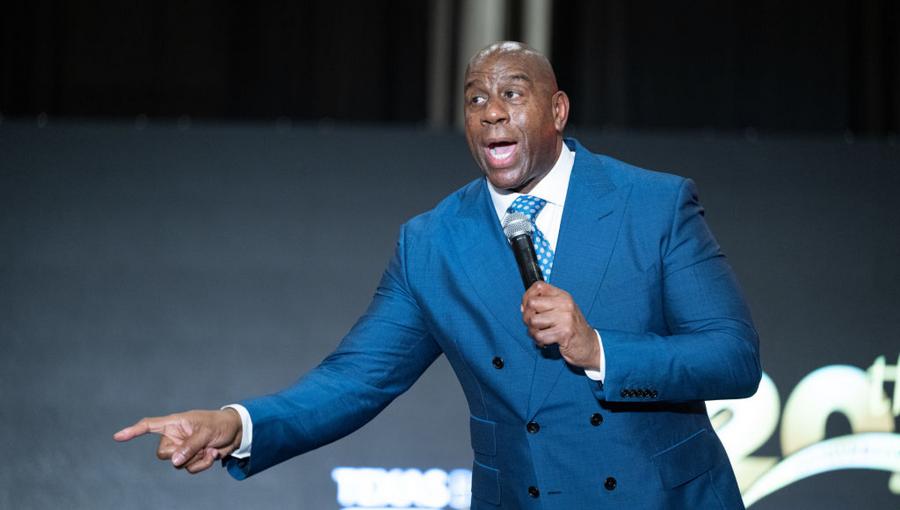
Marcus Ingram/Getty Images
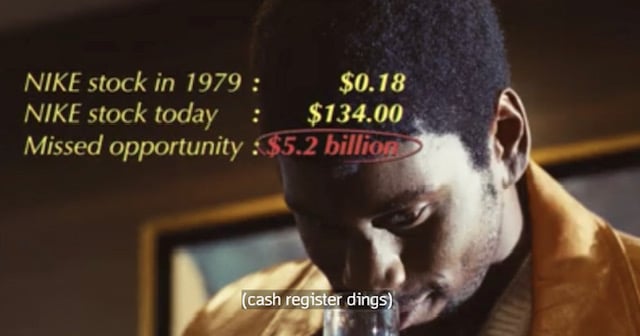
Johnson explained that Nike founder Phil Knight told him the company couldn't compete with Adidas and Converse in terms of money, but they could offer company stock. Nike would give Johnson $1 for every pair of shoes sold and 100,000 shares of stock. Nike was not yet a public company in 1979. But it has been implied that the strike price of the stock Magic was offered was $0.18 per share.
In an episode of the HBO series "Winning Time" that aired last month, Magic's decision to reject Nike's offer was reenacted. In the scene, viewers are told that Magic's "missed opportunity" cost him…
$5.2 billion
Is This Story True?
There have been a number of people who have called BS on this story. Neither Nike, nor Phil Knight have ever confirmed it. Furthermore, it is generally agreed that Michael Jordan was the first athlete to receive stock from Nike as a signing incentive. Jordan was also the first Nike athlete to earn a percentage of sales. Finally, Magic had already signed with Converse by July 1979. That was just four months after he won the NCAA Championship and just a few weeks after his Sophomore year ended and he decided to turn professional. If this Nike offer was real, when did it happen? Within a few weeks of graduating? Before Converse locked him up? Smells fishy.
Johnson's math may be a little off, too. It's highly unlikely that Nike would have offered Magic 100,000 shares of the firm's pre-IPO stock in 1979. That would have constituted significant amount of the company's total equity.
Let's say he was given 100,000 shares when the company finally did go public in December 1980. Nike went public at $22 a share. So 100,000 shares would have been worth $2.2 million at the IPO.
Nike's stock has split 2-1 seven times since going public. That would mean a single share would be 128 shares today. 100,000 shares would be 12.8 million shares today. Assuming a price per share of $100 (which is a rough average in the last few months), 12.8 million shares would be worth
If Johnson had kept all of his shares from the original IPO and did nothing else, they'd be worth just under $1.3 billion today. But that's not accounting for any reinvesting of dividends, which would only add to the total value. The more realistic number is probably between $2-3 billion — not quite $5 billion, though still a fantastic return.
Though these hypotheticals are always fun to dive into, there's one other thing we often don't take into account. Johnson commented how it's been 45 years (technically 44) since he would have received these shares. It's hard to imagine he wouldn't have sold some or all of them along the way, either to build his wealth or to invest in one of his many business ventures.
Johnson has done very well for himself anyway, with a net worth of $620 million. So while he may kick himself for passing on Nike, he's made plenty of great moves throughout his life, both on and off the court.
Hear Magic tell the story about Nike below:
View this post on Instagram
/2019/11/Magic-Johnson.jpg)
/2018/06/GettyImages-959637218.jpg)
/2015/09/magic.jpg)
/2023/03/GettyImages-1474223316.jpg)
/2017/06/GettyImages-492240458.jpg)
/2015/06/GettyImages-52216922-e1513997415894.jpg)
/2020/01/lopez3.jpg)
/2009/11/George-Clooney.jpg)
/2017/02/GettyImages-528215436.jpg)
/2020/06/taylor.png)
/2019/10/denzel-washington-1.jpg)
/2018/03/GettyImages-821622848.jpg)
/2009/09/Jennifer-Aniston.jpg)
:strip_exif()/2015/09/GettyImages-476575299.jpg)
/2019/11/GettyImages-1094653148.jpg)
/2019/04/rr.jpg)
/2009/09/Brad-Pitt.jpg)
/2020/02/Angelina-Jolie.png)
:strip_exif()/2009/09/P-Diddy.jpg)
/2020/04/Megan-Fox.jpg)
/2009/09/Cristiano-Ronaldo.jpg)