
I have owned and operated CelebrityNetWorth.com for 17 years. Throughout these years, the finances of professional athletes has easily been the most common topic that I pay attention to on a near constant basis. There are just so many current and former professional athletes who have made so much money in such a short time. It's a constant wellspring of good content. Whether we're writing about an athlete who just signed a massive new contract, made a business investment, bought a $30 million home, or traded their salary for bitcoin, there's always a good story to be found.
And whenever athlete finances are discussed… on a sports talk show, podcast, news article, interview, etc… without fail, you will hear someone breathlessly repeat the belief that an absolutely staggering percentage of professional athletes go broke after they retire.
More often than not, the statistic that gets breathlessly repeated without citation is something like "…after all, 80% of pro athletes go broke in retirement."
In fact, just last week, during NFL draft week, former player Ndamukong Suh was asked if he had any advice for the 2026 draftees. And of course, the first thing he said was: "78% of NFL players go broke within two years of retiring. That's the reality when you mistake temporary cash flow for permanent wealth." He even posted a bunch of inspirational text cards reflecting this belief on his Facebook page:
In a quick search, I found the articles from Fox Business, Yahoo Finance, and CNBC, all confidently parroting these stats. The Fox Business and CNBC articles take it even further. According to Fox Business, these athletes go broke just THREE YEARS after retiring. The CNBC article says it happens after just TWO YEARS!!??? Here are the quotes:
"Being a professional athlete can be extremely rewarding and lucrative. However, a stark 78% of them will go broke after just 3 years of retirement." – Fox Business
"At last look, an estimated 60 percent of former NBA players go broke within five years of departing the league. And by no means are these financial problems confined to the NBA. A reported 78 percent of former NFL players have gone bankrupt or under financial stress just two years after retirement." – CNBC
During a given season, there are around 3,660 active professional athletes in the NFL, NHL, MLB, and NBA. Using each league's average career length, we can roughly estimate that around 900 pro athletes retire every year. If these statistics were true, 702 of these athletes would file for bankruptcy in 2-3 years. That would be an utterly shocking situation if it were true.
In case you haven't figured out yet from my tone, there's just one teeny tiny problem. It's not true AT ALL.
The original source of the claim, before it was telephone-gamed into a bunch of different sources and forms, was a March 2009 Sports Illustrated article (which is no longer online) titled:
"How (and Why) Athletes Go Broke."
In the article, the author referenced the following claims:
- "By the time they have been retired for two years, 78% of former NFL players have gone bankrupt or are under financial stress because
of joblessness or divorce."
- "Within five years of retirement, an estimated 60% of former NBA players are broke."
There they are, in all their original glory. Two shocking statistics that are still reverberating in the media today, some 17 years after they were published.
So what was the author's source for his numbers? Here's what he referenced as a citation:
"reports from a host of sources (athletes, players' associations, agents and financial advisers"…
In other words, there was no peer-reviewed academic study, hard dataset, or scientific methodology behind these specific percentages. He talked to some guys who gave him some hunches.
So What are the Real Statistics?
In 2015, the National Bureau of Economic Research (NBER) conducted a more scientific examination of this question. In its study, NBER studied actual bankruptcy filings made by the roughly 2,000 players who were drafted by NFL teams between 1996 and 2003.
The result? Within two years of retiring, 1.9% of NFL players in this group file for bankruptcy. Within 12 years, the number jumped up to 15.7%. Wanna know something else that will blow your mind? Those are almost the exact same percentages experienced by the general population of non-professional athletes. In other words, pro athletes are just like us! Even though they earn way more money, they go bust at the exact same rate as anyone else. Here's a graph NBER included in its report:
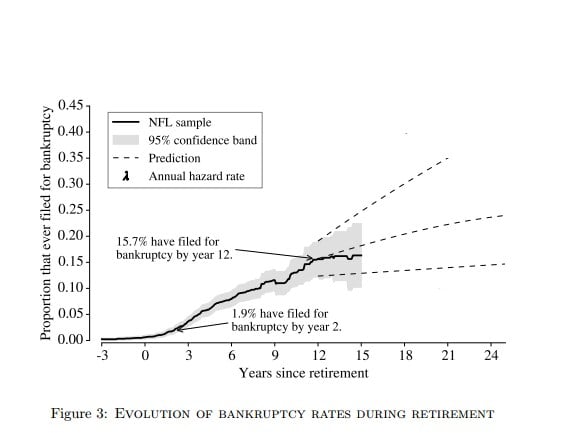
By our estimation, out of the 900 pro athletes who retire every year, roughly 500 are NFL players (because the league is so big and NFL careers are so short). If 500 NFL players retire every year, that means there is a rolling pool of 1,000 players in their first two years of retirement. According to Sports Illustrated's math, 780 of those 1,000 men should be broke. The real number? Around 19.
And here's one more fun fact that I just discovered upon re-reading the 2009 Sports Illustrated article:
In the article, one financial advisor in particular is referenced over and over. His name is mentioned in the article 19 times. I'm intentionally not naming him here because, as you'll see in a moment, he's not shy to sue an outlet for defamation, and I dont got time for that.
In 2018, this advisor was one of the main people who perpetuated the conspiracy theory that Democratic National Committee staffer Seth Rich was murdered for leaking DNC information. When NPR published several articles detailing this person's involvement in the false story, which was eventually retracted by Fox News, this person filed a $57 million defamation lawsuit against NPR.
Yada yada yada… In January 2021, this person issued an apology and retraction as part of a settlement in a lawsuit filed by Aaron Rich, Seth's brother:
"I take full responsibility for my comments, and I apologize for any pain I have caused. I sincerely hope the Rich family is able to find out who murdered their son and bring this tragic chapter in their lives to a close."
That's all I have to say about this. Please let this article be the final nail in the coffin of that dumb statistic! Have a great day!
/2017/05/GettyImages-461023458.jpg)
/2015/03/GettyImages-494859588.jpg)
/2024/03/GettyImages-1370407811.jpg)
/2019/01/GettyImages-1063594354.jpg)
/2015/11/Peyton-Manning.jpg)
/2018/03/GettyImages-900113954.jpg)
/2009/11/George-Clooney.jpg)
/2020/02/Angelina-Jolie.png)
/2020/01/lopez3.jpg)
/2020/06/taylor.png)
:strip_exif()/2009/09/P-Diddy.jpg)
/2009/09/Brad-Pitt.jpg)
:strip_exif()/2015/09/GettyImages-476575299.jpg)
/2020/04/Megan-Fox.jpg)
/2018/03/GettyImages-821622848.jpg)
/2017/02/GettyImages-528215436.jpg)
/2019/04/rr.jpg)
/2009/09/Cristiano-Ronaldo.jpg)
/2019/10/denzel-washington-1.jpg)
/2019/11/GettyImages-1094653148.jpg)
/2009/09/Jennifer-Aniston.jpg)