
When Cristiano Ronaldo left Europe for Saudi Arabia in December 2022, it marked one of the most dramatic career pivots in modern sports history. For nearly two decades, Ronaldo's contracts had defined the upper limits of football wealth. At Manchester United, he was the Premier League's highest earner. At Real Madrid, his 2009 world-record €94 million transfer shattered every salary benchmark in the game. By the time he moved to Juventus in 2018, he was earning more than $100 million a year from salary and endorsements combined—an unprecedented sum for a player in his mid-30s.
But by late 2022, the relationship with Manchester United had soured. After a string of public clashes with management and a viral interview criticizing the club's leadership, his contract was terminated just weeks before the World Cup. Suddenly, the five-time Ballon d'Or winner—one of the most famous athletes on Earth—was a free agent at 37.
Most assumed he would head to MLS or back to Portugal for a farewell tour. Instead, Saudi club Al Nassr stunned the sports world by offering a package that reportedly dwarfed anything previously seen in team sports: roughly $535 million over two and a half years.
That original deal worked out to $210 million in earnings per season and made him the highest-paid athlete in the world overnight by a mile. It still stands as the seventh-largest contract in sports history. Then, in June 2025, he signed an even richer two-year extension. This extension pays Cristiano a MINIMUM of $620 million (and as much as $936 million with bonuses) to stay with Al Nassr through mid-2025.
In addition to officially vaulting Cristiano into billionaire status for the first time in his life, this deal also gives him a 15% equity stake in the Al Nassr soccer club, $5 million worth of private jet expenses, a 16-person household staff, and works out to $224 million per season without even considering the potential bonus sweeteners.
If this latest deal ends up being Ronaldo's last Saudi contract, he will have played for Al Nassr from 2023 through 2027. Without even counting bonuses, his total earnings during that period will be $1.155 billion. But here's the craziest part of Cristiano's Saudi income: It's 100% tax free.
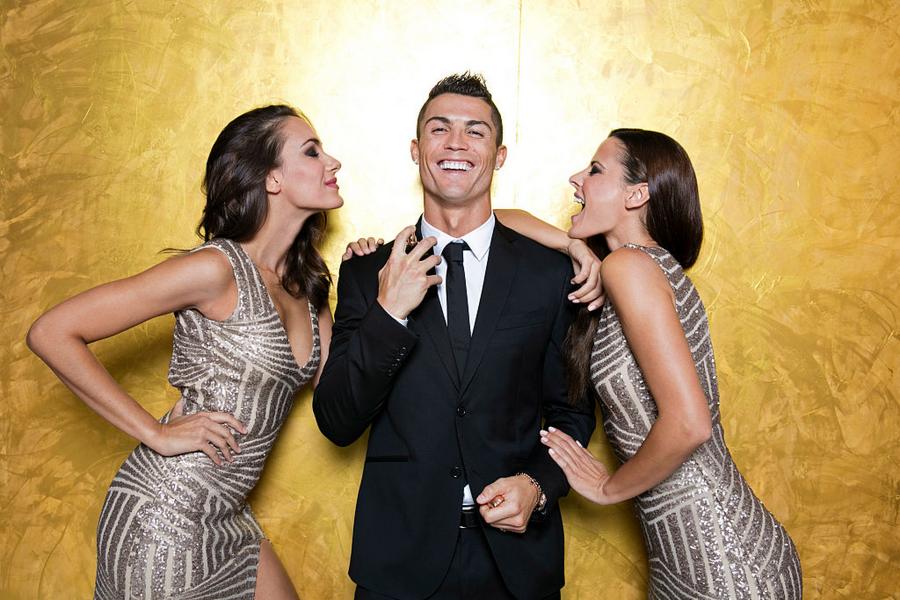
Getty Images
The Tax-Free Saudi Loophole
Here's where things get almost unbelievable. Saudi Arabia doesn't impose personal income taxes. That means Cristiano Ronaldo's entire salary, signing bonuses, and commercial incentives are completely tax-free.
I know what you're thinking – Won't Portugal—his home country—demand a cut of his income? Not if Ronaldo is no longer a Portuguese tax resident. Unlike the United States, Portugal taxes people based on where they live, not which passport they hold. If Ronaldo spends the majority of the year outside Portugal and does not maintain a primary residence there, Portuguese tax law considers him a non-resident, and non-residents are only taxed on Portuguese-sourced income. Since his Al Nassr salary is neither paid by a Portuguese employer nor earned on Portuguese soil, it's untouchable by Portugal's tax authorities.
So let's pretend for a moment that there was an American soccer star at the caliber of Cristiano Ronaldo who signed a $500 million Saudi contract. Let's call him Christopher Ronald. Not only would Uncle Sam request his cut, but if Christopher lived in a state with an income tax, the state's tax authority would ALSO request a cut.
Let's run the math: The top federal income tax rate in the U.S. is 37%, and that doesn't include the 3.8% Medicare surtax on investment income that high earners often trigger. Therefore, Christopher Ronald's $500 million salary would equate to roughly $185 million in federal taxes alone. If he happened to live in a state with an income tax—say California (13.3%), New York (10.9%), or New Jersey (10.75%)—his combined federal and state tax bill could rise to around 48–50%, or roughly $240–$250 million.
Even if Christopher moved to Saudi Arabia and lived there 200 days a year—or even 365 days a year—the U.S. would still tax him. That's because the U.S. is one of only two countries in the world (the other being the tiny North African country of Eritrea) that taxes its citizens based on citizenship, not just residency. American citizens owe U.S. taxes on all worldwide income, no matter where they live or earn it.
Yes, there is a provision called the Foreign Earned Income Exclusion that allows U.S. citizens living abroad to exclude up to $126,500 of foreign-earned income (as of 2024)… but big whoop when you're making hundreds of millions per year.
Now let's run the math on Cristiano Ronaldo's Saudi tax burden: He pays zero dollars.
If you zoom out over the full run of his Saudi career, the numbers become almost surreal. Between 2023 and mid-2027, Ronaldo will have earned $1.155 billion, averaging roughly $257 million per season, all of it tax-free. For an American athlete, for example, the hypothetical Christopher Ronald, to take home that same amount, he would need to gross around $467 million per year before taxes—or a $2.1 billion contract over four and a half years. That's the difference between Cristiano Ronaldo's Saudi fortune and what a U.S. citizen in the same position would actually keep after the IRS and state tax authorities take their share.
Taking Saudi Money
Critics have long questioned the morality of taking Saudi money, whether in football, boxing, golf, or even comedy. The country's efforts to lure global stars have been described as sportswashing—using entertainment to soften a reputation still defined by authoritarian rule, censorship, and the 2018 murder of journalist Jamal Khashoggi.
Recently, a bunch of comedians found themselves in a boiling cauldron of controversy after it was revealed that they were performing at the Riyadh Comedy Festival. Long story short, some of the funniest comedians on the planet, plus Kevin Hart, agreed to perform at the festival, which took place from Sept 26 to 2025. The lesser-known comics were offered hundreds of thousands of dollars; the headliners, including Bill Burr, Dave Chappelle, Louis C.K., Aziz Ansari, and Pete Davidson, were reportedly paid between $1 million and $5 million apiece.
The backlash was swift. Human Rights Watch accused Saudi Arabia of using the event to whitewash its image. Many were especially outraged that Pete Davidson performed, considering that his father died on 9/11—an attack that many believe was supported in part by Saudi operatives. Others criticized Jessica Kirson, a lesbian comedian, for appearing in a country where same-sex relationships are punishable by death.
Several comedians—including Mike Birbiglia, Shane Gillis, and Leslie Liao—publicly declined the offers, calling them "blood money." In the aftermath, some who did perform, like Aziz Ansari and Jessica Kirson, offered to donate their earnings to Human Rights Watch, but, amazingly, Human Rights Watch DECLINED BECAUSE THEY CONSIDER IT BLOOD MONEY!
The same criticism has followed Cristiano Ronaldo since the moment he landed in Riyadh. Then again, can you really blame him? What money isn't a little dirty these days? Am I going to sit here and tell you I wouldn't sell Celebrity Net Worth to the Kingdom of Saudi Arabia for $100 million? No, I am not. Even though, let's be honest—I'd lose about half of it in taxes.
/2009/09/Cristiano-Ronaldo.jpg)
/2022/11/cristiano-ronaldo.jpg)
/2023/01/GettyImages-1325105287.jpg)
/2022/12/ronaldo.jpg)
/2018/07/thumb-1.jpg)
/2015/02/GettyImages-455987296.jpg)
/2020/04/Megan-Fox.jpg)
/2009/09/Jennifer-Aniston.jpg)
/2020/06/taylor.png)
:strip_exif()/2015/09/GettyImages-476575299.jpg)
/2020/02/Angelina-Jolie.png)
/2009/09/Cristiano-Ronaldo.jpg)
/2009/11/George-Clooney.jpg)
/2019/11/GettyImages-1094653148.jpg)
/2020/01/lopez3.jpg)
/2017/02/GettyImages-528215436.jpg)
/2019/04/rr.jpg)
/2009/09/Brad-Pitt.jpg)
/2018/03/GettyImages-821622848.jpg)
:strip_exif()/2009/09/P-Diddy.jpg)
/2019/10/denzel-washington-1.jpg)