
For the entire time he owned the Lakers, people would make unsolicited humongous offers to purchase the team from owner Jerry Buss. Buss would always ponder the offers. He would imagine the liquid cash windfall sitting in his bank account, ready to be deployed on new investments and assets. But in the end, he would always reach the exact same conclusion: If he had a huge pile of cash, the #1 thing he would want to buy was… The Los Angeles Lakers. And he already owned the Lakers! So why sell?
That clarity shaped everything Jerry Buss did as an owner. The Lakers were not just an investment or a trophy asset. They were the family jewels, meant to be held, protected, and passed down.
In the years leading up to his death, Buss became increasingly focused on legacy. He didn't just want his children to inherit wealth. He wanted them to inherit the team itself, bound together by shared ownership for generations. His estate planning was meticulous, designed to ensure that the Buss family would own the Lakers not just for decades, but forever, for as long as professional basketball existed as a concept.
Jerry Buss died in 2013. Barely a decade later, the Lakers were gone.
According to a sweeping longform investigation published by ESPN, the $10 billion sale of the Lakers in 2025 was not the result of changing economics or an offer too good to refuse. It was the culmination of years of internal conflict, mistrust, and unresolved family tensions that slowly eroded the very foundation Buss had built to preserve his legacy. The trust structure meant to keep the team in the family instead magnified rivalries and hardened divisions, until owning the Lakers together became impossible.
This is the story of how a man with a crystal-clear vision for his life's goal succeeded beyond imagination, and how that vision unraveled almost immediately after he was gone. What follows is an inside look at the family war that turned Jerry Buss' dream of eternal ownership into a $10 billion exit, and why the Lakers ultimately proved too powerful, too valuable, and too divisive to remain a family heirloom.
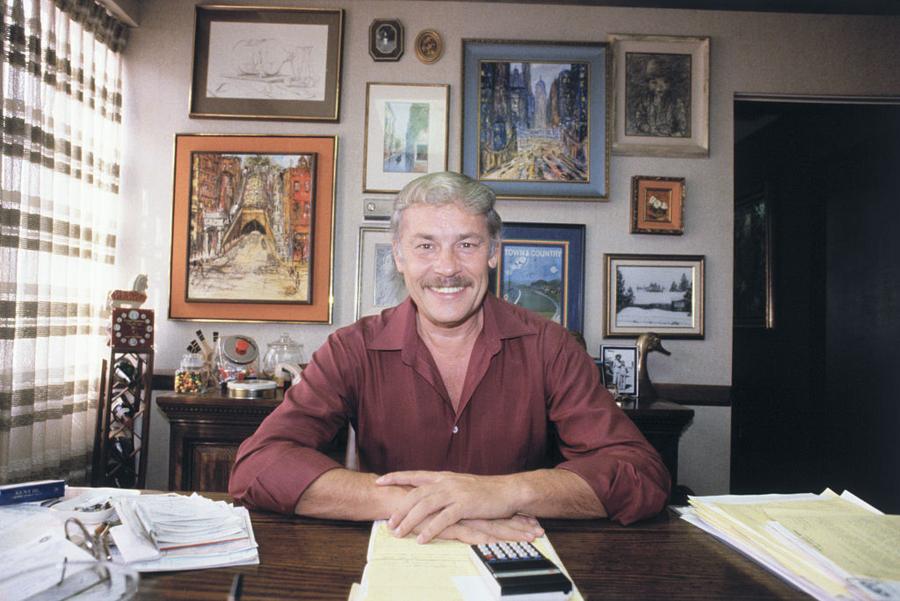
Jerry Buss (via Getty)
Jerry Buss' First Fortune
Long before Jerry Buss became synonymous with the Los Angeles Lakers, he was a quietly aggressive real estate investor who understood leverage, timing, and scale better than most people in Southern California. His wealth did not come from sports. Sports came later, financed almost entirely by the empire he built in property.
After earning a Ph.D. in physical chemistry and briefly working in aerospace and academia, Buss began buying apartment buildings in Los Angeles in the 1960s to supplement his income as a university professor. What started as a side investment quickly became a full-time obsession. Buss recognized that postwar Southern California was undergoing explosive growth, and that income-producing real estate, particularly apartment buildings, offered both steady cash flow and long-term appreciation.
Partnering with longtime associate Frank Mariani, Buss co-founded Mariani-Buss Associates and began acquiring undervalued properties across West Los Angeles, Santa Monica, and other rapidly developing neighborhoods. Buss reinvested relentlessly, used debt strategically, and benefited from rising rents and property values. Unlike many investors who cashed out early, he compounded his gains by holding assets and expanding his portfolio.
By the late 1970s, Buss and Mariani reportedly controlled more than 700 income-generating properties, including thousands of apartment units and multiple commercial buildings. The portfolio produced enormous recurring cash flow and gave Buss access to financing on favorable terms. Crucially, it also gave him confidence. He was no longer thinking like a professor or even a traditional investor. He was thinking like someone who could afford to take a once-in-a-lifetime swing.
The Lakers Go Up For Sale
The Los Angeles Lakers were already a valuable and glamorous franchise long before Jerry Buss entered the picture. In 1965, the team was purchased by Canadian media mogul Jack Kent Cooke for $5.1 million from Bob Short. Cooke was in the midst of assembling one of the most powerful sports empires in North America, and the Lakers quickly became a centerpiece of his holdings.
Over the next several years, Cooke expanded aggressively in Los Angeles sports. In 1966, he acquired the expansion Los Angeles Kings of the NHL for $2 million. The following year, he completed construction on a brand-new arena in Inglewood, spending $16 million on what would soon become world-famous as simply "The Forum." Fueled by the star power and growing popularity of the Lakers, the venue evolved into one of the most recognizable arenas in the world within a decade.
At his peak, Cooke controlled teams in the NBA, NHL, NFL, and professional soccer. He also played a pioneering role in sports media, financing the 1971 Muhammad Ali vs. Joe Frazier bout, the first global closed-circuit television event, which helped lay the foundation for modern pay-per-view sports broadcasting. For a time, Cooke was effectively the owner of Los Angeles sports.
But while his business instincts were extraordinary, Cooke's personal life proved far more volatile, and it would ultimately dismantle his Los Angeles empire.
In 1979, Cooke's 45-year marriage to his first wife, Barbara Jean Carnegie, ended in a highly public and financially devastating divorce. He was ordered to pay a $42 million settlement, a figure so enormous for its time that it became the most expensive divorce payout in history and earned Cooke a place in the Guinness Book of Records. Adjusted for inflation, the settlement would be roughly $185 million today.
Despite his vast wealth, Cooke's fortune was largely illiquid. His assets were tied up in sports franchises, real estate, and long-term investments. To satisfy the settlement, he needed cash quickly. That meant selling off his most valuable and prestigious holdings, including his entire Los Angeles sports portfolio.
The timing could not have been better for Jerry Buss.
When Cooke put the Lakers, Kings, The Forum, and a 13,000-acre California ranch on the market, Buss seized the opportunity. In 1979, he agreed to purchase the entire package for $67.5 million, the largest sports transaction in U.S. history at the time. Only about $16 million of that price was allocated to the Lakers themselves.
Jerry eventually took on some minority investors, including AEG founder Phil Anschutz, who bought a 27% stake, and a real estate developer named Ed Roski, who bought an 8% stake. At the time of his death in 2013, Jerry owned 66% of the Lakers.
Succession Plan
Jerry understood better than most owners that dynasties rarely survive the founder. Long before his death, he worried aloud that the Lakers, for all their success, could become a source of bitterness among his children. The solution he arrived at was not simple, but it was deliberate.
Rather than naming a single heir, Buss placed his 66% controlling stake in the Lakers into a family trust that divided ownership equally among his six children. Each would receive an identical 11% economic interest in the team. No one would be favored. No one would be cut out. Buss believed equality would eliminate resentment and preserve harmony.
To further protect the family's future, Buss prepaid estate taxes, created internal buyout provisions, and added safeguards meant to keep the team from being sold under financial pressure. The intent was clear: the Lakers would remain in the Buss family not because of sentiment alone, but because the structure made selling unnecessary and, ideally, undesirable.
The Lakers Become the Fault Line
When Jerry Buss died in 2013, the Lakers passed smoothly into family control. His daughter Jeanie Buss became the team's governor and public representative, while her siblings shared voting power under the trust. On paper, the transition worked exactly as designed.
In practice, the Lakers quickly became the central tension point in the family.
As years passed, disagreements over strategy, spending, leadership, and authority began to surface. According to ESPN's reporting, siblings who could otherwise be cordial found that conversations about the Lakers reliably led to conflict. The team was no longer just a shared asset. It was a measure of influence, identity, and legacy.
The trust structure unintentionally magnified those pressures. Because each sibling held equal ownership, control mattered more than equity. Decisions were zero-sum. Influence gained by one sibling was influence lost by another. Instead of binding the family together, ownership turned them into rivals competing for relevance within the same institution.
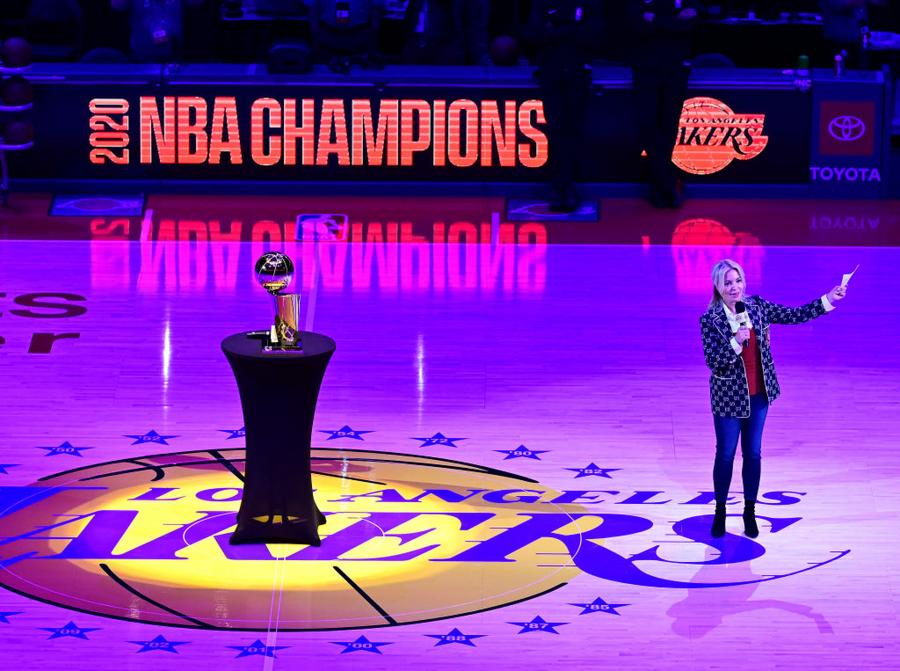
(Harry How/Getty Images)
The 2017 Power Struggle
The conflict became public in 2017, when Jeanie Buss fired her brother Jim Buss from his role overseeing basketball operations. What followed was a legal battle that laid bare the fragility of the family arrangement.
Jim and brother Johnny attempted to remove Jeanie as controlling owner, arguing that the trust did not give her unilateral authority. Jeanie responded by going to court. The dispute ended with Jeanie retaining control and her siblings formally granting her full operational authority over the Lakers.
From that moment forward, the family ownership model shifted from shared stewardship to centralized control layered on top of fractured relationships. The Lakers continued to operate. The family did not.
A Decade of Strain
In the years that followed, the Lakers oscillated between dysfunction and success. The franchise endured several losing seasons, then rebounded to win the 2020 NBA championship. On the surface, the business appeared stabilized. Internally, trust continued to erode.
Communication narrowed. Alliances hardened. Decisions increasingly flowed through a small inner circle. The trust that Jerry Buss believed would guarantee unity instead locked the family into an arrangement that none of them could easily escape. Pretty soon, the question was no longer whether the Buss family wanted to own the Lakers forever. It was whether they could continue owning them together at all.
The $10 Billion Breaking Point
When billionaire Mark Walter emerged as a buyer willing to value the Lakers at $10 billion, the offer did more than set a record. It presented an exit. The deal was not the result of a long, open-market process. It came together quickly. It went to a vote. And once Jeanie Buss committed to selling, the outcome was effectively sealed.
Each sibling stood to receive roughly $1.025 billion in cash before taxes. They also each retained a 3% stake valued at $300 million on paper. Financially, it was a triumph. Emotionally, it was an acknowledgment that Jerry Buss' vision had failed.
In June 2025, the vote passed unanimously.
After the Sale
The aftermath underscored what the sale truly represented.
In the months following the deal, several Buss family members who had held operational roles with the Lakers were removed. Jeanie Buss remained as governor and public representative. The rest of the family, for all practical purposes, was out.
The Lakers, once envisioned as a multigenerational family enterprise, became a professionally run asset controlled by a billionaire owner with no familial ties to the team's past.
What Jerry Buss Got Right—and What He Couldn't Control
Jerry Buss turned a $16 million investment into a sports dynasty that was worth $1 billion at the time of his death in 2013 and $10 billion in 2025. Unfortunately, just like in sports, business dynasties don't last forever, even with the most deliberate and careful planning. But on the bright side, his six children are now all billionaires who have the liquid cash to launch six new dynasties of their own.
/2010/06/jerry-buss-2.jpg)
/2025/06/Jeanie-Buss.jpg)
/2025/06/jack-kent-cooke.jpg)
/2009/10/mb.jpg)
/2013/04/Mark-Walter-1.jpg)
/2017/03/thumb.jpg)
:strip_exif()/2015/09/GettyImages-476575299.jpg)
/2020/02/Angelina-Jolie.png)
/2020/01/lopez3.jpg)
/2019/04/rr.jpg)
/2018/03/GettyImages-821622848.jpg)
/2009/09/Brad-Pitt.jpg)
/2019/11/GettyImages-1094653148.jpg)
/2009/11/George-Clooney.jpg)
/2019/10/denzel-washington-1.jpg)
/2017/02/GettyImages-528215436.jpg)
:strip_exif()/2009/09/P-Diddy.jpg)
/2020/06/taylor.png)
/2009/09/Jennifer-Aniston.jpg)
/2020/04/Megan-Fox.jpg)
/2009/09/Cristiano-Ronaldo.jpg)