
In September 1857, the sidewheel steamer SS Central America sank during a powerful hurricane roughly 160 miles off the coast of the Carolinas. The ship was traveling from Panama to New York carrying passengers, mail, and a staggering shipment of gold from the California Gold Rush. When the storm overwhelmed the vessel, 425 passengers and crew members died and thousands of pounds of gold disappeared into the Atlantic Ocean.
The ship's cargo was valued at roughly $8 million in 1857, an enormous sum at the time and the equivalent of hundreds of millions of dollars today. The loss sent shockwaves through the American financial system and contributed to the Panic of 1857, one of the worst economic crises of the 19th century. Because of the immense value of the lost cargo, the wreck soon became known as the "Ship of Gold."
For more than 130 years, the treasure remained somewhere nearly two miles beneath the ocean surface. The depth and technological limitations of earlier eras made recovery impossible. The wreck became one of the most tantalizing mysteries in maritime history, inspiring generations of treasure hunters who dreamed of locating the lost gold.
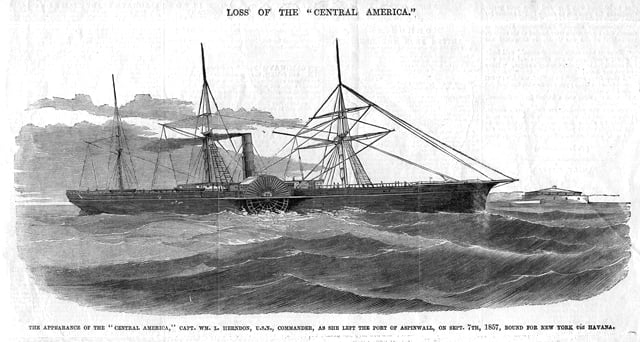
Frank Leslie's Illustrated Newspaper – Library of Congress (public domain)
The High-Tech Treasure Hunt
In the 1980s, a young Ohio-born ocean engineer named Tommy Thompson set out to solve that mystery. Thompson was not a traditional treasure hunter. Trained as a scientist and engineer, he approached the search like a complex mathematical problem. He spent years studying ship logs, weather records, and ocean currents, developing probability models to predict where the wreck might lie.
To fund the search, Thompson convinced 161 investors to contribute approximately $12.7 million to the project. Many of those investors were based in Ohio, including prominent business figures and institutions that believed the expedition could yield enormous profits. Thompson formed a company called Recovery Limited Partnership and assembled a team of engineers and deep-sea specialists.
The operation relied on cutting-edge technology for the time. Using the research vessel Arctic Discoverer and a remotely operated robotic submersible named Nemo, Thompson's team conducted an extensive search thousands of feet beneath the Atlantic.
In September 1988, the cameras on Nemo finally captured an extraordinary sight. On the dark ocean floor nearly 8,000 feet below the surface, the robot's lights illuminated piles of glittering gold coins and bars scattered across the seabed. Thompson had found the long-lost SS Central America.
The discovery made headlines around the world. Over the following years, Thompson's team recovered thousands of gold coins, bars, and ingots in what became the largest treasure recovery in American history. One particularly famous artifact was an 80-pound gold ingot produced by the San Francisco firm Justh & Hunter. The ingot later sold at auction for roughly $8 million, setting a record for a Gold Rush-era artifact.
For a brief time, Thompson was celebrated as a technological pioneer who had solved one of the greatest maritime mysteries in history. Books and documentaries were produced about the discovery, and the recovered treasure became highly prized among collectors.
But the triumph soon gave way to a bitter and complex legal battle.
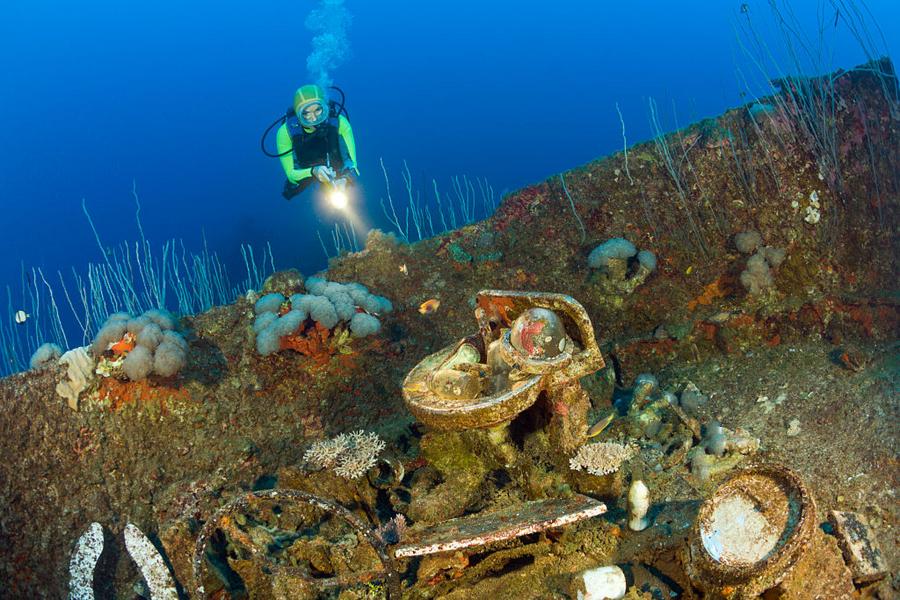
(Photo by Reinhard Dirscherl/ullstein bild via Getty Images)
The Lawsuits and Vanishing Treasure
Even before the recovery operations were complete, ownership of the treasure became the subject of intense litigation. Insurance companies that had paid claims after the ship sank in 1857 argued they still had legal rights to part of the cargo. After years of legal wrangling, a federal judge eventually ruled that Thompson's recovery group would receive 92% of the treasure, with the remaining share going to the insurers.
Despite that victory, Thompson soon faced a new conflict. The investors who had funded the expedition began demanding their share of the profits.
Over time, large quantities of recovered gold were sold to collectors and dealers. Estimates suggest that tens of millions of dollars worth of coins and bars were marketed and sold. Yet many investors claimed they received little or none of the money they had been promised.
By 2005, dozens of investors filed lawsuits accusing Thompson of hiding assets and failing to distribute the proceeds. Crew members also filed legal claims alleging they had not been paid their agreed-upon shares.
Thompson responded that much of the money had gone toward paying off loans, covering expedition costs, and funding years of litigation. He also claimed that some of the recovered gold had been transferred to a trust in Belize and that he no longer had control over it.
As the legal pressure mounted, the dispute began to focus on a particularly mysterious piece of the treasure: roughly 500 gold coins believed to have been minted from gold recovered from the wreck.
On the Run: The Treasure Hunter Becomes a Fugitive
In 2012, a federal judge in Ohio ordered Thompson to appear in court and disclose the location of the missing coins. Instead, Thompson failed to appear. A warrant was issued for his arrest.
For the next two years, he vanished.
U.S. Marshals later described Thompson as one of the most sophisticated fugitives they had ever pursued. When investigators searched his abandoned Florida home, they discovered evidence suggesting he had carefully planned his disappearance. Authorities found large quantities of cash, prepaid burner phones, and even a book titled "How to Live Your Life Invisible."
Thompson and his longtime assistant, Alison Antekeier, had quietly moved into a Hilton hotel in Boca Raton, Florida. Living under false identities, they paid cash for everything, avoided banks, and owned no vehicles.
For more than two years they managed to stay hidden.
In January 2015, acting on a tip, U.S. Marshals raided the hotel and arrested Thompson. He was returned to Ohio to face the court that had ordered him to reveal the missing treasure.

Tommy Thompson via Franklin County Sheriff
The Missing Gold Coins and a Decade Behind Bars
After his arrest, Thompson reached a plea agreement for failing to appear in court in 2012. The agreement included a two-year prison sentence and a $250,000 fine. As part of the deal, Thompson also agreed to reveal the location of the missing coins.
When questioned by the court, however, Thompson insisted he could not provide that information.
He claimed the coins had been transferred to a Belize-based trust years earlier and said he no longer knew their whereabouts. At various points he also told the court he suffered from memory problems and did not remember where the treasure had gone.
The judge was unconvinced.
In December 2015, Thompson was found in civil contempt of court for refusing to answer questions about the coins. He was ordered jailed indefinitely until he complied with the court's demands. The judge also imposed a fine of $1,000 per day, causing the financial penalties against him to climb into the millions.
For years, Thompson remained in prison while courts repeatedly attempted to compel him to reveal the treasure's location. Yet he never provided an answer.
By early 2025, after nearly a decade behind bars, the judge overseeing the case concluded that further imprisonment was unlikely to force Thompson to cooperate. The civil contempt sentence was lifted. Thompson was then ordered to begin serving the separate two-year sentence for failing to appear in court.
Earlier this week, after roughly ten years in federal custody, Tommy Thompson was finally released from prison.
The mystery that put him there, however, remains unsolved. The 500 gold coins are still missing.
/2018/05/GettyImages-539443365.jpg)
/2021/06/GettyImages-56003012-e1623899439571.jpg)
/2015/12/GettyImages-56003006.jpg)
/2016/12/GettyImages-3311197.jpg)
/2018/01/GettyImages-678975-e1516865917657.jpg)
/2017/11/GettyImages-51241647.jpg)
/2019/11/GettyImages-1094653148.jpg)
/2017/02/GettyImages-528215436.jpg)
/2009/09/Cristiano-Ronaldo.jpg)
/2020/06/taylor.png)
/2020/04/Megan-Fox.jpg)
/2019/10/denzel-washington-1.jpg)
/2009/11/George-Clooney.jpg)
/2019/04/rr.jpg)
/2009/09/Jennifer-Aniston.jpg)
/2018/03/GettyImages-821622848.jpg)
/2009/09/Brad-Pitt.jpg)
:strip_exif()/2015/09/GettyImages-476575299.jpg)
/2020/02/Angelina-Jolie.png)
:strip_exif()/2009/09/P-Diddy.jpg)
/2020/01/lopez3.jpg)