
Art heists are fascinating. That's why they make such a good subject for movies. "The Thomas Crown Affair," "Monument Men," "Entrapment," "Ocean's Twelve," and "Hudson Hawk," are just a few of my favorite examples. In reality, modern museums have incredibly advanced and complicated security systems.
That said, there is one infamous art heist where, even with a relatively decent security system, thieves made off with more than a billion dollars worth of art… arguably a priceless haul.
It all went down in the morning of March 18, 1990.
Security guards for Boston's Isabella Stewart Gardner Museum allowed two men in police uniforms to enter the museum, bypassing several locked doors and security features. The supposed police officers claimed to be responding to a disturbance call. They tied the guards up and proceeded to spend the next 81 minutes looting the museum.
Over 30 years later and the case has never been solved. No arrests have ever been made. And none of the pieces of art have ever been recovered, not even on the black market.
How The Museum Came To Exist
Isabella Stewart Gardner lived from 1840 to 1924. She was born into extreme wealth as the daughter of linen merchant David Stewart.
The Isabella Stewart Gardner Museum opened in 1903 to house the private collection of future masterpieces that Isabelle collected in her world travels. When Isabella died in 1924, she also left the museum a $3.6 million endowment. That's the same as around $60 million in today's dollars, on top of a priceless collection of art.
Her will stated that no items could be sold or brought into the collection and the arrangement of the artwork was to remain unchanged.
By the early 1980s, the museum was running low on funds and the building was falling into disrepair. It had no climate control system and no insurance policy. Nonetheless, after the FBI uncovered a robbery plot in 1982 the museum upgraded its security system.
Sixty infrared motion detectors were installed in the inside the museum. The exterior was protected by four cameras connected to a closed-circuit television system. No cameras were actually put inside the building due to the expense of doing so in a historical building. The only way the police could be called to the museum was via a button at the security desk. Other museums, for instance, required the night watchman to call the police every hour to let them know all was well.
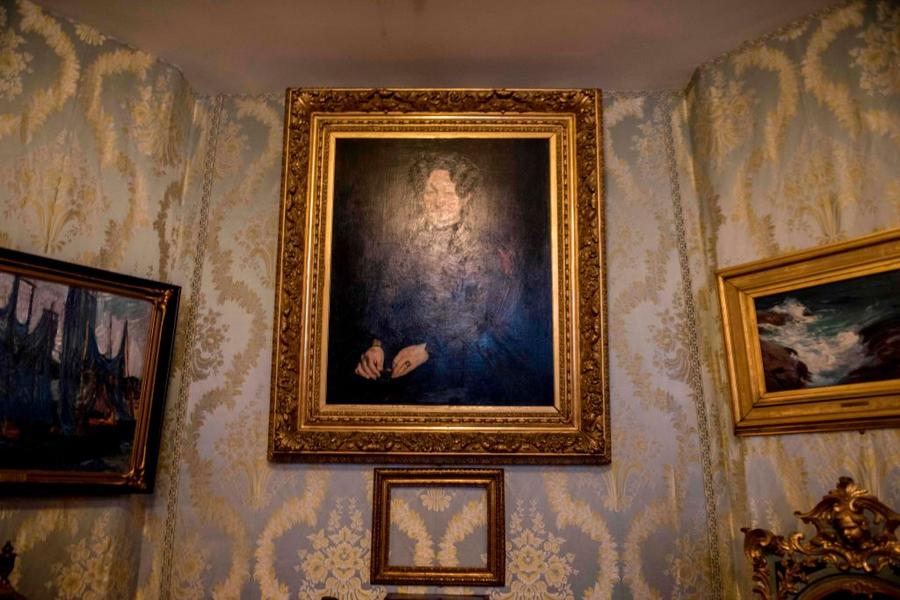
(RYAN MCBRIDE/AFP via Getty Images)
Independent security consultants and the security director at Boston's Museum of Fine Arts reviewed the system at the Isabella Stewart Gardner Museum in 1988 and recommended additional, major improvements. Unfortunately the museum simply couldn't afford the upgrades PLUS Gardner's will restricted major renovations, so the museum's board of trustees did not approve the security enhancements. The board also rejected a motion to pay the guards more to attract more qualified candidates. The guards they had were paid just a bit more than minimum wage. All of the museum's security guards were well aware of the deficiencies in the security at the museum.
The Robbery
On the night of March 18, 1990, the guards on duty were 23-year-old Rick Abath and 25-year-old Randy Hestand. It was Hestand's first time working the night shift. While Abath was patrolling the premises fire alarms started going off, but he couldn't find any smoke or fire. The fire alarm control panel in the security room indicated there was smoke in a number of rooms. He figured the system was malfunctioning and turned it off. He went back on patrol and stopped at the side door to the museum to open and close it. He returned to the security desk around 1 am. Hestand then went on his rounds, per museum protocol.
At 1:20 am, the thieves dressed as cops rang the buzzer on the side door. That connected them to Abath via intercom. They told him they were police investigating a disturbance. Abath could see them on the closed-circuit television that they were wearing police uniforms. As it was St. Patrick's Day, he figured some drunk partier had climbed over the fence and been spotted. He let them in. They asked Abath to come out from behind the desk, he complied – which put him too far from the button to alert the actual police. He was forced against the wall and handcuffed. Hestand soon returned to the room and he too was handcuffed. Duct tape was wrapped around the head and eyes of the guards and they were taken to the basement and handcuffed to a pipe.
The thieves spent the next 81 minutes raiding the museum. Their movements through the building were recorded on the infrared motion detectors. They began taking art off the walls and throwing it on the ground to break the glass so they could cut the canvasses out. They went to the security office and took the videotapes of their entrance on the closed-circuit cameras as well as the printouts from the motion detectors. They exited the side entrance at 2:45 am. When the morning shift guards arrived they realized something was amiss when no one was responding to the buzzer to let them in. They called the security director and once he realized no one was at the security desk, he called the police. The police found the guards still handcuffed and duct-taped up in the basement.
The Most Valuable Stolen Item In The World
In total, thirteen works of art were stolen including works by Rembrandt, Degas, Manet, Vermeer, and Flinck. A finial from a Napoleonic flag and a piece of Chinese pottery were stolen. At the time, the value of these items was $200 million. That figure jumped to $500 million by 2000 and today sits at easily over $1 billion.
Vermeer's "The Concert" was the most valuable item stolen as he only painted 34 works. Experts have called this the most valuable stolen item in the world.
Police and art experts were confused by what was taken and what was left. For instance, the theives did not steal valuable works by Michelangelo, Botticelli, Raphael, and Titian. Because Gardner's will stipulated that the artwork never be rearranged, to this day empty frames hang where the stolen artwork once was.
Now, remember, the museum was struggling financially and had no insurance policy. Rewards via Sotheby's and Christie's for the return of the artwork in good condition started at $1 million and kept rising. In 2017, the reward was $10 million. The statute of limitations expired in 1995, so anyone who returns the art cannot be prosecuted.
Abath was investigated due to the odd behavior of opening and closing the side door. He said he did this regularly to make sure the door was locked. In the end, the police decided Abath and Hestand were too incompetent to have been involved. Crime boss Whitey Bulger was also investigated due to his strong ties to the Boston police which would have made it easy to procure some very authentic police uniforms. A retired art expert from Scotland Yard believes Bulger gave the art to the IRA and the pieces are probably in Ireland right now.
None of the investigations turned up anything. The police and FBI investigated an anonymous letter the museum received in 1994, a known art thief in the area, various branches of the Boston Mafia – and that revealed nothing. The only possible lead with some gravitas was mafia member Bobby Donati who was seen at a party near the museum earlier in the night with a bag filled with police uniforms. Unfortunately, Donati was murdered in 1991 during a gang war.
The investigation is still open and the museum is still offering a $10 million reward.
/2015/04/Screen-Shot-2017-12-22-at-1.05.16-PM.png)
/2019/11/GettyImages-1184547673.jpg)
/2015/03/GettyImages-88639846.jpg)
/2014/12/GettyImages-825880144.jpg)
/2013/05/jg.jpg)
/2017/02/GettyImages-166421604-e1487643704182.jpg)
/2022/01/Jane-Birkin.jpg)
/2021/02/barry-sanders.jpg)
/2010/02/Jennifer-Hudson.jpg)
:strip_exif()/2020/06/taylor.png)
/2019/10/Paulina-Porizkova.jpg)
/2012/07/GettyImages-508683722.jpg)
/2009/10/Peyton-Manning-1.jpg)
/2021/03/ben.jpg)
/2020/01/akon2-1.jpg)
/2020/01/Patrick-Duffy.jpg)
/2012/09/Delta-Goodrem.jpg)
/2012/08/Archie-Manning.jpg)
/2019/12/jd.jpg)
/2017/06/Lauralee-Bell-1.jpg)
/2021/07/Michael-Gelman.jpg)
/2019/12/Amanda-Anisimova.jpg)
/2010/12/fm.jpg)