
On Sunday, the New England Patriots face off against the Seattle Seahawks in Super Bowl LX—a high-stakes rematch of their legendary 2015 clash. While the names on the jerseys have changed (with Coach Mike Vrabel and quarterback Drake Maye now leading the charge), the man in the owner's box remains the same. The Patriots have been the NFL's gold standard for over two decades, but in 2000, no one would have predicted this level of dynastic success. After all, the team had just gambled on a skinny, relatively unknown quarterback from the University of Michigan with the 199th overall pick.
Looking back, it's clear that owner Robert Kraft had more than just an inkling that the pieces were falling into place. But how did a kid from Brookline amass enough wealth and tactical leverage to buy his favorite team in the first place?
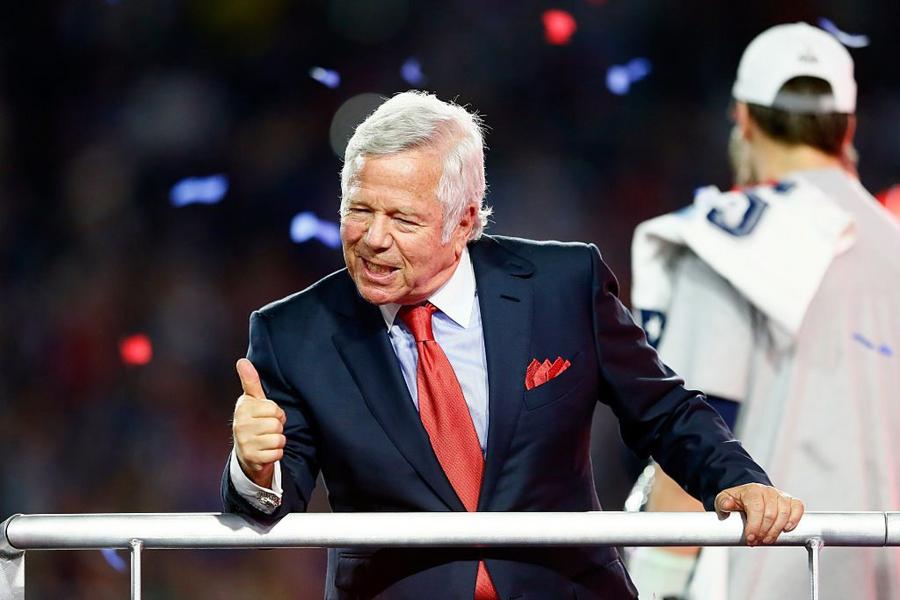
Robert Kraft – Billionaire Patriots Owner / Kevin C. Cox/Getty Images
Paper Trail to His First Fortune
Robert Kraft was born in 1941 in Brookline, Massachusetts, into a working-class Jewish family. He attended Columbia University on a scholarship, where he played football and joined the Zeta Beta Tau fraternity. After graduating in 1960, he earned his MBA from Harvard Business School in 1965. Along the way, he married Myra Hiatt in 1963—a partnership that would become the emotional cornerstone of his life until her passing in 2011.
Kraft's business ascent began at the Rand-Whitney Group, a Worcester-based packaging company owned by his father-in-law, Jacob Hiatt. Kraft eventually took control of the company through a leveraged buyout. In 1972, he founded International Forest Products, a firm specializing in trading physical paper commodities. Together, these entities form the largest privately-held paper and packaging conglomerate in the United States.
Does Robert Kraft Have Any Connection To Kraft Foods?
There is a persistent misconception that Robert Kraft earned his fortune from the grocery giant Kraft Foods. This is entirely false. Robert Kraft has no connection to the company behind Jell-O, Maxwell House, and Velveeta. Kraft Foods was founded in Chicago in 1903 by James L. Kraft, who is not related to Robert in any way. While the food conglomerate has a massive market cap, Robert's billions were built on cardboard, paper, and shrewd real estate maneuvers.
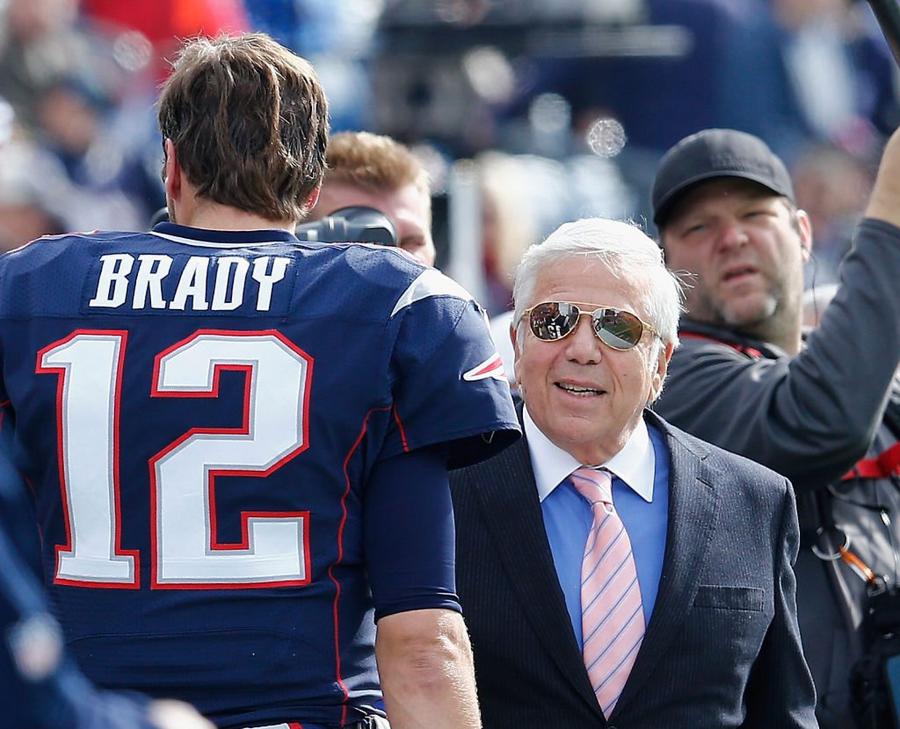
(Tom Brady and Robert Kraft / Jim Rogash/Getty Images)
Buying the Patriots
Kraft's acquisition of the Patriots wasn't a sudden impulse; it was a decade-long strategic siege.
- Step 1 (1985): Kraft bought the parcel of land adjacent to the Patriots' then-home, Foxboro Stadium.
- Step 2 (1988): When the stadium fell into bankruptcy, Kraft outbid a crowd of competitors to buy the venue for $25 million.
Crucially, the stadium purchase included the team's lease. This gave Kraft the ultimate "poison pill": the team was legally obligated to play in his stadium until 2001.
In 1992, a St. Louis businessman named James Orthwein bought the Patriots from a man named Victor Kiam. Orthwein's great-grandfather was Anheuser-Busch founder Adolphus Busch. At the time, James was the largest individual shareholder of Anheuser-Busch. He owned 1.6 million shares that were worth approximately $150 million.
Victor Kiam had owned the Patriots since 1988, when he bought the team from team founder Billy Sullivan for $84 million. The sale did not include Foxboro Stadium, which was owned by another party that was in the midst of bankruptcy proceedings. The obvious plan was for Victor Kiam to buy Foxboro, but at the last minute, another investor won the auction. That last-minute investor? Robert Kraft.
Owning the team but not the stadium turned into a financial mess for Victor Kiam. By 1992, he was facing personal bankruptcy. One of his creditors was James Orthwein, who struck a deal to forgive Victor's debts in exchange for the Patriots.
Over the next two years, rumors swirled across Boston that the Patriots were moving to St. Louis because it was well known that Orthwein wanted the NFL to return to his hometown. St. Louis had been without an NFL franchise since 1988, when the Cardinals moved to Arizona. He even had a new name picked out for the team: The St. Louis Stallions. There was just one problem: In order to leave Massachusetts, Robert Kraft would need to agree to allow the team to buy out the remaining years on their stadium's lease agreement.
James Orthwein offered Robert Kraft $75 million in 1994 to buy out the remainder of the team's lease at Foxboro Stadium had Kraft agreed. Robert Kraft saw an opportunity and seized it. He made a counter bid of $175 million–at the time a record for the NFL–to purchase the Patriots.
This was a shocking amount of money to pay for a team that, at the time, was one of the least valuable franchises in the league. Knowing that getting out of the lease would be an insurmountable hurdle, Orthwein accepted the offer.
Jimmy Orthwein's dreams of St. Louis football may have been crushed, but at least he had $175 million to show for a two-year effort.
Patriots fans embraced Kraft's purchase. They showed their appreciation by purchasing nearly 6,000 season tickets, demonstrating to Kraft how thrilled they were that he kept their team in New England. In fact, that season they sold out every game for the first time in the team's 34-year history. Since then, every single home game has been sold out, including pre- and post-season games. And in 1994, the Patriots ended up making the playoffs for the first time in eight years, on the strength of a seven-game winning streak at the end of the season.
Still, the drama for Patriots fans wasn't quite over. By 1999, a number of plans to improve the stadium and the area it resided in had failed, and Kraft began to explore moving his team to Hartford, Connecticut. Kraft reached an agreement with the Governor of Connecticut to move into a new stadium in downtown Hartford. It must be asked, however, if this move was really going to happen, or was this just another wily move by Kraft to advance his own agenda? The pending deal reopened negotiations with the Massachusetts legislators, who had originally refused to pay for a new stadium in Foxboro.
Eventually, and at nearly the last minute, the Massachusetts legislature approved subsidies that laid the groundwork for Gillette Stadium. The $350 million stadium was privately financed by Kraft and opened in 2002. Since the opening of Gillette Stadium, the Patriots have been on one heck of a roll.
Prior to Kraft, the Patriots were a footnote in NFL history, with only one Super Bowl appearance (a blowout loss to the '85 Bears) and six playoff appearances in 33 years. Under Kraft's stewardship, the transformation has been staggering:
- 6 Super Bowl Championships (tied for the most in NFL history).
- 11 AFC Titles since he took ownership.
- 23 Playoff Appearances in 32 seasons.
Krafting a Fortune
In September 2025, Robert sold an 8% stake in the Patriots at a $9 billion valuation. That resulted in a $720 million windfall. When you combine his other assets, notably his still-thriving paper business, today Robert sports a $14 billion net worth. That makes him one of the richest sports team owners on earth.
/2009/10/kraft.jpg)
/2019/02/thumb.jpg)
/2019/01/GettyImages-462751772.jpg)
/2018/01/GettyImages-52146060.jpg)
/2016/06/GettyImages-466653829.jpg)
/2015/02/Jonathan-Kraft-e1577755815201.jpg)
/2009/11/George-Clooney.jpg)
/2018/03/GettyImages-821622848.jpg)
/2020/01/lopez3.jpg)
/2009/09/Brad-Pitt.jpg)
/2020/02/Angelina-Jolie.png)
/2009/09/Cristiano-Ronaldo.jpg)
/2020/06/taylor.png)
/2009/09/Jennifer-Aniston.jpg)
/2020/04/Megan-Fox.jpg)
:strip_exif()/2015/09/GettyImages-476575299.jpg)
/2019/10/denzel-washington-1.jpg)
:strip_exif()/2009/09/P-Diddy.jpg)
/2017/02/GettyImages-528215436.jpg)
/2019/04/rr.jpg)
/2019/11/GettyImages-1094653148.jpg)