
In the summer of 2000, Richard Hatch won the first season of "Survivor." With the victory, he became a national celebrity overnight, albeit briefly. He also walked away with a $1 million grand prize and a Pontiac Aztek.
Richard parlayed that reality TV fame into additional appearances, media opportunities, and even a few one-off sitcom cameos. In the year following his win, he earned at least $1.4 million from "Survivor" and related opportunities.
Let's say after taxes, he walked away with $800,000.
Let's say Richard invested that $800,000 into the S&P 500 in late 2000 and reinvested every dividend along the way. Today, at age 64, his portfolio would be worth roughly $7 million. A textbook example of how a sudden windfall can quietly compound into a comfortable retirement.
Unfortunately, that is not the path Richard Hatch took.
And it all comes down to one key assumption above: "Let's say after taxes…"
That line is the entire story. Because Richard didn't pay taxes on his reality TV income.
So instead of being a multi-millionaire retiree sitting on a $7 million portfolio, today Richard Hatch is a convicted felon who has spent years in prison and now faces a very different financial reality: a $3.3 million federal tax bill tied to that original "Survivor" win.
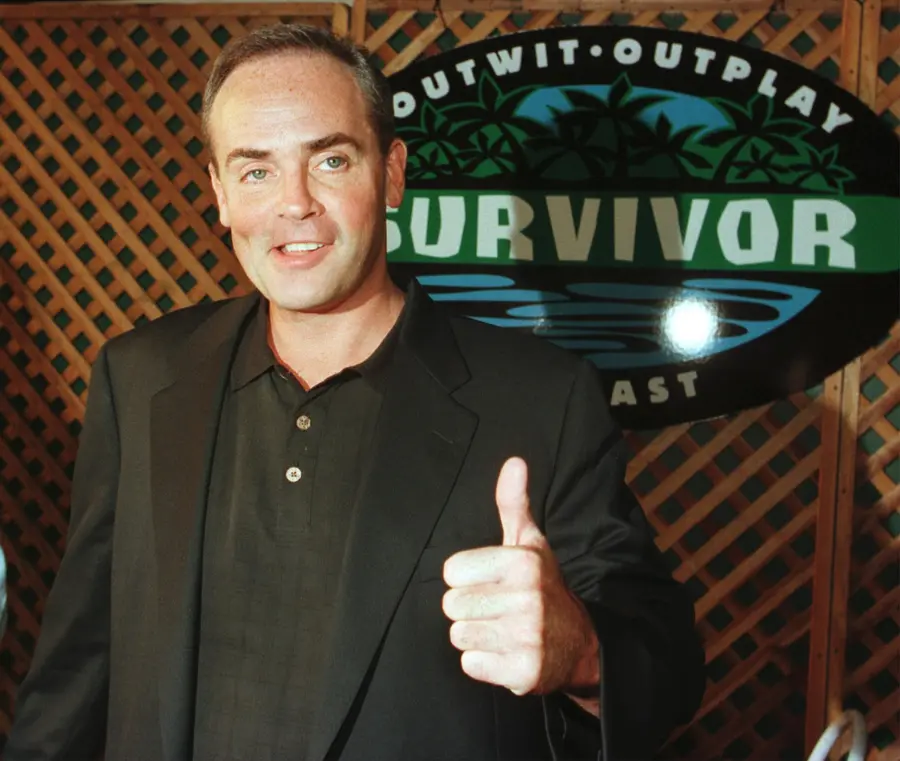
(Photo by Online USA via Getty)
The Original Tax Bill
Hatch's problems began almost immediately after "Survivor" ended.
According to federal authorities, he failed to report and pay taxes on more than $1.4 million in income, including his $1 million prize, the Pontiac Aztek he won during the competition, and additional earnings from media appearances such as radio hosting.
At the time, this was not an unusual situation. Reality TV winners, athletes, and entertainers routinely face large tax bills after sudden windfalls. The difference is that most pay them.
Hatch did not.
From the government's perspective, the case was simple: he earned the money, he owed taxes on it, and he failed to report it properly. But Hatch has spent more than two decades arguing that the situation was far more complicated.
The Theory That Started It All
Hatch has long maintained that he did not intentionally evade taxes and that, in his view, the obligation should not have fallen entirely on him.
His core argument has two parts.
First, he has claimed that CBS and "Survivor" creator Mark Burnett should have been responsible for withholding taxes on the prize before it was ever paid out, similar to how employers withhold income taxes from wages.
Second, he has argued that because "Survivor" was filmed in Malaysia, the taxes were actually owed to the Malaysian government, not the IRS. According to Hatch, U.S. law and international tax rules required the production to handle those obligations at the source.
In his telling, he was not trying to avoid taxes. He believed they had already been handled, or should have been handled, by others.
Courts have repeatedly rejected both arguments.
Judges ruled that regardless of where the show was filmed or how the prize was paid, Hatch was personally responsible for reporting his income and paying U.S. federal taxes on it.
From TV Fame To Federal Prison
By 2006, the dispute had escalated into a criminal case.
Hatch was charged with tax evasion and fraud, but a jury ultimately convicted him of filing false personal income tax returns. He was sentenced to 51 months in federal prison and three years of supervised release.
The court also ordered him to file amended tax returns for 2000 and 2001 and pay all outstanding taxes.
According to federal records, he did not fully comply with those requirements.
That failure ensured that the problem would not go away.
The Snowball Effect
In 2010, the IRS formally assessed Hatch's unpaid taxes, penalties, and interest.
From that moment on, the debt began to compound.
Interest accrued year after year. Penalties continued to stack. And because the underlying balance was never resolved, the total amount owed kept growing.
Compounding works both ways. In a best-case scenario, it turns $800,000 into $7 million over time. In Hatch's case, it turned an unpaid tax bill into a financial avalanche.
By the mid-2000s, much of the money he had earned from "Survivor" and its aftermath was already gone, leaving him with a growing liability and fewer resources to address it.
The IRS Comes Back For More
In 2022, the federal government renewed its efforts to finally collect what Hatch owed.
Prosecutors moved to convert the outstanding tax assessments into a formal court judgment, which would give them broader powers to pursue collection. That included attempts to enforce tax liens against two properties in Newport, Rhode Island.
Those properties had been transferred into his sister's name years earlier.
The government argued that Hatch remained the true owner and that the transfers were designed to shield the assets from creditors. If successful, the IRS could have forced the sale of the homes to help satisfy the debt.
That effort failed.
A judge ruled that the government could not prove Hatch retained an ownership interest in the properties. The court also found that the transfers, which occurred in 2003 and 2005, were too old to challenge under Rhode Island law.
It was a rare partial victory for Hatch in an otherwise one-sided legal battle.
The Final Judgment
In March 2026, U.S. District Court Chief Judge John McConnell Jr. entered a final judgment ordering Hatch to pay $3,293,471.
The ruling covered federal income tax liabilities from 2000, 2001, and later years, along with decades of accumulated penalties and interest. It also cleared the way for the federal government to begin collection using standard debt enforcement tools.
Hatch has appealed the decision to the U.S. Court of Appeals and has, at times, represented himself in court.
He has remained publicly optimistic about his chances, insisting that the full story has not yet been properly considered.
/2015/01/richard-hatch-1.jpg)
/2011/05/niki-taylor-1.jpg)
/2009/11/GettyImages-53188813.jpg)
/2018/11/Dick-Durbin.jpg)
/2015/10/GettyImages-166541319.jpg)
/2015/06/GettyImages-479969344.jpg)
/2017/02/GettyImages-528215436.jpg)
:strip_exif()/2009/09/P-Diddy.jpg)
/2020/02/Angelina-Jolie.png)
/2019/11/GettyImages-1094653148.jpg)
/2009/09/Brad-Pitt.jpg)
/2019/10/denzel-washington-1.jpg)
/2020/01/lopez3.jpg)
:strip_exif()/2015/09/GettyImages-476575299.jpg)
/2009/11/George-Clooney.jpg)
/2019/04/rr.jpg)
/2020/06/taylor.png)
/2009/09/Jennifer-Aniston.jpg)
/2018/03/GettyImages-821622848.jpg)
/2020/04/Megan-Fox.jpg)
/2009/09/Cristiano-Ronaldo.jpg)