
Most people have a vague sense that Pokémon trading cards were a huge deal in the late 1990s. I was around 16 when they started popping up in schools, so they weren't something I ever paid much attention to. But clearly, they mattered. A lot. And somehow, decades later, they still do.
When Logan Paul fought Floyd Mayweather back in June 2021, he famously walked into the ring wearing a Charizard Pokémon card around his neck.
And just last month, Logan sold an ultra-rare Pokémon Illustrator card for $16.5 million, setting a Guinness World Record for the most expensive card ever sold. The buyer was A.J. Scaramucci, son of Anthony Scaramucci.
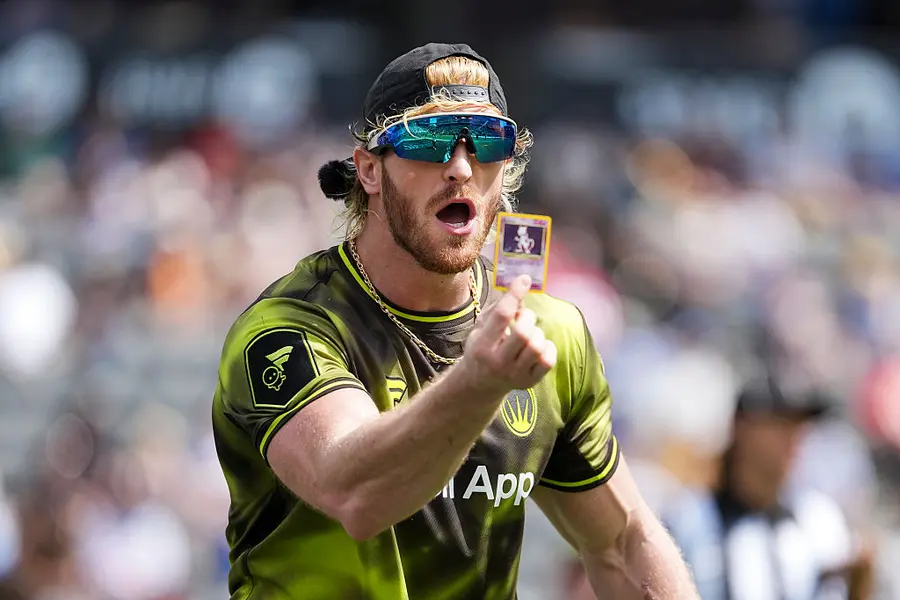
(Photo by Michael Owens/Getty Images for OBB Media – FANATICS STUDIOS )
So again, what is Pokémon?
I mean that both literally and figuratively. Literally, what is a Pokémon? Is it an animal? A creature? Something imaginary?
The simplest answer is that Pokémon are fictional creatures that live in a shared universe with humans. Some resemble animals, some look like plants, some feel almost like aliens or mythical beings. In that world, people capture, train, and battle them, while also forming bonds with them as companions. Think of them as a cross between pets, collectible species, and characters in a game.
And then, zooming out, what is Pokémon as a business? Is it a video game? A cartoon? A movie franchise? A collectible market? The answer is yes to all of the above. But even that doesn't come close to capturing the full picture.
As crazy as this may sound, Pokémon is the single highest-grossing media franchise in human history, generating well over $100 billion in lifetime revenue. It has earned more than Mickey Mouse, more than "Star Wars," more than the Marvel Cinematic Universe, and more than "Harry Potter."
And here's where it gets even more interesting. Pokémon is controlled by a unique three-way partnership between three companies:
- Nintendo
- Game Freak
- Creatures Inc.
Those three companies cooperate through a joint venture called The Pokémon Company, which manages the global brand.
At the center of it all is the quiet, little-known creator who started the entire phenomenon: Satoshi Tajiri.
From "Dr. Bug" to Game Designer
Satoshi Tajiri did not grow up dreaming of building a $100 billion entertainment empire.
He grew up catching bugs.
In the late 1960s and 1970s, Tajiri was raised in Machida, a still-rural suburb outside Tokyo. He spent his childhood wandering through rice paddies, climbing through tall grass, and turning over rocks in search of insects. He wasn't just casually interested. He was obsessed. He studied them, categorized them, memorized their patterns. His friends gave him a nickname: "Dr. Bug."
Then, in a way that would later define his entire career, that world disappeared.
As Japan's economy boomed, Machida rapidly urbanized. The forests and fields were paved over, replaced by apartment buildings and shopping centers. The insects vanished. The environment that had fueled his imagination was gone.
So Tajiri found a new obsession indoors: video games.
He became particularly hooked on early arcade hits like "Space Invaders." But just like with insects, he didn't want to just play. He wanted to understand. He began taking apart hardware, teaching himself how games worked, and eventually learning how to program.
At 16, he started a handmade gaming magazine called "Game Freak," which he distributed in arcades. A young artist named Ken Sugimori discovered the zine, reached out, and the two formed a partnership that would change entertainment history. By 1989, they had turned "Game Freak" from a stapled fanzine into a legitimate video game development studio.
The Six-Year Gamble That Almost Failed
The idea that would become Pokémon came from a simple piece of hardware.
When Tajiri saw the Game Boy and its link cable, he didn't see competition. He saw connection. He imagined creatures moving between devices, like bugs crawling from one child to another.
He pitched the concept, originally called "Capsule Monsters," to Nintendo. The idea was strange, complicated, and unlike anything on the market. But legendary designer Shigeru Miyamoto saw potential and agreed to mentor Tajiri.
What followed was a brutal six-year development process.
Game Freak nearly collapsed. Several employees quit. Tajiri stopped paying himself entirely and moved back in with his parents to survive. At one point, the project was so delayed and over budget that it looked like it might never be finished.
Finally, in 1996, "Pokémon Red" and "Pokémon Green" were released in Japan.
At first, nothing happened.
Sales were slow. The launch was quiet. It looked like a commercial disappointment.
Then something strange occurred.
Rumors began spreading among schoolchildren about a secret, hidden creature buried deep in the game's code: Mew. Whether through glitches or special events, the only way to obtain it was by interacting with other players.
That single mechanic, trading, changed everything.
Pokémon wasn't just a game you played alone. It forced you to connect with other people in the real world. You had to trade, compare, collaborate, and compete.
The result was explosive.
Pokémania and Global Domination
Once Pokémon caught on in Japan, it spread like wildfire.
The franchise quickly expanded beyond games. The trading card game launched. The animated series debuted. Merchandise flooded the market. By the time Pokémon reached the United States in 1998, it wasn't a new idea. It was a fully weaponized global brand.
The impact was immediate and chaotic.
Schools banned Pokémon cards because playgrounds turned into trading markets, complete with arguments, theft, and negotiations over rare holographic cards. Kids memorized hundreds of character names. The phrase "Gotta Catch 'Em All" became a cultural mantra.
Within a few years, Pokémon had embedded itself into global pop culture in a way very few franchises ever achieve.
And unlike most "fads" from that era, it never went away.
The Secret Behind Its Staying Power
Most people assumed Pokémon would burn out like Beanie Babies or Pogs.
They were wrong.
The reason Pokémon endured comes down to its structure.
Because the franchise is jointly owned by Nintendo, Game Freak, and Creatures Inc., no single entity could oversaturate it or run it into the ground. Each company focused on its specialty. The games evolved. The cards evolved. The shows evolved.
At the same time, Pokémon's core concept never changed: collect, organize, and master a growing universe of creatures.
That simple loop proved timeless.
It also turned out to be uniquely appealing to a wide range of players, including many who found comfort in its structured, rule-based world.
The Three-Headed Structure That Made It Bulletproof
Most people assumed Pokémon would burn out like Beanie Babies or Pogs.
They were wrong.
The real reason Pokémon didn't flame out comes down to one thing most fans have never even heard of: its ownership structure.
Pokémon isn't run by a single company. It's controlled by three separate entities that each handle a different piece of the empire: Nintendo, Game Freak, and Creatures Inc..
Because of this joint structure, no single entity could oversaturate the brand or run it into the ground. Each company focused on its specialty, constantly feeding the same ecosystem from different angles.
Nintendo publishes the games and owns the trademarks. Game Freak designs and builds the core video game experience. But the third company, Creatures Inc., is where things get especially interesting.
Creatures Inc. was founded by Tsunekazu Ishihara, who would go on to become the longtime CEO of The Pokémon Company. In the mid-1990s, as Game Freak was burning cash and teetering on collapse during the development of the original games, Creatures stepped in to help keep the project alive.
In exchange for saving the franchise, they didn't just get a thank you.
They got a seat at the table.
Creatures secured a one-third stake in Pokémon and took charge of creating the trading card game, which would become one of the most lucrative arms of the entire empire.
Which brings us right back to that $16.5 million card.
The same cardboard collectibles that were getting kids in trouble on playgrounds in 1999 are now being treated like fine art, bought and sold by investors, celebrities, and collectors at prices that would have been unthinkable when the franchise first launched.
The 2016 Moment That Proved Everything
If there was ever doubt about Pokémon's relevance, it disappeared in the summer of 2016.
That's when "Pokémon GO" launched.
For a few months, the entire world seemed to step outside at the same time. Parks were packed. Cities were flooded with players. Complete strangers talked to each other in public spaces, all chasing the same digital creatures layered over the real world.
The game generated over 100 million downloads in its first month and billions in revenue over time.
So… How Rich Is The Guy Who Created Pokémon?
Today, nearly 30 years after its debut, Pokémon is larger than ever.
In 2024 alone, the franchise generated roughly $12 billion in retail sales. The trading card market remains so intense that stores regularly deal with scalpers and shortages. New digital products, like mobile card games, are generating billions more.
At the center of all this is The Pokémon Company, which manages the brand and distributes profits to its three owners.
In a recent year, the company reported around $400 million in net profit. That means each of the three parent companies, including Game Freak, receives roughly $130 million annually.
And that brings us back to the original question: Who actually gets rich from Pokémon?
As the founder, president, and CEO of Game Freak, Tajiri holds a significant ownership stake in a private company that effectively controls one-third of the most valuable intellectual property on Earth.
Based on standard valuation multiples, a company like Game Freak, generating over $100 million in annual profit while holding a permanent stake in Pokémon, would likely be valued between $1.5 billion and $2 billion. If Tajiri owns an estimated 30% to 50% of the company, his personal equity alone could reasonably be worth between $450 million and $750 million. And that's on top of any salaries, bonuses, and dividends he's received in the last thirty years.
A Mysterious Half-Billionaire
So, where is the man sitting on this half-billion-dollar fortune? If you search for Satoshi Tajiri on Getty Images, the world's premier database for celebrity and editorial photography, you will find absolutely nothing. There are no recent paparazzi shots, no red-carpet appearances, and no photos of him stepping off a private jet or wearing a diamond necklace at WrestleMania.
Despite being the architect of the most valuable intellectual property on Earth, Tajiri is practically a ghost. His personal life is a fiercely guarded vault; whether he is married, has children, or where exactly his Tokyo home is located remains entirely unknown to the public. There are no outward signs of his immense wealth. He does not give interviews. He is notoriously reclusive and operates on a highly eccentric schedule, historically known to work for 24 hours straight and then sleep for 12.
Widely understood to be on the autism spectrum, Tajiri seems entirely uninterested in the fame, the power, or the dizzying financial metrics of the empire he built. He is a man perfectly content to remain in the shadows while his creation stands in the blinding spotlight.
There is a profound, almost poetic irony to all of this. Satoshi Tajiri never set out to create a $100 billion corporate behemoth, nor did he intend to manufacture the most expensive pieces of cardboard on the planet. He simply wanted to digitally bottle the quiet, solitary joy of being a kid in the woods, turning over rocks to find insects in the dirt. He built a world to share his hyper-focused obsession—and in the end, "Dr. Bug" accidentally caught all of us.
The 20 Highest-Grossing Media Franchises of All Time
| Franchise | Revenue |
|---|---|
| Pokémon | $115 billion |
| Mickey Mouse & Friends | $61.2 billion |
| Winnie the Pooh | $50.2 billion |
| Star Wars | $46.7 billion |
| Disney Princess | $45.4 billion |
| Anpanman | $38.4 billion |
| Barbie | $36.3 billion |
| Marvel Cinematic Universe | $35.2 billion |
| Harry Potter / Wizarding World | $34.7 billion |
| Hello Kitty | $33.5 billion |
| Call of Duty | $31 billion |
| Batman | $29.9 billion |
| Spider-Man | $26.8 billion |
| Transformers | $25 billion |
| Dungeon Fighter Online | $22 billion |
| Cars | $21.5 billion |
| Candy Crush | $20 billion |
| Looney Tunes | $17.46 billion |
| Teenage Mutant Ninja Turtles | $17.4 billion |
| SpongeBob SquarePants | $16.6 billion |
/2019/09/GettyImages-1148012567.jpg)
/2020/02/jp.jpg)
/2012/08/Paul-Ryan1.jpg)
/2014/05/paul-wesley-1.jpg)
/2025/09/logan-house.png)
/2022/06/GettyImages-1198331442.jpg)
/2018/03/GettyImages-821622848.jpg)
/2019/10/denzel-washington-1.jpg)
/2020/02/Angelina-Jolie.png)
/2009/11/George-Clooney.jpg)
/2020/01/lopez3.jpg)
/2020/06/taylor.png)
/2019/11/GettyImages-1094653148.jpg)
/2009/09/Jennifer-Aniston.jpg)
:strip_exif()/2009/09/P-Diddy.jpg)
:strip_exif()/2015/09/GettyImages-476575299.jpg)
/2020/04/Megan-Fox.jpg)
/2009/09/Brad-Pitt.jpg)
/2009/09/Cristiano-Ronaldo.jpg)
/2019/04/rr.jpg)
/2017/02/GettyImages-528215436.jpg)