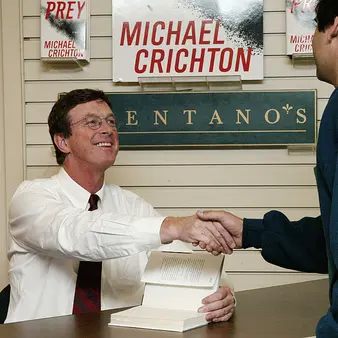
On November 4, 2008, Michael Crichton died at age 66, leaving behind an extraordinary entertainment empire that included "Jurassic Park," "Westworld," dozens of bestselling novels, and one of the most lucrative television contracts in Hollywood history.
Exactly 18 years later, to the day, a California appeals court handed his widow, Sherri Crichton, a potentially valuable victory in a legal fight over the hit HBO medical drama "The Pitt."
In a unanimous ruling issued Wednesday, November 4, 2026, a three-judge appellate panel determined that "The Pitt" shares enough similarities with Crichton's legendary NBC series "ER" to allow his estate's breach-of-contract lawsuit against Warner Bros. Television to proceed.
The decision is significant not just because "The Pitt" is one of television's most acclaimed dramas. It's significant because of the extraordinary financial deal Crichton negotiated when he created "ER" in 1994.
As we explored in a deep dive published in January, Crichton and his estate earned an astonishing $280.8 million from "ER" through a combination of producer fees, creator royalties, and backend profit participation.
Now, nearly two decades after his death, one of the contractual protections he negotiated more than 30 years ago could potentially produce another major payday.
How "The Pitt" Became An "ER" Lawsuit
The dispute traces back to 2020, when Noah Wyle, who became a household name playing Dr. John Carter on "ER," approached his former showrunner, John Wells, about bringing the character back to television.
The proposed series would revisit Carter years after the original show's conclusion, following an older, more battle-scarred physician navigating the relentless pressures of emergency medicine. Warner Bros. Television was interested, and negotiations began with Sherri Crichton, who controlled the contractual rights her husband had retained.
Those negotiations ultimately collapsed. According to the estate's lawsuit, Warner Bros. had been preparing to revive "ER," complete with draft publicity materials, but could not move forward without Sherri's approval.
Rather than abandon the project, the creative team developed a new medical drama. The setting moved from Chicago to Pittsburgh. Wyle's character changed from Dr. John Carter to Dr. Michael "Robby" Robinavitch. The new show was called "The Pitt."
Warner Bros. maintained that this was an entirely original production, with different characters, a different hospital, and its own storytelling approach. The Crichton estate saw things differently.
In August 2024, months before "The Pitt" premiered, the estate filed a lawsuit accusing Warner Bros. of taking a proposed "ER" revival, changing the names and location, and proceeding without the permission required under Michael Crichton's original agreement.

(Photo by Phillip Faraone/Getty Images for HBO Max)
What The Appeals Court Just Decided
The latest ruling represents a major development in that dispute.
Warner Bros. had attempted to dismiss the lawsuit under California's anti-SLAPP law, which protects defendants against certain lawsuits targeting constitutionally protected speech and creative expression. A trial court rejected that effort in February 2025, and Warner Bros. appealed.
On Wednesday, the California Court of Appeal agreed that the estate had presented enough evidence for its claims against the television studio to move forward.
The judges identified numerous similarities between the original "ER" and "The Pitt," including their frantic emergency-room settings, overlapping medical crises, graphic depictions of injuries, rapid-fire dialogue, technical medical terminology, and portrayals of young doctors struggling to cope with the demands of hospital life.
The court also considered the arrangement of these elements, rather than simply whether both programs happen to be medical dramas.
In its opinion, the court stated:
"There are clear and numerous similarities between The Pitt and ER."
Importantly, the judges concluded that the estate had presented a viable preliminary case even under the narrower, more demanding definition of a derivative work advocated by Warner Bros.
That doesn't mean the court has decided "The Pitt" illegally copied "ER." The ruling establishes that the estate has enough evidence to continue pursuing its contractual claims. Whether Warner Bros. ultimately violated Crichton's agreement remains unresolved.
The appellate court also gave the defense a partial victory. It ordered the dismissal of claims against Wyle, Wells, Wells' production company, showrunner R. Scott Gemmill, and the other defendants besides Warner Bros. Television. The judges found insufficient evidence to establish that those parties knowingly interfered with the specific contractual restrictions.
But the central lawsuit against Warner Bros. Television survives, and the estate can now continue pursuing its case.
In a statement following the ruling, Sherri Crichton said she was deeply gratified by the decision and looked forward to presenting the case to a jury. She emphasized that the dispute has implications for writers, creators, and the families and estates that inherit their rights.
How Michael Crichton Made $280 Million From "ER"
To understand the financial stakes, it helps to appreciate just how extraordinary Michael Crichton's original "ER" deal was.
Crichton first conceived the project in 1974, drawing on his experiences at Harvard Medical School to write a screenplay about a chaotic day inside a hospital emergency department. The project sat dormant for years before being revived in the early 1990s with the involvement of Steven Spielberg and Amblin Entertainment.
When "ER" debuted on NBC in September 1994, it became a sensation. The series helped launch George Clooney into superstardom, made Wyle a household name, and dominated Thursday-night television for years.
Over 15 seasons and 331 episodes, "ER" generated billions in television revenue, international licensing, syndication, and other distribution deals. According to financial figures cited in the estate's litigation, Warner Bros. generated more than $3.5 billion from the franchise.
Crichton had negotiated an extraordinary participation in that success.
His original 1994 agreement included a $7,500 per-episode royalty tied to his "Created By" credit, producer fees initially ranging from $35,000 to $40,000 per episode with escalations, and a share of merchandising revenue.
Those per-episode payments alone amounted to roughly $16 million over the show's original run.
But the real money came from the backend.
Crichton's contract entitled him to 17.5% of the show's Adjusted Gross Proceeds, an unusually generous participation for a television creator. That gave him a substantial financial interest in the revenue generated by the series long after episodes originally aired.
According to figures disclosed by the estate's attorneys, Crichton's backend participation ultimately worked out to roughly $800,000 per episode.
Multiply that by 331 episodes:
$264,800,000
Add the roughly $16 million in upfront royalties and producer fees, and the total reaches:
$280,800,000
That is the cumulative "ER" windfall we calculated in January, covering earnings received by Crichton during his lifetime and by his estate following his death.
And remember, "ER" was only one component of his financial empire. His bestselling novels, the "Jurassic Park" franchise, other film adaptations, and his extensive art collection contributed to a fortune worth hundreds of millions of dollars.
But the amount of money "ER" generated also helps explain why the estate is so determined to protect the contractual rights attached to the series.
The 1994 Contract That Could Cost Warner Bros. Millions
Beyond negotiating a generous share of "ER" profits, Crichton insisted on an unusual contractual protection known as a "frozen rights" provision.
The clause required mutual agreement among Crichton, Amblin, and Warner Bros. before the studio could produce sequels, remakes, spinoffs, or other derivative works based on "ER."
The provision effectively gave Crichton approval rights over future extensions of the franchise. It also ensured that if Warner Bros. wanted to exploit his creation in a new series, he would have the opportunity to negotiate appropriate credit and compensation.
Those rights survived his death.
The estate argues that Warner Bros. attempted to sidestep the provision by transforming an unauthorized "ER" revival into "The Pitt." Warner Bros. counters that the new series is an independent creative work and therefore does not trigger the contractual restriction.
The financial implications are substantial.
"The Pitt" has become a critical and commercial success for HBO Max, winning Outstanding Drama Series at the 2025 Emmy Awards, with Wyle taking home Outstanding Lead Actor in a Drama Series. Its success makes the question of who controls the underlying creative rights especially consequential.
If the estate ultimately proves that Warner Bros. breached Crichton's agreement, it could pursue monetary damages. A negotiated settlement could also involve a substantial payment or some form of financial participation in the series.
There is no publicly established damages figure, and Crichton's original 17.5% participation in "ER" would not automatically entitle his estate to the same percentage of "The Pitt." Any financial award would depend on the claims proved in court, while a settlement would depend on terms negotiated between the parties.
But when the underlying intellectual property has already generated billions of dollars, even a relatively small financial participation in a successful successor series could be enormously valuable.
A Hollywood Contract That Outlived Its Creator
There is a certain irony to the timing of Wednesday's ruling. On the exact 18th anniversary of Michael Crichton's death, a court breathed new life into a legal dispute centered on a deal he negotiated more than three decades earlier.
Crichton understood something that many successful creators never manage to secure: the value of retaining contractual control over what happens to their work after the original project becomes a hit.
When he signed the "ER" agreement in 1994, he couldn't have known the show would run for 15 seasons, generate billions in revenue, or inspire a legal battle involving a new medical drama more than 30 years later. But he made sure that if Warner Bros. ever wanted to revisit the franchise, he and his heirs would have a seat at the negotiating table.
That foresight helped turn "ER" into a $280 million payday. Whether it produces another financial windfall through "The Pitt" remains to be seen.
For now, Warner Bros. has failed to end the estate's central lawsuit, and Sherri Crichton has won the right to continue fighting over the value of her husband's creation.
Eighteen years after his death, Michael Crichton's contracts are still very much alive.