
In 1981, a young sales executive named Howard Schultz walked into a small coffee shop in Seattle's Pike Place Market called Starbucks. At the time, the company operated just four locations and didn't serve drinks. It sold coffee beans, brewing equipment, and little else. But something about the place struck him immediately. It wasn't just the quality of the coffee. It was the atmosphere, the conversations, and the sense of community that seemed to form around a simple cup.
Schultz became convinced that coffee could be more than a product. It could be an experience.
Within a year, he persuaded the company's founders to hire him, and in 1982 he moved to Seattle to join Starbucks as its head of marketing and operations. Not long after, a trip to Italy changed the trajectory of his career. While visiting Milan, Schultz was captivated by the country's coffee culture. Espresso bars were everywhere, serving as daily gathering places where people stopped in multiple times a day. These cafes were woven into the fabric of everyday life.
He returned to Seattle convinced that the United States was missing a "third place" between home and work, and that Starbucks could become that place. The problem was that the company's founders didn't share his vision. They were committed to selling beans, not building a coffeehouse chain.
Unable to convince them, Schultz left in 1986 to start his own company, Il Giornale, which was built around the Italian-style coffee experience he had seen overseas. The concept quickly proved successful, but Schultz knew that if he truly wanted to scale his vision, he needed to acquire Starbucks itself.
In 1987, that opportunity arrived when the founders agreed to sell the company for $3.8 million. Schultz didn't have the money, so he began pitching the deal to a small group of Seattle business leaders, looking for investors who understood both risk and opportunity.
One of those investors was a local entrepreneur named Harold Gorlick.
Gorlick was not a venture capitalist or financier. He was a hands-on businessman. His family had emigrated to the United States from Eastern Europe in the early 1920s and eventually settled in Seattle. Like many immigrant families, they built their success from the ground up. In 1951, Harold and his brother co-founded Thrifty Supply Company, a chain of thrift stores that grew steadily across the Pacific Northwest.
By the mid-1980s, Gorlick had built a comfortable fortune and developed a reputation as someone who knew how to spot a good opportunity. So when Howard Schultz approached him with the chance to invest in a small, six-store coffee company, he listened. And ultimately, he decided to invest.
Harold co-founded Thrifty Supply with his brother Morris. For reasons I could not ascertain, as an adult, Morris chose to spell his last name "Gorelick" as opposed to his brother's "Gorlick."
Morris had several children, including a son named Kenneth. Around the time Harold was considering investing in Starbucks, Kenneth was beginning to make a name for himself in the music business.
After getting his start as a sideman for Barry White's Love Unlimited Orchestra while still a teenager, Kenneth Gorelick signed a record deal with Clive Davis' Arista Records in the early 1980s.
Performing under the name "Kenny G," his 1982 debut album went gold. His next two releases went platinum.
By 1986, his fourth album, "Duotones," had turned him into a bona fide star, thanks to the hit instrumental single "Songbird."
By the mid-1980s, Kenny G was in his mid-20s and, for the first time in his life, had meaningful money to invest. Around that same time, his uncle Harold reached out with a suggestion.
As Kenny would later recall in interviews, the message was simple: he had been selling a lot of records, he had some cash, and he should meet a guy named Howard Schultz who was raising money for a small Seattle coffee company called Starbucks.
Kenny listened.
At the time, Starbucks was still a tiny regional business. The company had just six stores, all in the Seattle area, and generated only a few million dollars in annual revenue. It wasn't publicly traded, and there were no guarantees it ever would be. In fact, Starbucks was still five years away from its 1992 IPO. What Schultz was pitching to investors like Gorlick and Kenny G wasn't a proven global brand. It was a risky bet on the idea that Americans might someday embrace espresso bars and pay a premium for coffee.
Kenny decided to invest. He also performed at a handful of store openings in those early days. Here he is performing at the opening of a Starbucks in Manhattan in 1999:
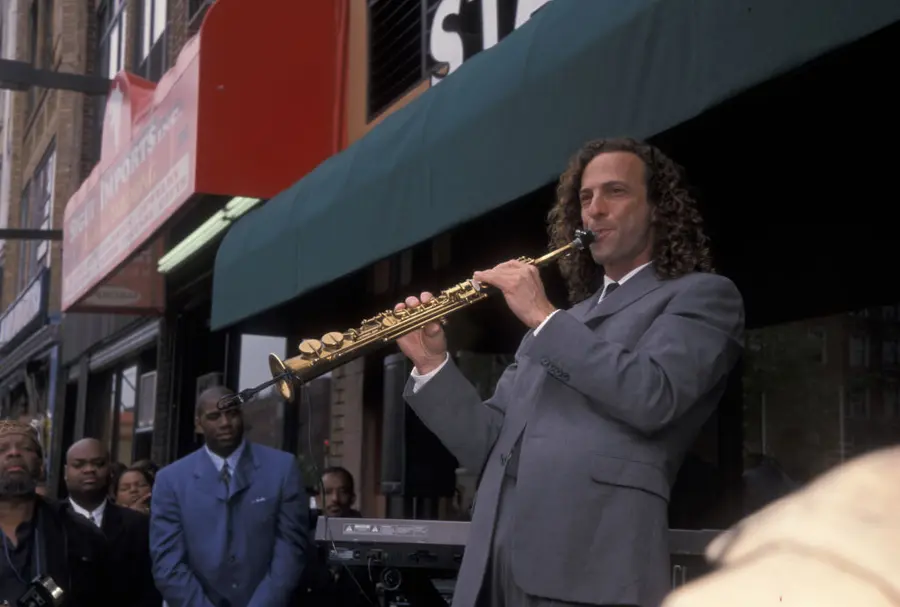
(Photo by Ron Galella, Ltd./Ron Galella Collection via Getty Images)
In the years that followed, Starbucks grew at a pace few could have imagined. The company expanded beyond Seattle, then beyond the West Coast, and eventually across the globe. By the time it went public in 1992, it had already grown to 165 stores. At its IPO on June 26, 1992, Starbucks was valued at roughly $250 million to $271 million.
What happened next is where the story gets interesting.
By mid-1996, Starbucks' market cap had climbed to around $2 billion. Just three years later, in 1999, it reached roughly $7 billion. Over the next two decades, the company continued to grow steadily, eventually hitting an all-time high market value of $144 billion in July 2021.
From its IPO to today, Starbucks stock has delivered a total return of more than 26,500%.
Today, Starbucks operates more than 41,000 locations worldwide and is worth roughly $115 billion.
So what did that early investment turn into for Kenny G?
Over the last decade, a persistent rumor has circulated that Kenny G made more money from his Starbucks investment than he did from his entire music career.
That is almost certainly a bit of a stretch.
The origin of that claim appears to trace back to a 2014 Reuters interview in which Kenny discussed his investing habits and the success of his portfolio. In that interview, he said that over the previous 10-year period, which would have included the lowest point in the record selling businsess, he had earned about as much money from stock trading as he had from music royalties.
That's very different from saying his Starbucks investment alone surpassed his lifetime music earnings. But the distinction has been blurred over time.
However, in that same 2014 interview, Kenny revealed that he still owned "a fair amount" of his original shares.
So let's do some quick napkin math to estimate what that might mean.
If you invested $1,000 in Starbucks at the 1992 IPO and never sold a share, today you would have $340,000. If you invested pre-IPO, you would have significantly more, but we can't calculate for sure without knowing the company's pre-IPO valuation. So let's just use the IPO return.
It's also safe to assume that he didn't invest a token amount. By the mid-1980s, Kenny G was already a successful recording artist with multiple gold and platinum albums. It is also safe to assume that Howard Schultz wasn't looking for investors to chip in a couple grand. The pre-IPO investment group was made up of very prominent Seattle businessmen. In addition to Kenny's uncle, one of Starbucks' key backers in those early days was Bill Gates' father, Bill Gates Sr.
Let's assume Kenny chipped in $100,000. Using the IPO baseline, $100,000 invested would be worth $34 million today.
We currently estimate Kenny G's net worth at $100 million. That number is based on a combination of his estimated stock holdings (he also owns early shares in Apple), his music catalog value, royalties earned from his 75 million records sold and his real estate holdings.
Speaking of his real estate holdings…
We actually got a bit of insight into Kenny G's wealth as part of a 2023 alimony dispute filed by ex-wife Lyndie Benson. In a filing that would help calculate his monthly spousal support obligation, Kenny revealed that his monthly rental income was…
$600,000
Not $600,000 per year. $600,000 PER MONTH. Want to know who was paying that much to rent his mansion? As it turns out, fellow former Seattleite, Jeff Bezos. Jeff and Lauren Sanchez rented Kenny's Malibu compound while they were completing their own nearby estate. Kenny's blufftop Malibu compound is actually two estates combined into one. He paid $12.5 million for the first half in 1997 and $3 million for the second half a few years later. Today, this property is almost certainly worth $40 million.
Has Kenny G made more money from Starbucks than from his music career? Almost certainly not. But again, that's not what he said in the 2014 Reuters interview. In that interview, he claimed that in the previous decade, he made more from investing than from music royalties. Even that statement is probably not accurate when applied to the next decade, when the streaming model was launched and eventually perfected.
Either way, he has forged an extremely impressive multi-faceted career. Musician. Venture capitalist. Real estate investor.
When we look back at the history of Starbucks, it is easy to assume its global dominance was inevitable. But in the late 1980s, investing in Howard Schultz's vision required a massive leap of faith. It took people who were willing to look past a local bean-roaster and see the potential for a cultural shift in how Americans consumed coffee.
Kenny G made that leap. And while his saxophone is what made him a global household name, his keen eye for opportunity—whether it was an unproven espresso bar in Seattle or premium, blufftop real estate in Malibu—proves that his sense of timing extends far beyond the recording studio. He may not have made more from coffee than he did from music, but thanks to a perfectly timed introduction from his uncle, he secured his place in one of the greatest venture capital success stories in modern history.
/2011/12/Howard-Schultz.jpg)
/2019/01/bucks.jpg)
/2018/06/GettyImages-957041746.jpg)
/2016/12/howard.jpg)
/2019/11/Magic-Johnson.jpg)
/2019/10/Kenny-G.jpg)
:strip_exif()/2015/09/GettyImages-476575299.jpg)
/2009/09/Jennifer-Aniston.jpg)
:strip_exif()/2009/09/P-Diddy.jpg)
/2009/11/George-Clooney.jpg)
/2020/02/Angelina-Jolie.png)
/2018/03/GettyImages-821622848.jpg)
/2019/04/rr.jpg)
/2009/09/Brad-Pitt.jpg)
/2009/09/Cristiano-Ronaldo.jpg)
/2020/06/taylor.png)
/2019/11/GettyImages-1094653148.jpg)
/2020/01/lopez3.jpg)
/2020/04/Megan-Fox.jpg)
/2019/10/denzel-washington-1.jpg)
/2017/02/GettyImages-528215436.jpg)