
Earlier today, Tim Cook revealed that John Ternus will take over as Apple CEO later this year.
John inherits one of the most valuable companies in history and one of the most profitable business models ever created. His challenge will be navigating the artificial intelligence revolution, managing increasingly complex global supply chains, and continuing a culture of innovation that has defined Apple for decades.
Pop quiz: Without looking it up, how many CEOs do you think Apple has had?
Most people can name two Apple CEOs instantly: Steve Jobs and Tim Cook. I'm also willing to bet that most people assume Steve Jobs was Apple's first CEO. After all, he was the co-founder and primary face of the company in its infancy. But that's not true!
Steve Jobs was not Apple's first CEO. He wasn't the second or third. He was CEO #6. Steve Jobs did not become CEO of Apple until 1997. That's 21 years after he, Steve Wozniak, and Ronald Wayne incorporated the business.
Here's another fun fact: Apple's first CEO was a guy named… Michael Scott 🙂
Believe it or not, John Ternus will be the EIGHTH person to serve as CEO of Apple. Who are and what happened to all the other Apple CEOs?
Apple CEOs: Tenure & Market Cap at Exit
| CEO & Tenure | Market Cap at Exit |
|---|---|
| 1. Michael Scott Feb 1977 – Mar 1981 (4 years) | ~$1.8 Billion Post-IPO valuation |
| 2. Mike Markkula Mar 1981 – Apr 1983 (2 years) | ~$1.5 Billion |
| 3. John Sculley Apr 1983 – Jun 1993 (10 years) | ~$2.5 Billion |
| 4. Michael Spindler Jun 1993 – Feb 1996 (2.5 years) | ~$3 Billion |
| 5. Gil Amelio Feb 1996 – Jul 1997 (1.5 years) | ~$2.3 Billion |
| 6. Steve Jobs Jul 1997 – Aug 2011 (14 years) | ~$348 Billion |
| 7. Tim Cook Aug 2011 – Sept 2026 (15 years) | $4 Trillion |
| 8. John Ternus Sept 2026 – Present (Incoming) | Incoming Taking over $4T empire |
Apple CEO #1. Michael "Scotty" Scott (Feb 1977 – Mar 1981)
- Market Cap Impact: Scott arrived when Apple was a private garage project worth zero. He exited shortly after the IPO, with the company valued at roughly $1.8 billion.
In 1977, Steve Jobs and Steve Wozniak were brilliant, but they were also unwashed, barefoot twenty-somethings operating out of a garage. Early investors demanded "adult supervision." Enter Mike Markkula, who poached Michael Scott from his director gig at National Semiconductor. Scott's mandate was simple: turn a pirate ship into a corporation.
Scott did exactly what he was hired to do. He established credit lines, banned typewriters (forcing employees to use Apple computers), and successfully navigated the company's blockbuster 1980 Initial Public Offering. Scott's early equity stake made him spectacularly wealthy during the 1980 IPO, netting him a nine-figure fortune almost overnight.
Unfortunately, his bedside manner was practically psychopathic. On February 25, 1981—a day known internally as "Black Wednesday"—Scott personally fired 40 employees he deemed redundant. That afternoon, he gathered the shellshocked survivors around a keg of beer and infamously declared, "I'll fire people until it's fun again."
Following the Black Wednesday debacle, the board quickly demoted Scott to Vice Chairman—a title with no real power. He quit a few months later. He subsequently founded a private spaceflight company that failed, before pivoting his vast fortune toward gemology. He quietly built one of the most valuable private collections of colored gemstones in the world. He remained an intensely private centimillionaire until his death last year, in April 2025, at the age of 80.
Apple CEO #2. Mike Markkula (Mar 1981 – Apr 1983)
- Market Cap Impact: Apple's market cap was $1.8 billion when he took over. When he handed it off, the company's value had dropped to $1.5 billion.
Mike Markkula was the original angel. A retired Intel millionaire at just 32 years old, he visited Jobs' garage in 1976, saw the Apple II prototype, and cut a $250,000 check to incorporate the business. His initial $250,000 investment bought him a staggering one-third of Apple. Following the IPO, Markkula was worth hundreds of millions of dollars. Today, we estimate his net worth at $1.2 billion.
Following Scott's implosion in 1981, Markkula reluctantly stepped out of the boardroom and into the CEO's office.
Markkula expertly managed the massive cash flow generated by the Apple II, which funded the company's future. However, he also oversaw the disastrous launch of the Apple III—a hardware nightmare that notoriously required users to drop the machine a few inches onto their desks to re-seat the motherboards.
Mike happily handed the CEO title to John Sculley in 1983 but remained a pivotal force on the board of directors until Steve Jobs' triumphant return in 1997. He later founded Echelon Corporation and endowed the Markkula Center for Applied Ethics at Santa Clara University. Today, at 84 years old, he is a quiet Silicon Valley billionaire, living off the monumental wealth generated by his garage-days gamble.
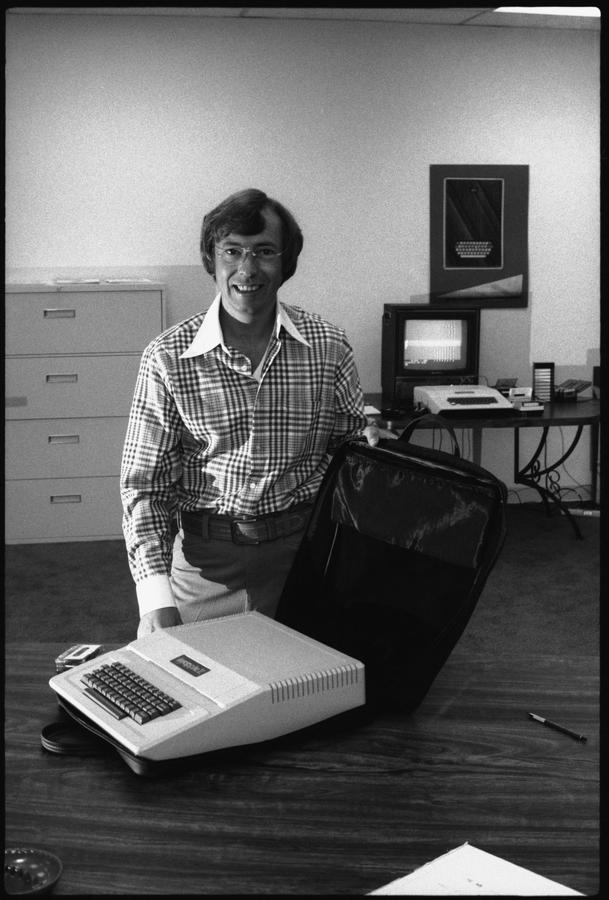
(Photo by Tom Munnecke/Getty Images)
Apple CEO #3. John Sculley (Apr 1983 – Jun 1993)
- Market Cap Impact: Arrived at $1.5 billion; exited at $2.5 billion (though he had peaked the company's value significantly higher mid-tenure).
It is the most famous poaching in corporate history. Steve Jobs lured John Sculley from the presidency of PepsiCo with a devastating guilt trip: "Do you want to sell sugar water for the rest of your life? Or do you want to come with me and change the world?"
Sculley's tenure began with a bang. He oversaw the launch of the Macintosh in 1984, supported by one of the most iconic commercials ever produced. But his legacy is forever tied to 1985, when a bitter boardroom battle resulted in Jobs being stripped of power and ultimately leaving the company to found NeXT.
Despite that fallout, Sculley's early years were financially successful. He grew Apple's revenue from roughly $800 million to $8 billion and introduced popular products like the PowerBook.
For a time, he was also one of the highest-paid executives in America. His compensation package included a $1 million signing bonus, a $1 million base salary, and options on 350,000 Apple shares. By 1987, his total compensation hit $10.2 million, making him the highest-paid executive in Silicon Valley at the time.
In hindsight, those stock options represent one of the great "what could have been" fortunes in tech history. Thanks to multiple stock splits over the decades, that original 350,000-share grant would have ballooned into roughly 78.4 million shares today. At today's price per share of $273, had John Scully never sold a share, today his 78.4 million shares would be worth $21.5 billion. He would also receive around $78 million per year in dividends.
Somewhat shockingly, when John was going through a divorce in 2010, he declared that the marital assets were worth just $4.8 million. In 2015, his ex-wife sued him, claiming he had hidden more than $25 million worth of assets when they divorced. She alleged he did not disclose "substantial private equity investments and investments in privately held companies and ventures around the globe." The ex-wife claimed that he enlisted his brothers, who were also his partners in an investment firm creatively named Sculley Brothers, to transfer or hide assets. Just one of his allegedly hidden assets was worth around $100 million in 2015 when she filed the lawsuit.
In January 2018, Sculley paid $14.925 million for an oceanfront mansion in Palm Beach, Florida. The property includes a private cabana on the beach across the street. He sold this home in September 2025 for $37 million. He had previously listed it for $50 million. We estimate his net worth at $100 million today. Impressive. But ooof what could have been! Never sell your Apple shares!
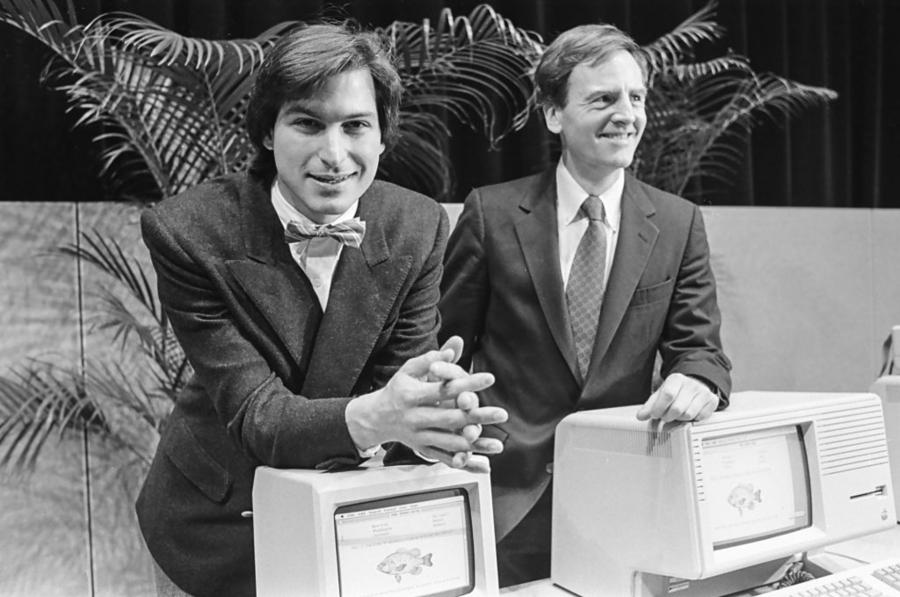
Steve Jobs and John Sculley in 1984 (Photo by Cap Carpenter/MediaNews Group/The Mercury News via Getty Images)
Apple CEO #4. Michael Spindler (Jun 1993 – Feb 1996)
- Market Cap Impact: Inherited a $2.5 billion company; exited near $3 billion, but the cash reserves were evaporating.
Nicknamed "The Diesel" for his grueling, relentless work ethic, the German-born executive climbed the ranks as head of Apple Europe. The board tapped Michael Spindler to replace Sculley, hoping an operations man could fix the bleeding margins.
Spindler successfully pulled off a high-wire hardware act: transitioning the entire Mac lineup from Motorola processors to PowerPC chips without alienating the user base. But that was his only real victory. He allowed the product line to bloat into a confusing matrix of Performas, Centrises, and Quadras. Worse, the company's next-generation operating system (Copland) was a catastrophic failure. Sensing a death spiral, Spindler frantically tried to sell Apple to IBM, Sun Microsystems, and Philips. All refused.
Earning standard mid-90s executive compensation, Spindler left with a multimillion-dollar severance package, though his wealth never approached the stratosphere of his peers.
Utterly burned out, Spindler left the tech world entirely. He retreated into highly guarded privacy, splitting his time between Paris and San Francisco. He died after a brief illness in September 2016 at the age of 73.
Apple CEO #5. Gil Amelio (Feb 1996 – Jul 1997)
- Market Cap Impact: Took over a sinking $3 billion ship; exited with the company valued at roughly $2.3 billion and the stock trading near historic lows.
Apple was reportedly 90 days away from bankruptcy when the board turned to one of their own: Gil Amelio, the CEO of National Semiconductor, who possessed a formidable reputation as a ruthless corporate turnaround artist.
Amelio stopped the immediate bleeding by slashing costs and firing thousands. But his singular, world-shifting legacy was a desperate acquisition. Realizing Apple could not build a modern operating system in-house, he bought Steve Jobs' company, NeXT, for $429 million in late 1996. It brought the underlying code that would become macOS and iOS into Apple—and it brought the wolf back into the hen house. Within months, Jobs convinced the board that Amelio was incompetent. Amelio was unceremoniously fired over the Fourth of July weekend in 1997.
Amelio famously negotiated an ironclad, highly lucrative contract before taking the suicidal job. Upon his firing, he walked away with a $7 million in cash and 135,000 shares of Apple, inciting absolute rage from shareholders.
If Gil never sold a single share of that 135,000 exit package grant, after several stock splits, today he would have around 15 million shares of Apple. Those shares would be worth around $4 billion today. He clearly sold the majority of those shares at some point because owning 15 million shares would make Gil one of the largest individual shareholders today, and that would be disclosed in the company's filings. It is not.
Today, at 83, he lives a quiet life of immense wealth, easily in the tens of millions. Maybe as much as $100 million. Today, he runs a private equity company called Accredo Capital. He was rich enough to have paid $600,000 for a plot of land in Reno, Nevada, in 2013. He and his wife proceeded to build a 14,000-square-foot mansion on the lot, which is located within a gated country club. They sold this home in 2024 for $7.5 million after listing it for $10.75 million.
Apple CEO #6. Steve Jobs (Jul 1997 – Aug 2011)
- Market Cap Impact: Steve inherited a $2.3 billion company on life support. He exited at a staggering $348 billion, briefly surpassing ExxonMobil as the most valuable company on the planet.
The prodigal son returned. Initially operating as a shadow advisor following the NeXT acquisition, Jobs stepped into the breach as "interim CEO" (or iCEO) following Amelio's execution.
Jobs orchestrated the greatest corporate renaissance in the history of capitalism. He purged the board, slashed the product line by 70%, and rebuilt the empire. The iMac, the iPod, the iTunes Store, the Apple Retail Stores, the iPhone, and the iPad—it was a 14-year run of unprecedented, world-bending home runs. His "failures" (the G4 Cube, the iPhone 4 "Antennagate") were mere blips in an otherwise flawless second act.
Jobs famously took a $1 annual salary. In return, Apple's board rewarded him with a Gulfstream V private jet and monstrous stock option grants. Combined with the 138 million shares of Disney he acquired by selling Pixar, his net worth at his peak was estimated at $10 billion.
Jobs resigned on August 24, 2011, as pancreatic cancer ravaged his body. He died six weeks later, on October 5, 2011, at the age of 56. He remains the reigning deity of Silicon Valley.
Apple CEO #7. Tim Cook (Aug 2011 – Sept 2026)
- Market Cap Impact: Inherited a $348 billion giant; as he prepares to step down, he leaves behind a $4 Trillion leviathan.
Cook was recruited by Jobs in 1998 from Compaq. He was an operational savant who fixed Apple's chaotic supply chain, brutally shutting down company-owned factories and outsourcing manufacturing to Foxconn. Jobs handpicked him as his successor.
Wall Street assumed Apple would wither without Jobs' visionary magic. Instead, Cook scaled the ecosystem to unthinkable heights. He launched the Apple Watch, AirPods, Apple Silicon, and the highly lucrative Services division. He weaponized the supply chain and mastered global logistics. His failures were quiet but expensive: the sputtering electric vehicle project (Titan) was ultimately scrapped, and the Vision Pro headset is currently battling for mainstream relevance.
Cook became one of the highest-paid executives in history. While his base salary was capped at $3 million, his performance-based stock grants generated over $1 billion in realized, liquid cash over his 15 years.
At 65, Cook is preparing to hand over the CEO title this coming September to become Apple's Executive Chairman. With a net worth of $2.2 billion, he plans to dedicate his twilight years to philanthropy, having pledged to give away the vast majority of his fortune.
Good luck, John!
John Tenus is inheriting one of the most valuable and iconic companies of all time. Let's say he remains CEO for 10 years. He's starting at a market cap of $4 trillion. What do you think the market cap will be in 2036?
/2012/01/tim.jpg)
/2026/04/john-ternus-2.png)
/2020/10/Rick-Fox.jpg)
/2026/04/hgtv-house.png)
/2026/01/Ilhan-Omar.png)
/2026/04/GettyImages-2237036037.jpg)
/2009/09/Brad-Pitt.jpg)
/2009/09/Jennifer-Aniston.jpg)
/2019/11/GettyImages-1094653148.jpg)
/2020/02/Angelina-Jolie.png)
/2017/02/GettyImages-528215436.jpg)
:strip_exif()/2015/09/GettyImages-476575299.jpg)
/2020/04/Megan-Fox.jpg)
/2009/11/George-Clooney.jpg)
/2009/09/Cristiano-Ronaldo.jpg)
/2019/04/rr.jpg)
:strip_exif()/2009/09/P-Diddy.jpg)
/2020/01/lopez3.jpg)
/2018/03/GettyImages-821622848.jpg)
/2020/06/taylor.png)
/2019/10/denzel-washington-1.jpg)