Jeff Koons has spent four decades convincing wealthy collectors to pay enormous sums for stainless-steel rabbits, balloon dogs, porcelain celebrities, vacuum cleaners and other objects that blur the line between fine art and mass-market kitsch.
Along the way, Koons became one of the richest living artists in the world, with a net worth of $400 million. By our count, Damien Hirst is the only living artist richer than Koons, thanks to his $700 million net worth.
But while collectors were spending fortunes on Jeff Koons, Jeff Koons was quietly spending a fortune collecting other artists. And now we're getting an extraordinary look at just how valuable that collection became.
Koons is selling nine works from his personal collection through Christie's in a group called "Heroes and Lovers." The collection, which spans roughly 500 years of art history and includes works by Pablo Picasso, Édouard Manet and Dutch Mannerist painter Cornelis van Haarlem, is expected to bring around $100 million.
One painting alone could account for $40 million of that total. And Koons bought it for $17.4 million.

Leon Neal/Getty Images
The $17.4 Million Picasso That Could Sell For $40 Million
The centerpiece of the collection is Pablo Picasso's 1969 painting "Le Baiser," or "The Kiss."
Koons bought the painting at Sotheby's in 2008 for $17.4 million. Christie's now expects "Le Baiser" to sell in the range of $40 million.
The painting depicts two abstracted faces merging in an intense kiss and comes from the final years of Picasso's life. Koons has spoken admiringly about Picasso's late work and has described the artist during this period as unusually generous and liberated.
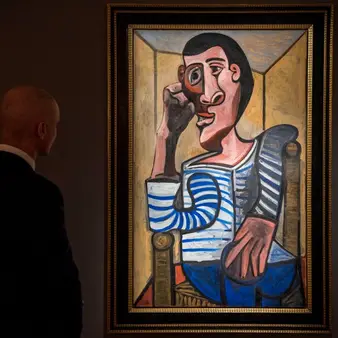
Apparently, he liked it enough to buy more than one. In 2011, Koons paid $10.5 million for another late Picasso from the same period. His collection being sold by Christie's actually contains four works by Picasso, including a portrait of Dora Maar painted in 1941.
He Also Paid $8.1 Million For A 436-Year-Old Painting
Another highlight is Cornelis van Haarlem's 1590 painting "Hercules and Achelous," which depicts the mythological battle between Hercules and the river god Achelous.
Koons bought the painting at auction in 2008 for $8.1 million, paying more than four times its high estimate and setting an auction record for the artist that still stands. Christie's now values it at about $12 million.
The nine-work collection also includes a pastel by Édouard Manet and works by artists including François Le Moyne, Jean-Honoré Fragonard and Tilman Riemenschneider. Seven of the works are scheduled to headline Christie's 20th Century Evening Sale in New York in November. The final two Old Master works are expected to be offered during Christie's Classic Week in early 2027.
Christie's Guaranteed The Collection
Christie's isn't simply taking the works on consignment and hoping bidders show up. The auction house has provided Koons with a guarantee on the collection.
In the high-end auction world, a guarantee means the seller is promised a minimum amount regardless of how the works ultimately perform at auction. Auction houses sometimes take that risk themselves and sometimes bring in third-party guarantors who agree to buy a work at a predetermined price if bidding falls short.
For someone selling a collection expected to generate $100 million, that guarantee significantly reduces the risk of an ugly auction-night surprise.
Christie's has publicly described the seller only as a "distinguished private collector." Multiple people familiar with the transaction identified that collector as Koons.
Meanwhile, Koons' Own Art Once Sold For $91 Million
There's an interesting symmetry here.
Koons is potentially collecting tens of millions of dollars in appreciation from artworks he bought from other artists. At the same time, collectors of Koons' work have experienced some spectacular appreciation of their own.
The most famous example is his 1986 stainless-steel sculpture "Rabbit." Publishing billionaire S.I. Newhouse acquired "Rabbit" for roughly $1 million in 1992. After his death, the sculpture was offered at Christie's in May 2019. It sold for $91.075 million.
The sale made "Rabbit" the most expensive work ever sold at auction by a living artist, surpassing the $90.3 million record David Hockney had established just six months earlier.
Koons had actually held the record once before. His "Balloon Dog (Orange)" sold for $58.4 million in 2013 before Hockney overtook him in 2018.
Those record prices don't mean Koons personally received $91 million or $58 million. Both were secondary-market transactions in which existing collectors were selling works they already owned. But prices like those helped establish Koons at the absolute top of the contemporary art market.
His Market Isn't As Hot As It Once Was
There is one wrinkle.
Koons remains one of the most recognizable living artists in the world, but prices for his work have cooled considerably since the frenzy that culminated with the $91.1 million "Rabbit" sale.
Art-market database ARTDAI estimates that the auction performance of Koons' work has declined nearly 60% over the last decade. That measurement covers public auctions rather than private transactions, but it illustrates how dramatically tastes and prices can move even for an artist once considered nearly untouchable.
Koons has also changed gallery representation several times in recent years. He left longtime dealers Larry Gagosian and David Zwirner for Pace Gallery in 2021 before returning to Gagosian in 2025.
None of that suggests Koons suddenly needs the money.
In fact, the newly revealed collection provides another reason to believe his personal finances are exceptionally strong.
A $400 Million Artist With A $100 Million Art Collection
We currently estimate Jeff Koons' net worth at $400 million, putting him among the richest living artists in the world.
And it's easy to see how a fortune on that scale could have developed.
Koons has operated at the highest levels of the international art business since the 1980s. His works have sold for eight figures, he runs a large studio operation, and he has accumulated significant real estate holdings in New York. He also spent decades acquiring major works by other artists.
Just three purchases disclosed in connection with this sale — "Le Baiser," the second Picasso and "Hercules and Achelous" — cost Koons a combined $36 million.
Now nine works from his collection are expected to generate something in the neighborhood of $100 million.
That's what makes the sale so fascinating.
Jeff Koons became enormously rich by creating art that other wealthy people wanted to collect. Then he took some of that wealth and became a major collector himself. And now, nearly two decades after one of his biggest buying sprees, he's about to find out just how good an art investor Jeff Koons turned out to be.