In February 2013, a Northern California couple set out with their dog for a walk along one of their favorite trails. It was a trail on their own property, one they had walked hundreds, possibly thousands, of times before. They were in their 40s, self-employed, and had recently endured some financial difficulties that threatened their ability to keep the land they loved.
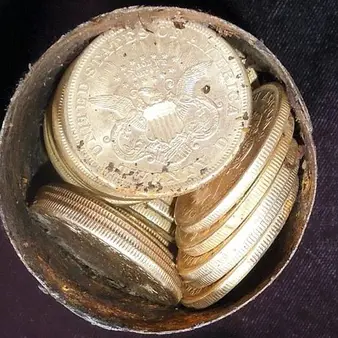
On this particular walk, something caught the woman's eye. Just a few inches off the trail, partially concealed by moss and dirt, was the rusted edge of an old metal can:

Under normal circumstances, finding a rusty piece of garbage on a hiking trail isn't exactly a life-changing experience. But this can was different. What followed became one of the most extraordinary buried-treasure discoveries in American history.
For privacy reasons, the couple has always been identified by the pseudonyms John and Mary. Their property is somewhere in Northern California's historic Gold Country, although its precise location has never been disclosed.
After spotting the can, Mary brushed away some moss and noticed that it appeared to have both ends intact. John grabbed a stick and began digging around it. Eventually, they managed to work the can loose from the soil.
It was incredibly heavy. So heavy that John assumed it must be filled with old lead paint. They decided to carry it home, stopping along the way to rest. Then the lid cracked open.
Through the opening, John caught a glimpse of something that made absolutely no sense: the ridged edge of a gold coin. He looked around almost instinctively, half-expecting somebody to appear and demand that he return what he'd found. Inside the can were stacks of old American gold coins, including a $20 piece dated 1890.
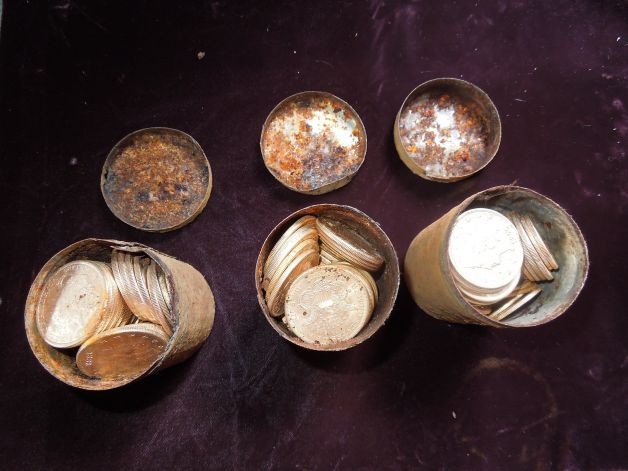
The couple had just discovered buried treasure, but they had no idea how much was still underground. They hurried back to the site and began digging. A foot away from the original can, they uncovered another container filled with coins. Then they found five more small cans. Eventually, using a metal detector, they located an eighth and final container.
Altogether, the couple had unearthed eight rusty cans containing 1,427 gold coins, dating from 1847 to 1894. A routine walk on their own property had turned into an extraordinary discovery.

What Were 1,427 Gold Coins Worth?
The collection, which became known as the "Saddle Ridge Hoard," consisted of 1,373 $20 gold pieces, 50 $10 gold pieces, and four $5 gold pieces. Most had been struck at the San Francisco Mint, although the collection also included a rare gold coin from the Dahlonega Mint in Georgia. Added together, their original face value was exactly $27,980.
Of course, nobody was going to spend these coins at their original face value. They were made of gold, and in 2014, the precious metal alone was worth around $2 million. FYI, in 2014, the price of gold was around $1,200 per troy ounce. Today, gold trades for around $4,200 per troy ounce. So if the couple found the cans today, or found them in 2014 but never sold, today the precious metal alone would be worth just under $6 million!
But the gold content was only a small part of the story.
As it turned out, many of the coins were in extraordinarily good condition. Despite spending more than a century underground, some had barely circulated before being buried. Gold itself doesn't rust, and the deteriorating cans had protected the coins from much of the wear they would have experienced in circulation.
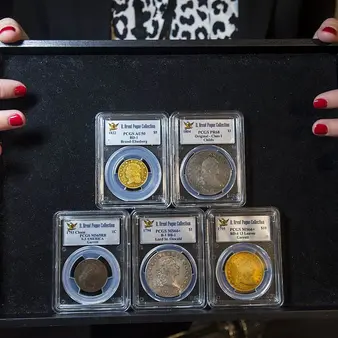
Eventually, the couple contacted Kagin's, a California rare-coin dealer whose specialists spent months examining and conserving the collection. Professional Coin Grading Service authenticated the coins and determined that at least 13 were either the finest known examples of their particular date and mint or tied for that distinction.
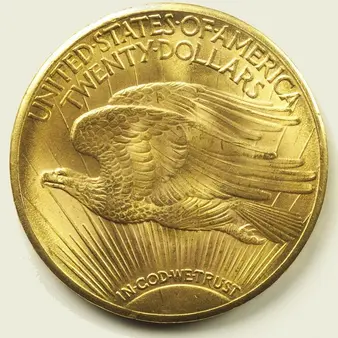
The most valuable was an 1866-S $20 Double Eagle minted in San Francisco without the words "In God We Trust." The coin was graded Mint State 62, making it the finest example of its type certified by PCGS. Experts valued that single coin at around $1 million.
Even more astonishing, one of the specialists explained that improperly cleaning such a coin could have reduced its value from seven figures to just a few thousand dollars. The couple's decision to seek professional help rather than scrub away the dirt potentially preserved an enormous amount of money.
When the entire collection was appraised, the estimated value exceeded $10 million, making it the most valuable known hoard of buried gold coins discovered in the United States. And that raised an obvious question: What do you do when you suddenly find $10 million in gold sitting in your house?
They Buried It Again.
One of the funniest details of the entire story is what happened immediately after the discovery. With more gold than they could possibly comprehend sitting in their house, John and Mary decided the safest thing to do was to put it back underground.
John placed the coins into plastic bags, packed them inside boxes, and put everything into an old ice chest. He then dug a hole beneath the family's firewood pile, lowered the cooler into the ground, and covered it with a slab of building material.
They eventually hired an attorney and brought the coins to Kagin's, where numismatists Donald Kagin and David McCarthy helped them plan an appropriate sale. The collection was formally announced to the public in February 2014, a year after its discovery.
The story attracted international attention. Newspapers and television networks reported on the remarkable find, while coin collectors began preparing to purchase pieces of the treasure. The couple, however, had no interest in becoming celebrities. They refused to disclose their real names, the location of their property, or any details that might encourage treasure hunters to descend on their land.
What Happened When the Treasure Went on Sale?
In May 2014, the coins finally reached the market.
Instead of selling the entire hoard to one wealthy collector, Kagin's arranged for the coins to be offered individually and in smaller groups. Most were listed through Amazon's collectibles marketplace, with particularly valuable pieces handled directly by Kagin's. The sale began on May 27, 2014, and collectors responded almost immediately.
According to figures released by Kagin's and reported by the numismatic press, Amazon sold 346 coins for $1.4 million during the first 24 hours, while Kagin's sold another 225 coins for $2.4 million. Combined, those early transactions represented more than $3.8 million in sales.
One of the first coins sold was an 1874 $20 Double Eagle, which fetched $15,000 at an event benefiting the preservation of San Francisco's historic Old Mint. By December 2014, only 137 coins from the collection remained available through Amazon, according to "Coin World." Many others had already passed into the hands of private collectors.
The most expensive coins proved more complicated to sell. Kagin's initially offered a group of 14 exceptional pieces for $2.75 million, including the celebrated 1866-S No Motto Double Eagle. When the group failed to attract a buyer, the dealer began marketing the coins individually. Even the million-dollar Double Eagle did not immediately sell at its original asking price.
Nevertheless, the hoard had already generated millions of dollars in documented sales, and the couple retained a selection of coins as family keepsakes. The ultimate amount they received was never publicly disclosed, but it has been speculated and estimated that the couple may have received as much as $10 million.
Who Buried the Gold in the First Place?
Perhaps the greatest mystery of the Saddle Ridge Hoard is that nobody has ever established who buried it or why.
One theory involved a famous 1901 theft at the San Francisco Mint, where an employee named Walter Dimmick was accused of stealing $30,000 in gold coins. The stolen amount and denominations bore a superficial resemblance to the Saddle Ridge collection, leading some observers to speculate that the mystery had finally been solved.
The U.S. Mint rejected that theory, announcing that it had no evidence connecting the discovered coins to any theft from its facilities. Researchers who examined the historical records also concluded that the two events were unrelated.
Other theories ranged from a wealthy prospector concealing his savings to a stagecoach robber hiding stolen money. The most straightforward explanation was that someone living in Gold Country had accumulated a fortune and buried it for safekeeping, perhaps because banks were scarce or unreliable.
California's history provides plenty of examples of people doing exactly that. In another story we've covered, a 19th-century prospector named Granville P. Swift reportedly hid a fortune in gold around Northern California, with portions subsequently discovered decades after his death.
As for the Saddle Ridge Hoard, whoever buried it apparently never returned. Maybe the owner died unexpectedly. Maybe the hiding place was forgotten. Or maybe there's a much more complicated story waiting to be uncovered. It sounds like the premise for a movie starring Nicolas Cage, except nobody would need to invent the treasure.
So Did the Couple Actually Retire?
When the discovery became public, one of the most compelling details was the couple's financial situation. They were self-employed, had been struggling through difficult economic circumstances, and feared that they might lose the property they loved. Suddenly, the solution to their financial problems had been sitting beneath their feet the entire time.
The treasure was valuable enough to make retirement a realistic possibility. But when the couple was interviewed by Kagin's in 2014, John said they did not intend to quit working. The point was not necessarily to abandon their careers or transform their lifestyle. It was to stop having money dictate their choices.
The couple planned to use the proceeds to eliminate debts, preserve their property, help relatives, and support local charitable causes. A later account published by the American Numismatic Association stated that they had paid off personal debt and made donations to local charities. They also retained some of the coins to pass down as family heirlooms.
Beyond those details, John and Mary successfully disappeared from public view.
Perhaps the most revealing statement came from Mary, who explained that they loved their existing lives. Their newfound wealth simply meant they no longer had to organize every decision around financial pressure. Which, when you think about it, might be an even better outcome than traditional retirement.
There is something wonderfully satisfying about that ending. Now, if you'll excuse me, I suddenly feel inspired to go for a hike in Northern California. And if I see an old rusty can sticking out of the dirt, I'm definitely not walking past it.