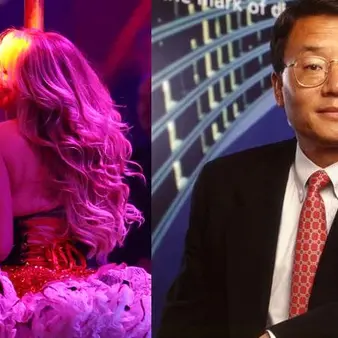
A while back, I went to a strip club for a bachelor party. When I walked in, I had about $100 cash in my wallet. When I walked out, not only was all my cash gone, but the only thing left in my wallet was an ATM receipt for the additional $60 I withdrew while inside the club (with a $5 strip club ATM fee). Why did this happen? Because strippers are absolute Zen masters when it comes to extracting money from men. It's what they were put on this planet to do.
Why did this happen? Because strippers are absolute Zen masters when it comes to extracting money from men. It's practically an art form.
On the other hand, can you imagine some bizarre alternate reality where, instead of taking money from you, a stripper actually ended up saving you a bunch of money? And not a few hundred dollars. Not a few thousand. Not even a few million. I'm talking HUNDREDS OF MILLIONS OF DOLLARS.
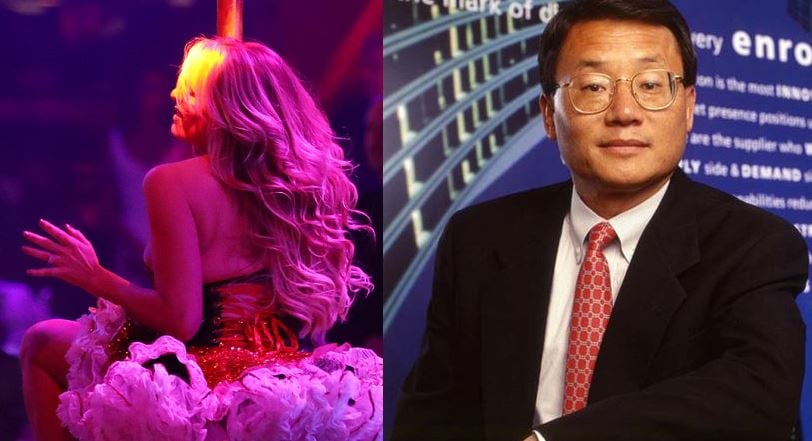
Sounds insane, right? Well, believe it or not, this is essentially what happened to former Enron executive (and alleged stripper aficionado) Lou Pai.
Lou Pai might be the only corporate executive in history whose affair with a stripper, resulting pregnancy, divorce, and spectacularly ill-timed career implosion actually helped him escape a financial catastrophe. By the time the dust settled, he had sold $353 million worth of Enron stock just before the company collapsed into one of the most notorious bankruptcies in American history.
And the craziest part? Had Lou remained happily married and comfortably employed at Enron, he might have watched virtually his entire stock fortune evaporate.
From Nanjing to Enron
Lou Pai was born in Nanjing, China, in 1947 and moved to the United States with his family as a young child. His father, Shih-I Pai, was a distinguished mathematician and aeronautical engineer who eventually became a professor at the University of Maryland, College Park. Lou followed in his father's academic footsteps, earning bachelor's and master's degrees in economics from the same university.
After college, Lou worked for several federal government agencies, including the Securities and Exchange Commission. In 1987, he joined a relatively obscure Houston energy company called Enron.
At the time, Enron was still largely a regional natural gas supplier. But under CEO Ken Lay and rising executive Jeff Skilling, the company was rapidly transforming itself into an energy-trading powerhouse. Within a decade, Enron was one of Wall Street's favorite companies, and Lou Pai had become one of Skilling's most trusted and highest-ranking executives.

James Nielsen/Getty Images
Enron Energy Services
In March 1997, Lou was named CEO of a new subsidiary called Enron Energy Services (EES). The goal was ambitious: revolutionize how American homes and businesses purchased electricity and natural gas.
Think of it like this. Traditionally, consumers have obtained electricity and gas from local utilities at regulated rates. EES wanted to create a competitive marketplace where customers could purchase their energy from alternative suppliers, potentially saving 5% to 15% on their annual energy bills.
Enron spent a fortune advertising the concept and signing customers to complicated long-term contracts. On paper, it sounded brilliant. In practice, it was a disaster.
EES struggled with expensive contracts, unpredictable energy prices, and enormous operating losses. Former manager Margaret Ceconi later alleged that more than $500 million in losses had been shifted into another Enron division to make EES appear profitable. Enron disputed the allegations, but subsequent investigations exposed serious problems with the company's accounting.
Despite these mounting problems, Pai remained one of Enron's most powerful executives. He received generous compensation, enormous stock-option grants, and a valuable arrangement giving him a percentage of the theoretical equity in Enron Energy Services, which he eventually converted into Enron shares.
These stock awards would ultimately make him extraordinarily wealthy.
But before the shit hit the fan for Enron, Lou was enjoying his corporate success in a rather unusual way.
Strip Clubs
When times were good, Lou Pai developed a reputation for enjoying Houston-area strip clubs. Actually, saying Lou had a reputation for visiting strip clubs is an understatement. His enthusiasm was legendary.
According to Bethany McLean and Peter Elkind's excellent book on the rise and fall of Enron, "The Smartest Guys in the Room":
"Only two things seemed to motivate Lou Pai. Money, and a peculiar fascination with strippers."
Lou reportedly visited a particular Houston strip club, located not far from Enron's headquarters, almost every night after work. He allegedly conducted business meetings at the club and rewarded top-performing salesmen with wild backroom parties, some of which were charged to his Enron corporate expense account.
As legend has it, the dancers didn't believe such a mild-mannered, almost meek person was actually a powerful energy executive. So how did Lou prove his identity? According to stories circulating among former employees, he brought dancers up to Enron's lavish corporate offices, where the parties continued late into the night. Pai later denied reports that he had been reprimanded for bringing dancers into the building.
My favorite detail is the alleged method Lou used to avoid getting caught by his wife. On his way home, he would reportedly stop at a gas station and splash a little gasoline on himself to disguise the smell of the strip club.
As you might imagine, coming home every night smelling like gasoline probably isn't a sustainable marriage strategy.
And eventually, Lou's frequent visits to strip clubs turned into a full-on affair with a dancer named Melanie Fewell. There were two problems. Lou was married to his wife, Lanna, with whom he had two children. And Melanie was also married with two children of her own.
Then came a third problem.
Melanie became pregnant.
Lou and Melanie welcomed a daughter in April 1997. When Lanna discovered the affair and the child in early 1998, their marriage began falling apart. Lou eventually moved out of the family home, and in March 2000, he filed for divorce.
Meanwhile, Enron was growing increasingly frustrated with the financial disaster that EES had become. Lou was eventually removed from his leadership position at the subsidiary, briefly transferred to another division, and left Enron altogether in June 2001.
At this point, Lou Pai's life must have seemed like a nightmare. His marriage was destroyed, his personal life was a mess, and his incredibly lucrative corporate career was coming to an end.
Was karma finally catching up with him?
Well, considering what happened next, I'm not sure you can believe karma had much impact on Lou Pai.
(Getty Images/Composite)
The $110 Million Divorce Settlement
Here's where Lou Pai's story takes an extraordinary financial turn.
In 2000, Lou and Lanna began dividing their substantial marital assets. And because so much of Lou's wealth was tied up in Enron shares and stock options, he began liquidating enormous amounts of stock to facilitate the divorce settlement.
How enormous?
According to a 2007 Texas appellate court decision involving Lanna and one of her former financial advisers, Lou and Lanna agreed that their marital estate was worth $193.6 million, excluding certain restricted and unissued securities.
Under their divorce agreement, finalized on August 21, 2000, Lanna received assets valued at $110,536,269, representing more than 57% of that portion of their marital estate. She was also entitled to half of certain additional equity Lou was owed in another Enron-affiliated company.
That's right. Lou Pai's divorce settlement awarded his ex-wife more than $110 million in assets, with additional stock interests on top.
And to make that enormous division of wealth possible, Lou was busy selling Enron shares.
On March 22, 2000, for example, Lou sold 1,760,500 shares at $74.57 apiece, generating more than $131 million in a single day.
Over the following two months, he sold nearly two million additional shares, generating another $130 million.
By the end of 2000, he had converted a huge portion of his Enron holdings into cash. He continued selling shares and exercising options in 2001, including another large series of transactions between May 18 and June 7, shortly before his departure from the company.
Those 2001 transactions took place at an average stock price of $53.78 per share.
When you add up his stock sales over the roughly three-year period leading up to Enron's collapse, Lou Pai generated an astonishing…
$353 MILLION
Now, to be clear, that $353 million represents the aggregate proceeds from his stock sales, not the amount Lou personally pocketed after his divorce settlement, option costs, and other expenses. And not every sale was directly required by the divorce.
But his marital disaster had pushed him to convert a gigantic amount of Enron stock into cash while the company's shares were still trading at extremely high prices.
At the time, that probably seemed like terrible luck.
Imagine being forced to sell hundreds of millions of dollars in stock in a company that everyone believes is going to keep growing forever. It would be like having to liquidate a huge NVIDIA position just before an artificial intelligence boom.
Except Enron wasn't NVIDIA.
And Lou Pai was about to discover that selling all that stock was one of the luckiest things that ever happened to him.
Timing Is Everything
Throughout 2001, Enron's seemingly unstoppable business empire began to unravel. Investors were increasingly questioning the company's accounting practices, the legitimacy of its reported profits, and the enormous debts buried inside complicated partnerships.
Remember, Enron's stock had reached an all-time high of $90.56 in August 2000. Lou had sold millions of shares earlier that year at prices above $70.
Now watch what happened next.
By August 15, 2001, Enron shares had fallen to around $42. By October, they were trading near $15. Meanwhile, executives like Ken Lay and Jeff Skilling were facing growing scrutiny over their own stock sales and public assurances about Enron's financial health.
By November 28, Enron's shares had fallen to approximately $1. On December 2, 2001, Enron filed for bankruptcy.
It was the largest corporate bankruptcy in American history up to that point. Thousands of employees lost their jobs. Investors lost billions of dollars. Workers who had invested their retirement savings in Enron stock watched their financial futures disappear almost overnight.
And Lou Pai?
Lou Pai had already cashed out hundreds of millions of dollars in Enron stock.
His affair, the unexpected pregnancy, and the resulting divorce had helped push him into liquidating a fortune that would have been virtually worthless if it had remained invested in Enron through the company's collapse.
It's one of the most spectacular examples of accidental financial timing you'll ever encounter.
But there's one important complication to the story.
The $31.5 Million SEC Settlement
Lou didn't escape the Enron disaster completely unscathed.
In July 2008, the Securities and Exchange Commission charged him with insider trading related to his stock sales in May and June 2001. The SEC alleged that before those transactions, Pai had received confidential information about serious financial and operational problems at Enron Energy Services.
Specifically, regulators alleged that losses at EES were far worse than the company had publicly disclosed. The SEC argued that Pai knew, or should have known, he could not sell his shares while possessing that information.
Pai maintained that his stock sales were connected to his divorce and financial arrangements. He ultimately agreed to a $31.5 million settlement without admitting or denying the SEC's allegations. The settlement included $30 million in disgorgement and interest, subject to a $6 million credit for money previously relinquished for investors, plus a $1.5 million civil penalty. He also accepted a five-year prohibition on serving as an officer or director of a public company.
That's certainly not an insignificant punishment.
But compare that $31.5 million settlement with the $353 million in stock-sale proceeds he'd generated before Enron imploded.
Lou Pai was never criminally convicted in connection with Enron's collapse, and he never served a day in prison.
Life After Enron
And here's another surprising part of Lou Pai's story. The relationship that destroyed his first marriage didn't turn out to be some brief, regrettable fling.
Lou married Melanie Fewell, who became Melanie Pai. The couple remained together for decades, raising their daughter and developing a shared passion for horses and equestrian competition.
For a time, Lou was also one of the largest private landowners in Colorado. In 1999, he purchased the sprawling 77,000-acre Taylor Ranch in the Sangre de Cristo Mountains for approximately $23 million. The property included Culebra Peak, one of Colorado's famous 14,000-foot mountains.
His ownership became controversial because of longstanding disputes with local residents over historic grazing and access rights. Lou eventually sold the ranch in 2004 for a reported $60 million.
Yes, while the rest of the Enron world was still dealing with the consequences of the company's collapse, Lou had managed to sell a mountain-sized ranch for nearly three times what he paid for it.
He also pursued other business ventures, including Element Markets, a company involved in renewable energy and environmental commodities.
In May 2022, Lou and Melanie purchased an $8.2 million equestrian estate in Wellington, Florida. The property featured extensive stables, riding arenas, and facilities for training horses. Their daughter, Natalie, became an accomplished competitive dressage rider.
So when you put everything together, Lou Pai really is one of the luckiest people in the history of corporate America.
An affair with a stripper destroyed his marriage. The divorce triggered a massive division of wealth, helping push him into selling hundreds of millions of dollars in Enron stock. Months later, one of America's most admired companies collapsed into bankruptcy, wiping out nearly everyone who had remained heavily invested.
And Lou walked away with an enormous fortune, a new wife, a second act in business, and a collection of beautiful horse farms.
I'm not suggesting anyone should follow Lou Pai's example as a wealth-building strategy. In fact, if you're happily married and financially successful, I would strongly advise against trying to replicate any part of his story.
But it's hard to imagine a more extraordinary silver lining to an otherwise spectacular personal disaster.
And believe it or not, there's another wealthy businessman who might understand exactly how Lou feels.
His name is Mikhail Prokhorov, a Russian billionaire and former Brooklyn Nets owner whose own scandalous encounter with the world of paid companionship helped accelerate a business breakup that left him with billions in cash just before the 2008 financial crisis.
You can read that equally ridiculous story here: "How A Private Jet Full Of Prostitutes Saved Mikhail Prokhorov $10 Billion."
I bet Lou and Mikhail would have some fascinating stories to swap over dinner.