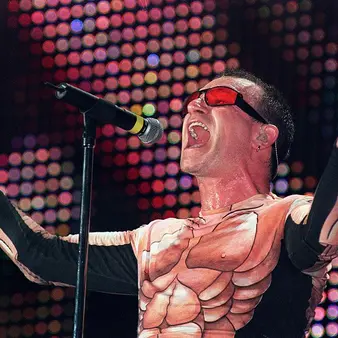
In 2009, U2 frontman Bono was already one of the wealthiest rock stars in the world. His band had sold millions of albums, filled stadiums across the globe, and generated hundreds of millions of dollars from touring. But Bono was also involved in a little-known Silicon Valley investment firm that was about to make one of the most spectacular bets in technology history.
But one of the people who had an opportunity to get in early wasn't a Silicon Valley tech executive or a Wall Street billionaire. It was Bono, the lead singer of U2.
Five years earlier, Bono had helped establish a private equity firm called Elevation Partners. And in November 2009, that firm invested $90 million in Facebook. Seven months later, it invested another $120 million. By the time Facebook went public in May 2012, Elevation's $210 million investment had grown into a stake worth more than $1.5 billion.
That's the kind of investment success most people spend their entire lives dreaming about. So you might understand why Elevation began cashing out immediately after the IPO. Unfortunately, as time has told, that was a HUGE, HUGE, HUGE mistake.
We went back through the company's SEC filings to reconstruct the investment, examine when Elevation reduced its stake, and calculate what those original shares could be worth today. And, perhaps most interestingly, how rich Bono would be today had he never sold a share…

ANDREAS SOLARO/AFP/Getty Images
How Bono Got Into Silicon Valley Investing
In 2004, Bono joined a group of experienced technology and finance executives to establish Elevation Partners, a private equity firm named after U2's song "Elevation." The founding partners included Roger McNamee, a longtime Silicon Valley investor; Fred Anderson, Apple's former chief financial officer; and John Riccitiello, a former president of Electronic Arts.
Elevation raised a $1.9 billion investment fund from pension funds, institutional endowments, and wealthy clients. Its strategy was to acquire stakes in technology, media, and entertainment businesses, including companies whose potential was not yet fully reflected in their valuations.
The firm's investments included Forbes magazine, video game developers BioWare and Pandemic Studios, handheld-computer company Palm, and the consumer review website Yelp. Some performed well, while others, particularly Palm, proved disappointing. But none would come close to the returns generated by Facebook.
The $210 Million Facebook Investment
In November 2009, Facebook was growing at an extraordinary pace. Founded just five years earlier by Mark Zuckerberg, the company had become a dominant force in social networking, but it was still privately owned and had yet to demonstrate the full earning potential of its enormous audience.
Elevation purchased $90 million worth of Facebook shares in a transaction that valued the company at $9 billion. In June 2010, it acquired another $120 million in shares at a $23 billion valuation. The two transactions gave Elevation a blended entry valuation of $14 billion.
May 2012: $210 Million Becomes $1.5 Billion
Facebook went public on May 18, 2012, at $38 per share, valuing the company at more than $100 billion. The offering created enormous fortunes for early investors, employees, and executives, including Zuckerberg, who became one of the world's richest people.
According to Facebook's original IPO prospectus, entities affiliated with Elevation Partners owned exactly 40,109,645 shares immediately before the offering. At $38 per share, the position was worth $1,524,166,510, representing a paper gain of more than $1.3 billion on the original investment.
Elevation decided to cash out part of that fortune immediately. It sold 4,622,496 shares during the IPO, generating $175.65 million in gross proceeds, while retaining another 35,487,149 shares worth $1.35 billion at the offering price.
The investment had been an extraordinary success in less than three years. It was such an enormous windfall that we published an article at the time asking whether Facebook's IPO would make Bono a billionaire. But the $1.5 billion belonged to Elevation's investment portfolio, not directly to Bono, which brings us to an important distinction about his personal financial interest.
How Much Was Bono's Personal Share Worth?
Elevation primarily invested other people's money. Its outside investors supplied the capital and were entitled to most of the profits, while Elevation's management team generally received a 20% share of investment gains, subject to the fund's contractual arrangements.
In May 2012, it was calculated that Elevation's $1.5 billion Facebook position represented a potential profit of $1.29 billion. A 20% share would equal $258 million for the firm's managers, and dividing that amount equally among six founding partners produced a hypothetical personal payday of $43 million for Bono. We explored the calculation in greater detail in our 2015 examination of Bono's Facebook investment.
What Happened To Elevation's Shares?
Facebook's first months as a public company were ugly. After debuting at $38, its shares tumbled as investors questioned whether the company could successfully transition its advertising business to smartphones. By September 2012, Facebook had fallen below $18, losing more than half its IPO value.
Elevation had already sold more than 4.6 million shares during the offering, and subsequent regulatory filings show a substantial reduction in its publicly reported position.
A Form 13F filed by Elevation Management reported 16,989,027 Facebook Class A shares at the end of December 2012. By December 31, 2013, its reported Class A holdings had fallen to just 778,099 shares, a reduction of more than 95%.
That doesn't establish exactly how many shares the firm sold for cash. The original investment included Class B shares, and shares can disappear from a manager's reported holdings through distributions or transfers to investors. The filings therefore cannot reconstruct every transaction or establish the precise date Elevation exited its entire investment.
What we do know is that Elevation substantially reduced its reported Facebook exposure during the years following the IPO. By 2015, its original private equity fund had completed its investment activities, following the sale of its final portfolio company.
The decision to realize gains made sense from the perspective of a private equity firm. Elevation had obligations to outside investors who expected their capital to be returned, and Facebook's disastrous IPO performance made locking in profits look prudent. But Facebook's subsequent rise would transform those early sales into a fascinating financial what-if.
What If Elevation Had Never Sold A Single Share?
Facebook eventually solved the problems that worried investors in 2012. Its mobile advertising business became enormously profitable, while acquisitions including Instagram and WhatsApp expanded its reach. The company subsequently changed its name to Meta Platforms and became one of the world's most valuable technology businesses.
As I type this article, Meta is trading at $737.54 per share.
Remember those 40,109,645 shares Elevation owned before the IPO? If the firm had held every single share through October 14, 2026, the position would be worth:
$29,582,467,573
That's $29.58 BILLION from an original $210 million investment.
And there's an additional source of income to consider. Meta introduced quarterly dividends in 2024, eventually increasing the payment to $0.525 per share. Through September 2026, shareholders had received a cumulative $5.675 per share, which would have generated another $227.6 million for Elevation.
And Bono's Personal Share?
Now let's apply the same private equity formula that produced the original $43 million figure in 2012.
Under our hypothetical, Elevation's $210 million Facebook investment would have generated $29.6 billion in total profit. If its managers received 20% of those gains, their collective share would equal $5.92 billion. Divide that equally among six founding partners, and Bono's hypothetical personal share would be $986.7 million. Whoops.
A Great Investment That Could Have Been Even Greater
It's difficult to criticize an investment that turned $210 million into a position worth $1.5 billion in less than three years. Elevation's Facebook investment was a tremendous success, and its managers had legitimate reasons to return money to investors rather than hold one stock indefinitely.
But with fourteen years of hindsight, those original shares tell a very different story. What seemed like an extraordinary payday in 2012 could have become a nearly $30 billion investment by 2026, with a hypothetical personal windfall for Bono approaching $1 billion.
For a rock star who took an unexpected detour into Silicon Valley investing, that's one remarkable missed opportunity.