
Back in 2017, "The Big Bang Theory" wasn't just a hit sitcom. It was a global syndication machine generating billions in licensing revenue for Warner Bros. The show had run for a decade by that point, during which time it dominated network ratings and turned its main cast into some of the highest-paid actors in television history.
At the center of that success were five original stars: Jim Parsons, Johnny Galecki, Kaley Cuoco, Simon Helberg, and Kunal Nayyar. By Season 8, each of them had reached the promised land of television compensation: $1 million per episode, plus backend participation in a series that would live forever in reruns.
But behind the scenes, the cast's financial story was far more complicated than that headline number suggests.
For most of the show's run, "The Big Bang Theory" operated under a three-tier salary system.
The Three-Tier Era
When the series debuted in 2007, everyone was earning relatively modest network sitcom money. Parsons, Galecki, and Cuoco reportedly started at roughly $60,000 per episode, while Helberg and Nayyar were closer to $45,000 per episode. There were 17 episodes in the first season, so that worked out to $765,000 for the season on the lower end and a little over $1 million for the top three actors.
As the show's ratings grew, so did the pay disparity.
By Season 4, Parsons, Galecki, and Cuoco renegotiated together and jumped to $200,000 per episode. By Seasons 5 through 7, their salaries escalated annually, reaching $350,000 per episode, along with a reported 0.25% stake in the show's backend profits. At 24 episodes per season, $200,000 per episode equated to $4.8 million. At $350,000 per episode, they were making $8.4 million per season.
Meanwhile, Helberg and Nayyar saw raises too, but not at the same scale. Their pay climbed into the $100,000–$125,000 per episode range during this period. They were original cast members and central to the show's chemistry, but they were not yet in the top tier financially.
Then there were Mayim Bialik and Melissa Rauch.
Both joined in Season 3 as recurring characters and became series regulars in Season 4. During the height of the show's global dominance, they were earning roughly $175,000–$200,000 per episode — a fraction of what their co-stars were making.
The financial gaps were significant. And they were about to get wider.
The $1 Million Club
Ahead of Season 8 in 2014, Parsons, Galecki, and Cuoco negotiated a historic deal worth $1 million per episode, plus a larger 1% backend stake in the show. Just on the salary alone, they were each making around $24 million per season.
Helberg and Nayyar reportedly held firm in negotiations during that same period, making it clear they would not continue under contracts that left them dramatically behind. The studio eventually adjusted their deals, putting them on a track that brought them up to the same $1 million per episode figure.
By the mid-2010s, the five original stars were each earning $24 million per season before backend profits.
Bialik and Rauch, however, remained on a separate contract track, earning roughly $200,000 per episode.
That meant that while the five leads were pulling in $24 million per season, the two actresses whose characters had become central to the show's emotional core were earning less than one-quarter of that amount.
And that set the stage for 2017.
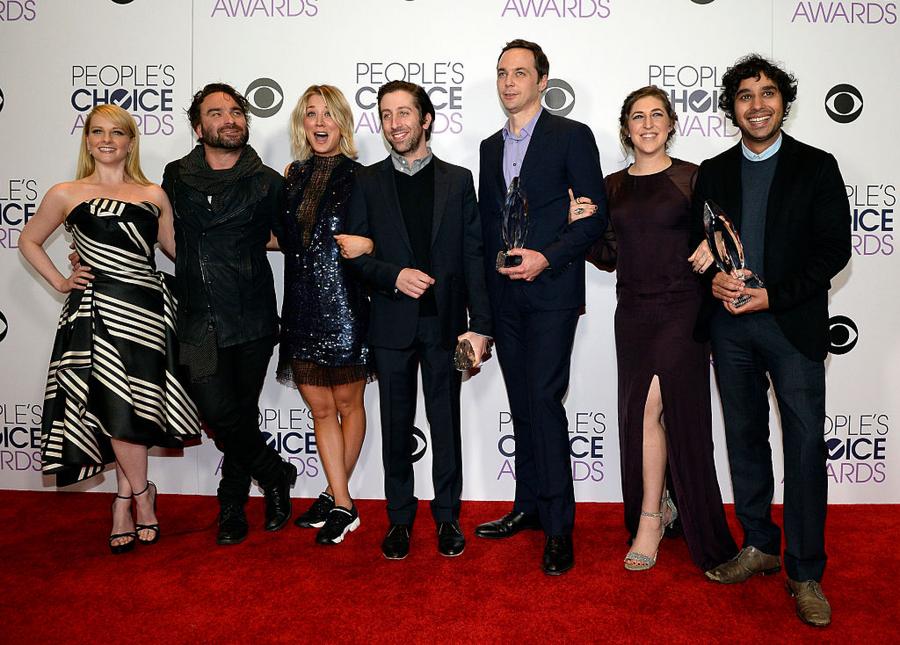
Kevork Djansezian/Getty Images
The 2017 Renewal
When "The Big Bang Theory" was renewed for its final two seasons, Seasons 11 and 12, the five original stars were expected to continue at $1 million per episode. Bialik and Rauch's contracts were up.
By that point, Amy and Bernadette were no longer supporting characters. Amy was married to Sheldon. Bernadette was married to Howard. Entire story arcs revolved around them. The show arguably could not function in its existing form without them.
Reports at the time indicated that Bialik and Rauch were seeking raises in the $450,000+ per episode range. Warner Bros. Television reportedly claimed there was not enough budget to accommodate those increases.
In most Hollywood situations, that would have been the end of it. Instead, something unusual happened.
The $100,000 Pay Cut
The five original stars — Parsons, Galecki, Cuoco, Helberg, and Nayyar — approached the studio with a proposal.
They would each voluntarily reduce their salaries by $100,000 per episode, lowering their pay from $1 million to $900,000 per episode for the final two seasons.
The math was simple:
- $100,000 pay cut
- × 5 actors
- = $500,000 freed up per episode
That half-million dollars per episode was redistributed to Bialik and Rauch, increasing their salaries to approximately $450,000–$500,000 per episode.
Over the course of the final 48 episodes, the five stars collectively gave up $24 million in potential earnings.
Individually, each actor sacrificed roughly $4.8 million.
It did not create total parity. The five original stars were still earning nearly double what their co-stars made. But the move significantly narrowed the gap and represented a voluntary redistribution of wealth that is almost unheard of in network television.
Why This Was So Unusual (and Risky)
To truly appreciate the magnitude of the "Big Bang" pact, one must look at the graveyard of television negotiations that came before it. In Hollywood, asking for a massive raise, even when you are essential to a hit show, is a dangerous game.
The industry is littered with cautionary tales of actors who tried to leverage their popularity for pay parity and lost everything.
The most famous example remains Suzanne Somers. In 1980, while starring in the #1 show on television, "Three's Company," Somers demanded a raise from $30,000 to $150,000 per episode to match her co-star John Ritter. When she missed tapings as a negotiation tactic, the network didn't blink. They reduced her role to sixty-second cameos filmed separately from the cast, and eventually fired her, proving that the show could—and would—go on without her.
Even in the modern era, studios have been ruthless. In 2004, CBS executives famously fired "CSI" stars George Eads and Jorja Fox immediately after they failed to show up for work during a salary dispute. The actors were eventually rehired, but only after publicly apologizing and accepting their old salaries.
/2017/03/thumb-3.jpg)
/2011/09/Kunal-Nayyar-1.jpg)
/2014/08/GettyImages-136002917-e1512523081420.jpg)
/2016/09/GettyImages-516090642.jpg)
/2015/08/GettyImages-464170140.jpg)
/2010/08/Johnny-Galecki.jpg)
/2019/11/GettyImages-1094653148.jpg)
/2020/02/Angelina-Jolie.png)
/2020/06/taylor.png)
:strip_exif()/2009/09/P-Diddy.jpg)
/2009/09/Brad-Pitt.jpg)
/2009/11/George-Clooney.jpg)
/2020/01/lopez3.jpg)
/2009/09/Jennifer-Aniston.jpg)
/2018/03/GettyImages-821622848.jpg)
/2009/09/Cristiano-Ronaldo.jpg)
/2017/02/GettyImages-528215436.jpg)
/2020/04/Megan-Fox.jpg)
:strip_exif()/2015/09/GettyImages-476575299.jpg)
/2019/10/denzel-washington-1.jpg)
/2019/04/rr.jpg)