
/2009/09/Michael-Schumacher.jpg)
/2019/09/cs.jpg)
/2014/10/GettyImages-486048505.jpg)
/2014/01/Damon-Hill.jpg)
/2013/05/GettyImages-459292552.jpg)
/2013/12/GettyImages-131975557.jpg)
/2018/03/GettyImages-821622848.jpg)
/2009/09/Brad-Pitt.jpg)
/2020/04/Megan-Fox.jpg)
/2009/09/Jennifer-Aniston.jpg)
/2017/02/GettyImages-528215436.jpg)
/2009/09/Cristiano-Ronaldo.jpg)
/2019/10/denzel-washington-1.jpg)
/2020/01/lopez3.jpg)
:strip_exif()/2015/09/GettyImages-476575299.jpg)
/2020/06/taylor.png)
/2019/04/rr.jpg)
What Is Michael Schumacher's Net Worth?
Michael Schumacher is a former German Formula One race car driver who has a net worth of $600 million. Michael Schumacher is one of just a handful of athletes who earned more than $1 billion during their career. At the peak of his career, he made $80-$100 million per year. Of that, he earned $10 million a year to wear a Shell hat during public appearances.
Michael Schumacher is widely regarded as one of the greatest drivers in the history of Formula One, a competitor whose dominance reshaped the modern era of the sport. Making his F1 debut in 1991, Schumacher quickly distinguished himself through relentless consistency, technical precision, and an almost obsessive attention to detail. His breakthrough came with Benetton, where he won back-to-back World Championships in 1994 and 1995, ending a long stretch of driver dominance by established teams and signaling the arrival of a new standard in performance and preparation.
Schumacher's legacy, however, was cemented during his time at Ferrari. When he joined the struggling Italian team in 1996, Ferrari had not won a drivers' championship in nearly two decades. Over the next several years, Schumacher became the centerpiece of a complete organizational rebuild, working closely with engineers, strategists, and team leadership. The result was one of the most dominant runs in motorsport history. From 2000 to 2004, Schumacher won five consecutive World Championships, leading Ferrari to unprecedented success and setting records for wins, podiums, and fastest laps that stood for years.
Known for his aggressive driving style and uncompromising competitiveness, Schumacher was also a polarizing figure. On-track controversies and fierce rivalries, particularly during championship battles, often placed him at the center of debate. Even so, his influence on racecraft, fitness standards, and team development permanently altered how Formula One drivers approached the sport.
After retiring at the end of the 2006 season, Schumacher returned to Formula One with Mercedes from 2010 to 2012, contributing to the foundation of what later became a dominant team, even if race wins eluded him during that period. By the time he stepped away for good, Schumacher had accumulated seven World Championships and redefined what sustained excellence in Formula One looked like, leaving a competitive and cultural imprint that continues to shape the sport.
In December 2013, Schumacher's public life came to an abrupt halt following a devastating skiing accident in the French Alps. While skiing off-piste, he suffered a severe traumatic brain injury after striking his head on a rock, despite wearing a helmet. He was placed in a medically induced coma and underwent multiple surgeries, launching one of the most closely watched and guarded recoveries in modern sports history. Since then, Schumacher's family has maintained strict privacy around his condition, offering only limited updates and shielding him from public view. The accident effectively ended any possibility of further involvement in motorsport and reframed his legacy in a deeply human way. Once defined almost exclusively by speed, dominance, and relentless control, Schumacher became a symbol of vulnerability and resilience, with fans around the world continuing to honor his achievements while respecting the family's wish for dignity and silence around his ongoing care.
Endorsements and Earnings
Endorsements and Earnings
Michael Schumacher remains one of the highest-paid athletes in history, with inflation-adjusted career earnings estimated at $1.39 billion. While modern figures like Michael Jordan, Tiger Woods, and Cristiano Ronaldo have surpassed him in total volume, Schumacher was the pioneer of the "billion-dollar athlete" era in motorsports. At the peak of his dominance with Ferrari, he frequently topped the Forbes annual list of highest-paid athletes—most notably in 1999 and 2000—and remained a fixture in the top ten for over two decades.
The Power of the "Schumacher Cap"
Perhaps the most famous aspect of his commercial portfolio was his headwear. Schumacher's personal endorsements were so lucrative that they often rivaled his racing salary:
- Deutsche Vermögensberatung (DVAG): In one of the longest-running partnerships in sports, the German financial services firm paid him an estimated $3 million to $8 million annually simply to wear their logo on his cap during all public appearances. This relationship spanned over 25 years and eventually extended to his son, Mick.
- Shell: During his peak, Schumacher earned roughly $10 million per year from Shell. This deal famously required him to wear a Shell-branded hat at nearly every public engagement, effectively turning him into a walking billboard for the petrochemical giant.
Sustained Wealth and Global Impact
Even during his first retirement (2007–2009), Schumacher's brand remained a juggernaut, generating roughly $50 million annually from passive endorsements and long-term licensing. At his absolute height between 2000 and 2005, his combined income from Ferrari and personal sponsors reached $80–$100 million per year.
Today, his financial legacy continues to place him among the elite "All-Time High Earners" in sports, a testament to a career that merged unprecedented on-track success with a revolutionary approach to personal branding.
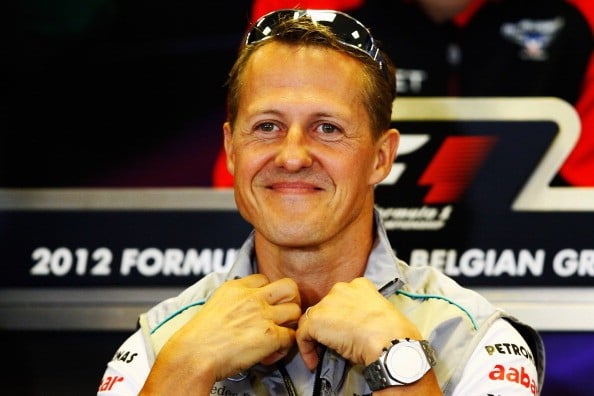
Vladimir Rys/Getty Images
Early Life and Rise
Michael Schumacher was born on January 3, 1969, in Hürth, West Germany, to Rolf and Elisabeth Schumacher. Growing up in a modest household, Michael was followed six years later by his brother, Ralf Schumacher, who would eventually join him in the elite ranks of Formula One. The family's life revolved around the local kart track in Kerpen-Horrem, where Rolf worked as a mechanic, and Elisabeth managed the canteen. Michael's competitive fire was ignited at age four when his father installed a small motorcycle engine into a pedal kart. Despite racing on a shoestring budget against wealthier peers, Michael's talent was undeniable; he became the youngest member of the Kerpen karting club and won his first championship at age six.
As Michael ascended through the ranks, Ralf followed in his footsteps, starting his own karting career at age three. To navigate strict German licensing laws that required a driver to be 14, Michael obtained a license in Luxembourg at age 12, allowing him to compete internationally while still a minor. By the time he secured his German license in 1983, he was already a seasoned veteran of the European circuit. His dominance caught the eye of manager Willi Weber, who signed Michael to his WTS Formula Three team in 1989, providing the professional springboard that would eventually lead both Schumacher brothers into the history books as the only siblings to both win Formula One Grands Prix.
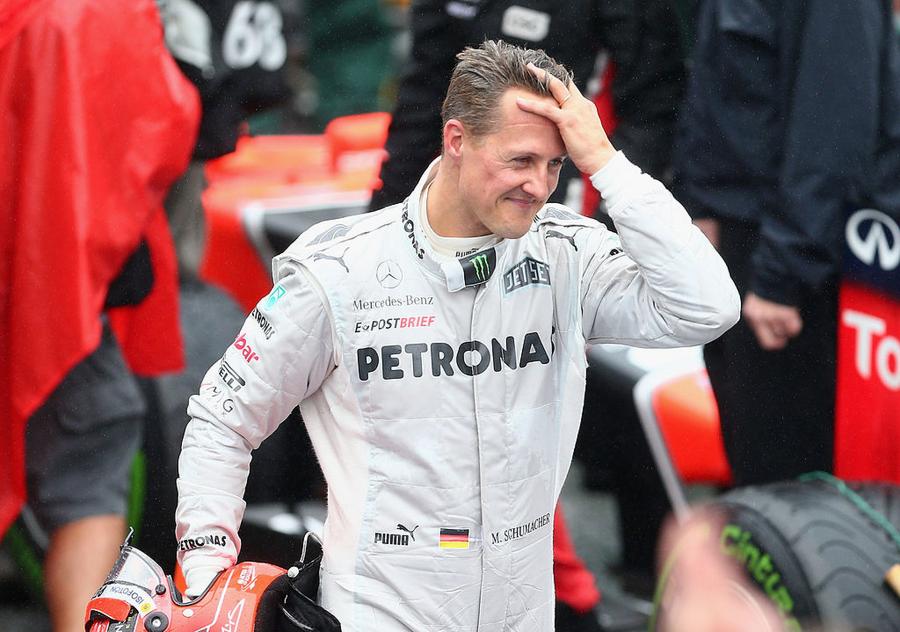
Clive Mason/Getty Images
Formula One Racing
The world first took notice of Michael Schumacher at the 1991 Belgian Grand Prix. Stepping in as a substitute for the Jordan team, he qualified a stunning seventh on the daunting Spa-Francorchamps circuit—a track he had never previously driven. This performance sparked a high-stakes legal battle as the Benetton team moved aggressively to sign him for the remainder of the season. By 1994, Schumacher had fully hit his stride, winning six of the first seven races of the season. Despite a year marred by the tragic loss of Ayrton Senna and various technical controversies surrounding his Benetton B194, he secured his first World Championship in a dramatic season finale. He successfully defended his crown in 1995, proving that his speed was no fluke and making him the most sought-after driver on the grid.
In 1996, Schumacher made the career-defining move to Scuderia Ferrari, a team that had not won a drivers' title in nearly two decades. The early years in Maranello were a grueling process of reconstruction alongside technical minds like Ross Brawn and Rory Byrne. Michael's impact was transformative; he brought a new level of physical fitness and technical feedback that helped the struggling team find its footing. After coming agonizingly close in 1997 and 1998, and suffering a broken leg in 1999 that sidelined him for much of the season, the breakthrough finally arrived in 2000. This victory sparked the most dominant era in the history of the sport, as Schumacher claimed five consecutive world titles from 2000 to 2004, shattering nearly every existing record for wins, poles, and points.
His first retirement in 2006 came after a hard-fought season against Fernando Alonso, but the lure of the cockpit remained too strong. In 2010, Schumacher returned to the grid with the newly formed Mercedes GP team. While he did not replicate the championship heights of his Ferrari years, his comeback was punctuated by flashes of the old "Kaiser" brilliance, most notably when he set the fastest qualifying time at the 2012 Monaco Grand Prix and secured a podium finish at the 2012 European Grand Prix. At age 43, he became the oldest driver to stand on a podium in over four decades, eventually retiring for good at the end of 2012 to make way for Lewis Hamilton. Throughout this legendary journey, Michael was often a polarizing figure, as his "win-at-all-costs" mentality led to several high-profile collisions and technical disputes that remain debated by fans to this day.
Ski Accident
Tragically, Michael's career was cut short after a skiing accident in December 2013 that left him with a traumatic brain injury. He had been out skiing with his 14-year-old son, Mick, in the French Alps when he fell and hit his head on a rock. He suffered severe head injuries despite wearing a ski helmet. According to physicians, he would have died if he had not been wearing the helmet.
Schumacher was placed in a medically induced coma for six months and has not been seen in public since. He regained consciousness in June 2014 and was transferred for further rehab in Switzerland.
Michael was finally able to be brought home for further recovery in September 2014. In November 2014, it was reported that he was paralyzed and in a wheelchair. He was unable to speak and suffered memory loss. In September 2019, Michael was transported to Paris to undergo an advanced stem cell treatment in the hopes that it might help him recover.
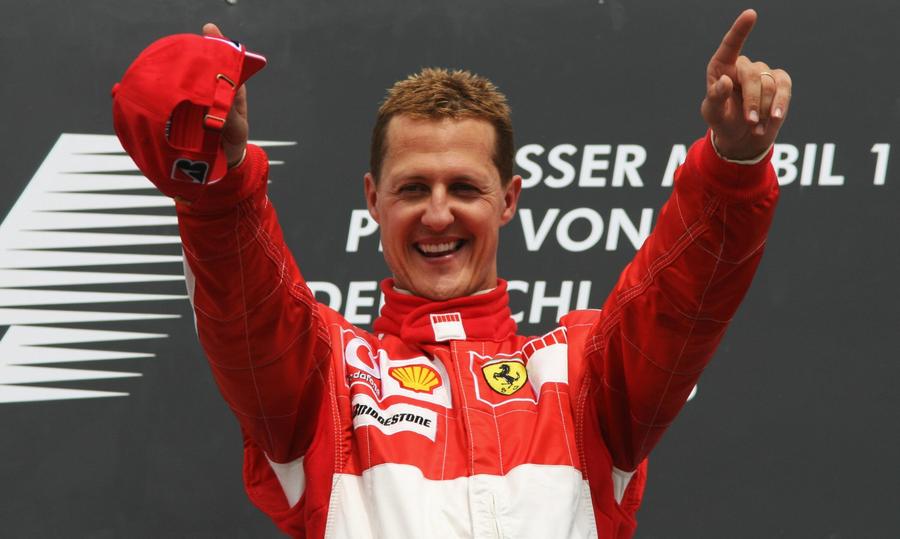
(PATRIK STOLLARZ/AFP via Getty Images)
Philanthropy
Michael Schumacher's philanthropic footprint is as vast as his racing record, defined by a preference for impactful, often anonymous giving. While the exact total of his lifetime donations is estimated to be in the hundreds of millions, several key contributions define his humanitarian legacy:
- The Keep Fighting Foundation: Established by his family following his accident, this foundation continues Michael's charitable work, focusing on road safety, medical research, and social projects.
- UNESCO Champion for Sport: A long-time UNESCO special ambassador, Schumacher donated over 1.5 million euros to the organization for global health and education. Additionally, he funded the construction of a school for underserved children in Dakar, Senegal, and supported the "Palace for the Poor" in Lima, Peru, providing shelter and education for homeless youth.
- War Victims in Sarajevo: Deeply moved by the Bosnian War, Michael made multiple trips to Sarajevo to fund specialized hospitals and prosthetic clinics for child victims of the conflict.
- 2004 Tsunami Relief: In one of the largest individual donations in sports history, Schumacher pledged $10 million to the Indian Ocean earthquake relief effort. The tragedy was personal for the family; Michael's bodyguard, Burkhard Cramer, and Cramer's two sons tragically lost their lives in the disaster while vacationing in Thailand.
- Global Outreach: His records include significant support for the Clinton Foundation (estimated between $5 million and $10 million) and various projects aimed at eradicating child hunger. In 2003, his humanitarian efforts led to his appointment as an Ambassador-at-Large for the Republic of San Marino.
Personal Life and Family
Michael married Corinna Betsch in August 1995, and the couple remains one of the most respected and private pairs in the sporting world. The Schumacher name continues to thrive in global sport through Michael and Corinna's two children:
- Mick Schumacher (b. 1999): After a successful stint in Formula 1 with Haas and serving as a reserve driver for Mercedes, Mick has made a high-profile move for the 2026 season. He is currently competing full-time in the NTT IndyCar Series for Rahal Letterman Lanigan Racing (RLL), driving the No. 47 Honda—a number chosen as a tribute to his father (combining Michael's 7 titles with Mick's favorite number).
- Gina-Maria Schumacher (b. 1997): A world-renowned equestrian, Gina-Maria has become an "NRHA Million Dollar Rider." In December 2025, she solidified her status by winning the World Reining Championship in Switzerland, continuing the family's dominance in the Western riding world.
Real Estate Portfolio
The Schumacher family maintains a world-class real estate portfolio, designed with a focus on privacy, medical care, and their deep-rooted passion for horses. In recent years, their holdings have transitioned to support a multi-residence lifestyle between Switzerland and the Mediterranean.
The Lake Geneva Stronghold
For years, the family's primary residence has been a custom-built, $50 million mansion in Gland, Switzerland, situated on the shores of Lake Geneva. Known as Villa La Réserve, the estate spans 15 acres and was extensively modified following Michael's 2013 accident to include a state-of-the-art private medical suite. While the family previously listed a separate farmhouse property in the region for roughly $6 million, the Gland estate remains a centerpiece of their Swiss holdings.
The Majorca Retreat (Villa Yasmin)
In 2018, Corinna Schumacher significantly expanded the family's portfolio by purchasing Villa Yasmin—a $40 million estate in Port Andratx, Majorca—from Real Madrid president Florentino Pérez. The 160,000-square-foot property features two swimming pools, a helipad, and guest villas. By 2024, reports indicated the family had further invested $3 million in adjacent land in Majorca to construct a specialized horse ranch, allowing Michael to spend winters in a warmer climate while maintaining his intensive rehabilitation schedule.
Global Horse Ranches: Texas and Switzerland
As world-class equestrians, Corinna and her daughter, Gina-Maria, operate a global breeding and training empire under the CS Ranch brand:
- XCS Ranch (Texas): Located in Gordonville, this 460-acre ranch is a premier facility for reining horses. Michael purchased the land in 2012 as a sanctuary from European media attention, and it has since become a cornerstone of the family's competitive horse breeding business.
- CS Ranch (Givrins): Their Swiss ranch is one of the largest and most modern private reining facilities in Europe, frequently hosting international tournaments and serving as the home base for the family's equestrian successes.
Car Collection & Private Plane
During his racing career, Schumacher was famous for his "commuter" lifestyle, often flying directly from his home in Switzerland to race tracks around the world. His primary jet was a silver Dassault Falcon 2000EX, customized with his "MS" logo on the tail and the personalized registration M-IKEL. Following his accident, Corinna Schumacher sold the jet in a "fiscally sensible" move. By 2022, it was confirmed the aircraft had been sold for an estimated $29 million, with the proceeds reportedly assisting in the funding of Michael's long-term, high-intensity medical care.
Michael Schumacher's personal car collection is one of the most significant in the world, split between road-going supercars and his legendary racing machinery. The "Michael Schumacher Private Collection" is a permanent, free-to-enter exhibition in Cologne, Germany. It houses over 12 of his original Formula 1 cars, including all seven title-winning chassis, alongside karts from his childhood and over 40 original trophies. Road-Going Rarities: His personal garage featured "gifts" from Ferrari and Mercedes, including:
- Ferrari Enzo: A custom-built Enzo (one of only 400).
- Ferrari FXX (No. 30): A track-only black FXX built specifically for him—the only one of its kind without a "30" on the side, replaced by his logo.
- Mercedes-Benz SLS AMG: He famously helped develop this car, even performing a 360-degree tunnel loop in a legendary promotional video.
/2009/09/Michael-Schumacher.jpg)
/2019/09/cs.jpg)
/2023/04/GettyImages-1189103070.jpg)
/2014/10/GettyImages-486048505.jpg)
/2021/03/GettyImages-1142670606.jpg)
/2014/07/Ross-Brawn-1.jpg)
/2019/11/Charles-Leclerc.jpg)
:strip_exif()/2009/09/P-Diddy.jpg)
/2019/11/GettyImages-1094653148.jpg)
/2020/02/Angelina-Jolie.png)