
Over the years, many huge fortunes have been made in the designer denim business. But out of all the major fashion success stories of the last few decades, no brand created as big of a worldwide phenomenon as Guess? and their signature ultra expensive jeans. Founded by brothers Georges, Paul, and Maurice Marciano in 1981, Guess? began a fashion revolution that absolutely took the 1980's by storm. During the company's growth explosion, Georges acted as the head designer for the company. During that time, Georges introduced innovations that were embraced around the fashion world. Today Guess? is largely credited with making acid washed denim fashionable.
Throughout the 1980s, Georges Marciano was the epitome of an American dream success story. After being born into a dirt poor family, George eventually amassed a humongous personal fortune. And he used that fortune to acquire an enormous mansion in Beverly Hills complete with no fewer than 11 Ferraris and other luxury vehicles that lined the driveway at all times. Georges owned houses all over the world, a private Boeing 737, an art collection containing works by Marc Chagall and Ed Ruscha, a cellar filled with priceless wines, and even an 84-carat $16 million diamond named after his daughter Chloe. And then, just as fast as he made the fortune, he lost it all.
The plane was sold off. The Ferraris disappeared. The art was auctioned off. His house in Beverly Hills sat vacant for years before it was seized in bankruptcy proceedings. It was a truly shocking fall from grace for a man who at one time was personally worth between $200 and $400 million dollars. So how on earth did Georges Marciano go from the top of the fashion and real estate worlds to a paranoid, lawsuit crazy, bankrupt fugitive on the run from the law? Let's take a look…

Getty Images
Rags To Riches:
You can say that, in many ways, Georges Marciano as a classic American success story – a poor immigrant who amassed an impressive fortune through hard work and business savvy. Georges Marciano was born on January 28, 1947 in France. He grew up in poverty and dropped out of school at the age of 15 to go to work in the garment industry. He visited California for the first time in 1977 and immediately fell in love with the weather, the beaches and the lifestyle. Despite not speaking a word of English, Georges and his brothers moved to the United States in 1981 to start their own clothing line in Los Angeles. Soon, Bloomingdale's bought two dozen pairs of his unconventional three-zipper jeans called "Marilyn. Bloomingdale's sold out in a few hours
Marciano was well on his way to establishing himself as a designer to watch. He pioneered the look of skintight jeans, zippered at the cuffs, and softened through repeated stone washing. Those jeans launched the Guess? brand. Nearly every woman from their teens through their 30s had (or wanted) a pair of those famous jeans. In fact, Marciano managed to convince not just the fashion world, but customers as well, that worn out, ripped up, scruffy looking jeans – bought looking that way brand new – – were the next hot thing.
The acid-washed jeans he designed and marketed for Guess? in the 1980s rocked the fashion world. The Marciano brothers made millions. Georges received an award from the Los Angeles Museum of Art as California's designer of the year in 1987.
In 1993, Georges sold his 40% stake in the company to his brothers for $220 million. After arriving in the US with no money in his pockets just 12 years earlier, Georges was now worth a quarter of a billion dollars (with his other assets included).
Not content to just sit back and polish his Ferraris for the rest of his life, Marciano was determined to make his fortune grow in a big way. He quickly shifted his focus from fashion to real estate. Soon he was snapping up properties- both commercial and residential – throughout Beverly Hills. The crown jewel to his real estate empire was the Bank of America tower located in downtown Beverly Hills. Locals called it the Power Tower because of its influential tenants.
Marciano and his wife Megan, whom he married in 1986, shared a 20,000 square foot mansion on luxurious Crescent Drive with their four children. They enjoyed a standard of living that had virtually no limit. Marciano was also generous to his employees and an active philanthropist.
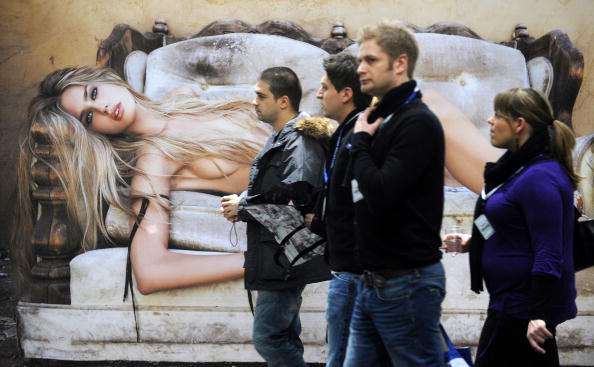
JOHN MACDOUGALL/AFP/Getty Images
Fall From Grace:
But every success story has its rough underbelly and every fairy tale has its ending. What precipitated Marciano's downfall? Was it his 2004 divorce from his wife of 18 years? Was it his prescription drug abuse? Was it his legendary temper? After all, Georges was known to fly off the handle in spectacular meltdowns at the drop of a pin. He was known to erupt over something as inane as a crinkled $100 bill or the smell of someone else's food invading his personal space.
Marciano was a rich man and then one day, seemingly out of nowhere, he became convinced that his employees were stealing from him. This belief, however irrational, set off a string of lawsuits and bizarre behaviors that would eventually bring his now estimated $500 million dollar empire to its knees. A self-made man became a self-destroyed man.
Georges was reeling from the bitter two year battle of his acrimonious divorce, binging on pain medication—spending $3,000 a week on pills, pursuing women 30 or more years younger than he was, and, eventually turned paranoid and made ridiculous and unfounded accusations about those closest to him. He suddenly began liquidating his assets, including the Bank of America tower, which he sold in 2005 for $135 million.
Marciano installed spyware on the computers in his home and monitored his employees' comings and goings by having security cameras mounted over their desks. One time he even accused employees of sneaking into his office to steal croissants. The truth is, Georges was taking huge doses of prescription painkillers. The drugs left him dazed, confused, and disoriented.
Marciano also initiated a number of lawsuits against both current and former employees who he was convinced were stealing from him. The problem was that Marciano's own accountants couldn't find a single cent that was missing. Law enforcement agencies also couldn't find any evidence of any wrongdoing. Georges' advisers begged him to end the crusade, but he insisted that he had to prove his allegations were true. Then, those falsely accused employees countersued him for damages. It didn't help that during the lawsuit Marciano came across like a man no longer in touch with reality.
And then there was the matter with the au pairs. Marciano wanted to hire a live-in baby sitter for his children who ranged in age from 11 to 18. He specified that the live-in baby sitter be young, attractive, and foreign. Oh, and by the way, his kids lived with his former wife. Marciano had employees search the profiles on an au pair website for just the right fit. In 2005, somewhere between 50 and 60 young women were flown to Los Angeles for interviews. They were picked up at LAX in limos, put up in luxurious hotels, wined and dined at the best restaurants in LA, taken on shopping sprees, and given $100 bills. None of them were hired. Georges Marciano used the au pair interviews as his own personal dating service. Reportedly he even told an employee that he was now a single man who had manly needs.
But despite the distraction of the young, attractive, foreign, prospective au pairs, Marciano was soon drawn deeper into the abyss of bizarre behavior. In January 2006, he was reviewing his financial records and became fixated on $1.4 million in cash that had been withdrawn (in increments) from his bank account over the previous year. Shocked at the amount he demanded an explanation from his head bookkeeper. He was sure that there was no way he had spent that money, even after the bookkeeper showed (and later testified in court) him paperwork that he had spent the money – much of it on the au pairs and his prescription drug habit. Marciano refused to believe her and accused her of theft.
In Mariciano's mind, his bookkeeper and her two assistants had masterminded this more than $1 million dollar embezzlement from him. When he had a friend who was also an accountant review his bank statement and records, that friend found no money missing. What did Georges do? He accused that accountant of being in on the scheme as well. More friends were drawn in to substantiate Mariciano's allegations and none found any money missing. All were then accused of being a part of a big conspiracy.
Marciano proceeded to hire outside accountants — five firms by one count — to perform forensic audits of his books and turned to law enforcement. Not a single misdoing was found.
Some employees were fired, others resigned, but over a period of two years Marciano sent them scores of emails and letters accusing them of defrauding him and stealing from him. He copied government officials on these letters and emails. He also allegedly had the families of the friends and employees he was accusing followed around town.
LAPD Sheriff Alex Gilinets spent 400 to 500 hours looking into Marciano's allegations. He subpoenaed bank records, interviewed accountants, and met time and time again with Marciano for conversations that, by his account, grew more and more unsettling. Marciano seemed to be seeing something happen in a movie and then became convinced it was happening to him.
The crimes Marciano accused his friends and employees of became bigger and more complicated over time. It got to the point that Marciano insisted that $413 million in cash and belongings were missing. No independent detectives, forensic accountants, or law enforcement ever found any evidence of any embezzlement. Law enforcement as well as those closest to him suspected that his prescription drug abuse was causing Georges to become delusional.
In fact, after reviewing reports from detectives, the Los Angeles district attorney's office elected not to prosecute Marciano's employees. The FBI, IRS, U.S. attorney's office and Beverly Hills police department all also refused Marciano's pleas to go after his employees. So what did the erstwhile denim designer decide to do? He ran for Governor of California.
Marciano ran for Governor as an independent. His campaign was a circus born of his frustration that authorities weren't taking his allegations seriously. Every interview became about how law enforcement was ignoring him.
In the end, Marciano sued seven former employees for allegedly stealing millions from him. He went through 17 law firms throughout the process and spent $12 million on legal and accounting fees. The employees all countersued for libel and intentional infliction of emotional distress. A security expert advised the employees to get 24/7 protection from the dangerous and unstable Marciano. The employees testified that the allegations had gravely affected their mental and physical health.
A Los Angeles jury eventually awarded five former Marciano employees $74 million each. The other two employees, were awarded $55 million each for a total judgement of $425 million.
The award was later reduced to $260 million, the amount the employees originally sought.
After the verdicts were handed down, the employees moved to seize Marciano' assets. Marciano's accountant placed the value of his assets at $175 million. An independent accountant said his assets were worth between $450 to $500 million. Soon, the Ferraris disappeared. The art was removed from his palatial Beverly Hills home. The 84-carat diamond he named for his daughter was gone. In fact, Marciano himself disappeared. The employees could not collect on their judgment. Marciano appealed the verdicts and was denied, so he packed everything up and left town. In fact, he left the entire country.
Eventually, Georges Marciano was forced into bankruptcy. He was held in contempt of bankruptcy proceedings and a bench warrant was issued for his arrest. His Beverly Hills mansion was seized and put on the market for $24.5 million. As of this writing, Georges is still working with his creditors to pay down his various debts. At one point the state of California and the IRS claimed Georges owed $100 million in back taxes and fines. Georges is currently living in Montreal, Canada.
At one time, Georges Marciano was the epitome of the American dream. He moved to the US with no money and launched a fashion empire that earned him hundreds of millions of dollars in a little more than a decade. Unfortunately, the American dream can sometimes turn into a nightmare. Especially when you mix in divorces, prescription pills, and a seemingly insatiable appetite for self-destruction.
/2014/08/GettyImages-1743402.jpg)
/2016/04/tg.jpg)
/2014/02/MC-Hammer.jpg)
/2013/10/GettyImages-510102868.jpg)
/2020/06/joe-francis.jpg)
/2015/10/GettyImages-461995432.jpg)
/2025/03/DUSTIN-LYNCH.jpg)
/2010/02/Jennifer-Hudson.jpg)
/2010/04/Emmitt-Smith-1.jpg)
:strip_exif()/2020/06/taylor.png)
/2014/04/noel-edmonds.png)
/2019/10/Troy-Aikman.jpg)
/2022/01/Jane-Birkin.jpg)
/2012/07/GettyImages-508683722.jpg)
/2021/02/barry-sanders.jpg)
/2009/11/Ciara-1.jpg)
/2010/12/Adrian-Peterson-1.jpg)
/2010/09/Gloria-Estefan.jpg)
/2022/02/Dan-Bongino.jpg)
/2012/08/Archie-Manning.jpg)
/2021/03/ben.jpg)
/2009/10/Peyton-Manning-1.jpg)
/2009/09/Andre-Agassi.jpg)