
As one of the most successful professional athletes of all time, LeBron James will likely make much more money in product endorsements, licensing deals, and various investments than he'll make on the court, even as a premier star athlete. During his career to date, LeBron has earned HUNDREDS of millions of dollars. By our count his career earnings as of this writing total $600 million. But if you believe one of LeBron's former teammates, LeBron supposedly earned more than his entire career earnings from one particular investment. Unfortunately, some quick calculations will tell you that these recent rumors are not as accurate as it's being reported to be in some other publications.
Here's what's going on:
Kendrick Perkins recently made an appearance on the Runnin' Plays, a podcast from the Golden State Warriors. During the podcast he spoke a bit on an investment he says paid off for James while they were teammates in Cleveland:
"When Dr. Dre got the big contract for the Beats by Dre, when they wrote him that check, LeBron James got $700 million off of it. He was a silent investor in the Beats and nobody knows this."
Unfortunately for James, while it's true that he's has made unspeakable sums of money in his various business endeavors over the years, it's next to impossible that he's made $700 million from Beats by Dre.
Apple bought the Beats brand in 2014 for $3 billion. Back then, it was widely reported that James was indeed one of the investors in the company. But his stake was widely confirmed to be just one percent of the company. That would have earned him something like $26 million in cash and $4 million worth of Apple stock when the deal closed. Fast forward a couple years, if LeBron held on to that stock, today it would be worth about $12 million.
That $12 million combined with the initial $26 million in cash combine to $38 million – not bad, but quite a ways off from any unconfirmed $700 million estimate.
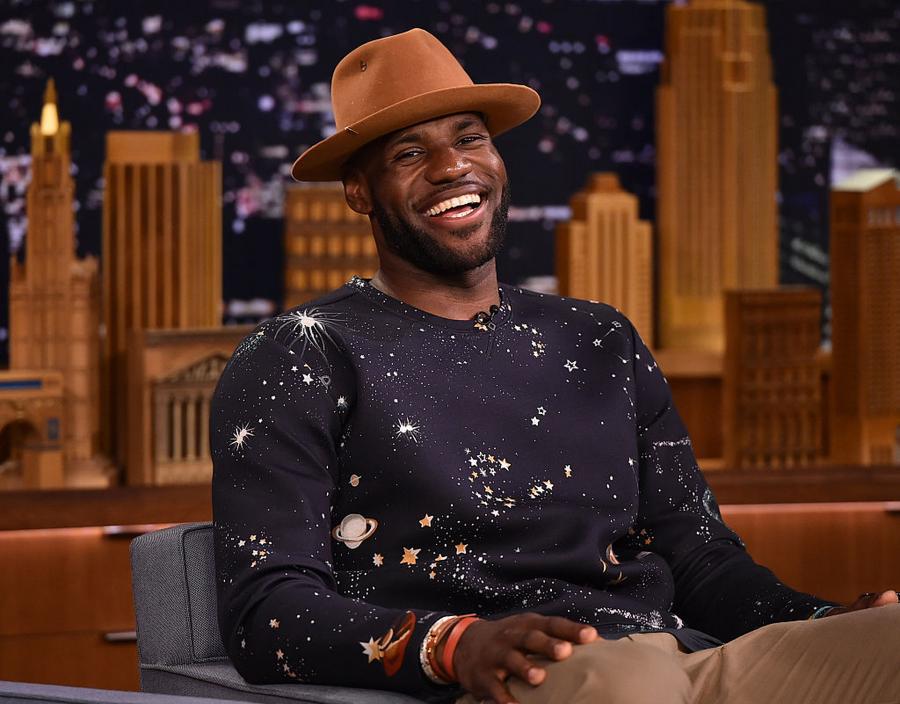
Theo Wargo/NBC/Getty Images
In order for James to have made anywhere close to $700 million in the sale, his stake would have had to be significantly higher than the reported one percent. It would have to be closer to 23 percent, which would make him a material investor and thus likely disclosed by Apple as a publicly traded company. Since that didn't happen – and since Apple would have likely been eager to publicize a star like LeBron's association with their brand – we can safely assume that he didn't make anywhere near $700 million as a result of his investment in Beats by Dre.
Of course, even if such an investment weren't disclosed or kept secret by all the parties involved, it's difficult to make the numbers work given what we know about the Beats brand's chief investors. A few years after the Beats brand was introduced to the public by Dr. Dre and Jimmy Iovine in 2008, half of the company was sold to electronics company HTC (at the time, the company was valued at $610 million). About a year after that deal was made, HTC sold half of their share back to Dre and Iovine for $150 million, leaving HTC with a 25 percent stake and Dre and Iovine with two 37.5 slices each. Then, in 2013, the private equity firm Carlyle Group made a major investment in the brand, buying off HTC's share completely and significant chunks of Dre and Iovine's shares – enough for a total 50 percent stake, leaving Dre and Iovine each with 25 percent stakes.
That was the lay of the land when Apple bought the brand in 2014, and the source of the confusion may be that when that deal happened, both Dre and Iovine each made about $750 million each before taxes, while the Carlyle Group got the remaining $1.5 billion in the $3 billion sale, all of which was a matter of public record in financial filings. Given that, it's just not mathematically possible for LeBron James to have a significant stake in Beats, and it's more likely that his small one percent stake in the company earned him a bonus that came out of each of the Dre, Iovine, and Carlyle Group takes.
The story still makes a certain kind of sense, though, even if it's not literally true, since LeBron James has undeniably demonstrated a proven knack for making good, lucrative business decisions time and time again. As Perkins himself put it:
"The crazy thing to me about LeBron James is that he is the chosen one in life…I tell him all the time 'I really hate you. I hate you!' And he'll be like 'What you mean, Perk?!' 'I hate you because everything you touch turns into gold!"
That's still true, even if James didn't make $700 million from a Beats by Dre investment.
/2014/06/GettyImages-466307985.jpg)
/2015/08/lebron.jpg)
/2021/04/GettyImages-1304969139.jpg)
/2022/06/lebron-billionaire.jpg)
/2017/04/GettyImages-474810474.jpg)
/2021/10/GettyImages-1345212743.jpg)
/2021/08/dov-charney.jpg)
/2021/06/bobby-bonilla.jpg)
/2015/08/Petra-Kvitova.jpg)
:strip_exif()/2020/06/taylor.png)
/2023/05/Jimmy-Swaggart.jpg)
/2021/09/Jessica-Hahn.jpg)
/2021/07/jim-bakker.jpg)
/2020/08/cusack.jpg)
/2020/09/jamie.jpg)
/2009/12/GettyImages-187692591.jpg)
/2014/04/GettyImages-909023006.jpg)
/2010/09/Novak-Djokovic-1.jpg)
/2009/12/John-McEnroe.jpg)
/2019/07/Coco-Gauff.jpg)
/2010/02/Don-Johnson.jpg)
/2011/03/Jimmy-Connors.jpg)
/2012/09/Robin-Wright.jpg)