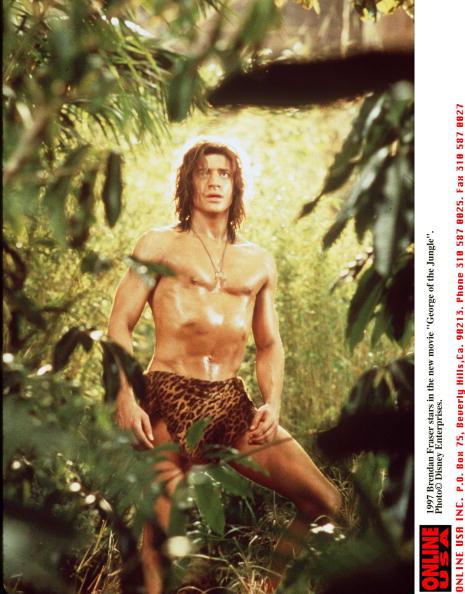
Actor Brendan Fraser has filed a lawsuit seeking at least $3 million over a big-budget William Tell movie that was supposed to begin filming months ago.
Fraser signed on in early 2011 to play the legendary Swiss marksman in "The Legend of William Tell: 3D," a historical family adventure planned for locations in Romania and Switzerland. The project was designed as the kind of effects-heavy action movie Fraser knows well from "The Mummy" franchise and "Journey to the Center of the Earth."
But after several changes to the director, screenplay, format, and production schedule, Fraser says the movie's producers still have not paid the $2.25 million guaranteed by his contract.
A $27 Million 3D Adventure
When the project was announced in May 2011, Fraser was expected to begin filming on October 1. Nick Hurran was attached to direct from a screenplay by Scott Reynolds, while Anna Paquin was being pursued to play William Tell's wife. German actor Til Schweiger was also in talks to play the villainous Austrian official Hermann Gessler.
Producer Todd Moyer described Fraser as an ideal choice to play the patriotic family man and claimed the actor had been a driving force behind the decision to shoot the movie in 3D.
The original schedule did not hold.
Hurran was replaced by Eric Brevig, who previously directed Fraser in "Journey to the Center of the Earth." A new screenplay was commissioned from Chad and Evan Law, and the planned production start was pushed to March 2012. The budget was increased to an estimated $27 million, with financing said to be coming from a Chicago hedge fund.
According to Fraser's lawsuit, however, the production continued to drift.
What Fraser Says Went Wrong
Fraser claims he committed himself to the movie's schedule and turned down other potentially lucrative acting jobs so he would remain available to play William Tell.
The complaint says one early version of the screenplay was considered too dark and serious for the broad family audience the producers hoped to attract. Fraser and Moyer allegedly agreed that new writers should be hired to make the story more accessible.
Fraser says he received a written agreement on November 30, 2011, confirming that he would remain attached to the project. The producers allegedly assured him filming would begin in the spring of 2012, but Fraser claims they became increasingly evasive about the financing and production details.
The lawsuit says no crew had been hired and that the producers failed to place $2.025 million of Fraser's compensation into escrow as required.
Fraser and his loan-out company are suing for breach of contract, fraud, and promissory estoppel. They are seeking at least $3 million in compensatory damages, along with additional punitive and exemplary damages.

Stephen Lovekin/Getty Images
What Is A Pay-Or-Play Contract?
At the center of the lawsuit is a Hollywood contract provision known as "pay or play."
Under a typical pay-or-play deal, an actor receives a guaranteed salary even if the producer ultimately decides not to make the movie or removes the actor from the project. The protection prevents a performer from reserving months for a production, rejecting other employment, and then being left with nothing when the movie collapses.
Fraser claims his contract guaranteed him $2.25 million whether or not "The Legend of William Tell" was actually filmed.
His demand for more than $3 million includes the guaranteed acting fee and additional damages connected to the jobs he says he rejected while holding open the movie's repeatedly shifting production dates.
The Producer Tells A Different Story
Moyer denies that the production is dead or inadequately financed. He claims the movie is ready to move forward under a new schedule:
"This is the first I have heard of this lawsuit. As we told Mr. Fraser's reps, we are ready, willing and able to make the movie for the September 3rd start date. [Producer] Julius Nasso and I have the movie fully financed."
Moyer also claims the dispute involves a significant change to the movie itself. Despite being announced, promoted, and titled as a 3D production, the producers now intend to make it in conventional 2D:
"Unfortunately, Mr. Fraser does not seem to be interested in making the movie as a 2D film as the producers intend to do. This is not a contractual decision Mr. Fraser has the ability to make."
That explanation creates the central question in the dispute.
Fraser's position is that the producers repeatedly missed production dates, failed to secure the necessary financing, and did not honor his guaranteed compensation. Moyer's position is that the financing is in place, filming can begin September 3, and Fraser cannot refuse to participate merely because the movie is no longer being made in 3D.
It is not clear from the publicly available details whether Fraser's contract specifically requires the movie to be filmed in 3D. The courts may therefore have to decide whether converting "The Legend of William Tell: 3D" into a 2D film materially changes the project Fraser agreed to make—or whether he remains obligated to appear.
William Tell is remembered for being forced to shoot an apple from his son's head with a crossbow. If the parties do not resolve their dispute, Fraser may never get the chance to take that famous shot.
For now, the only projectiles flying are lawsuits.
/2010/03/Brendan-Fraser.jpg)
/2026/08/CC-Music-Factory.jpg)
/2017/07/fl.jpg)
/2015/06/floyd1.jpg)
/2026/08/Selena-gomez-lawsuit.png)
/2016/01/Scott-Storch.jpg)
/2020/02/Angelina-Jolie.png)
/2018/03/GettyImages-821622848.jpg)
/2009/11/George-Clooney.jpg)
/2020/06/taylor.png)
/2020/04/Megan-Fox.jpg)
/2009/09/Brad-Pitt.jpg)
/2009/09/Jennifer-Aniston.jpg)
/2017/02/GettyImages-528215436.jpg)
:strip_exif()/2009/09/P-Diddy.jpg)
/2009/09/Cristiano-Ronaldo.jpg)
/2019/10/denzel-washington-1.jpg)
/2019/11/GettyImages-1094653148.jpg)
/2020/01/lopez3.jpg)
/2019/04/rr.jpg)
:strip_exif()/2015/09/GettyImages-476575299.jpg)