
Back in the early 1980s, Oprah was locked in a head-to-head ratings battle with local Chicago TV rival Phil Donahue. Other popular TV hosts of the era included Sally Jessy Raphael, Geraldo, and Jerry Springer. Fast forward 30 years, and Phil Donahue's net worth is $150 million. Sally Jessy is worth $40 million. Springer is worth $60 million. Oprah's net worth? $3.5 billion. That's around 60 times larger than her closest former rival. How did this happen? By all indicators, Oprah should have had a respectable TV career that maybe went national for a decade or two. A respectable career that would have left her rich today…a fortune in the tens of millions of dollars. We can't possibly know the actual amount, but it's safe to bet it would have been a mere fraction of billionaire status. So, what's the difference between Oprah and basically everyone else? It all boils down to one brilliant business risk that she took in 1984.
Oprah got her TV start at a CBS station in Nashville when she was just 19 years old. In 1976, she moved to an ABC station over in Baltimore as an evening news host. In 1978, she jumped to a new morning talk show on the same station. It was in the morning talk show format that Oprah found her niche with viewers. She listened, she emphasized; she could chat about everything from a serious crime to a new recipe for muffins.
By 1980, she was beating the nationally syndicated Phil Donahue in the local Baltimore market. By the end of her Baltimore run, she was earning $220,000 per year, which is the same as around $560,000 today after adjusting for inflation.
Recognizing her potential, in 1984, ABC gave Oprah her very own 30-minute morning talk show in Chicago to be produced by a company called King World Productions. King World was also the production studio behind Jeopardy and Wheel of Fortune. The job came with a 4-year contract and a $30k per year pay raise to $250k, which is the same as around $600k today. There was also a plan to take the show national.
Oprah was ecstatic. How could she not be? She had come from wretched poverty and pulled herself up by the bootstraps to earn an enormous salary and become a star. The American dream come true!
Oprah's Net Worth 1984: $500,000
Pretty soon after signing the new deal, something seemed fishy to Oprah. ABC executives wouldn't shut up about how good the deal was for her and how easy her agent was to work with. No executive had ever told her she had a good deal before. They always bemoaned how much she was making.
Oprah mentioned her fishy feeling to fellow Chicago TV personality, film critic Roger Ebert. Roger confirmed the deal was bad, especially considering his assumption that profits from the show would increase 40X if it ever went national. Exponentially more than the $30k bump they were paying.
Oprah then pinged Bill Cosby about the situation. Cosby was struck by her description of the agent and network getting along so well. Cosby explained:
"When they see my agent coming down hallways at TV studios, networks, anywhere, people get scared…My agent is a piranha. You need a piranha. I know a guy. He'll explain to you why I'm wealthy. They're just offering to make you RICH."
Oprah immediately fired her longtime agent and, following Cosby's advice, hired a lawyer named Jeffrey Jacobs.
Jacobs looked at her contract and explained:
Jeffrey Jacobs: "You can sign this contract. You can sign it if you're willing to be nothing more than a slave.
Oprah: "Excuse me?"
Jacobs: "This is a slave contract. Slaves work for a fixed dollar. They're willing to bank on a national show. This contract is for 4 years, totaling $1 million, an effort to make you a highly-paid slave. Now there's a thing called syndication that they're going to market this through."
Oprah: "Roger Ebert told me how he and Gene Siskel held out for a piece of their show's syndication revenue but had to take on production costs… I think that's the kind of deals Bill Cosby brokers for Fat Albert and The Cosby Show… but I don't have that kind of clout."
Or did she???
Getty Images
With her blessing, Jacobs went into King World/ABC and told them the contract was a pile of crap. They demanded to renegotiate right away.
This was a huge risk. Think about it. Oprah was a black female regional TV host in the 1980s. She wasn't Bill Cosby-famous. What would have stopped ABC from simply firing her on the spot? Even if they had to pay out her contract, it would have been a rounding error.
Jacobs and Oprah proceeded to drop a bomb on ABC/King World. A bomb that would ultimately turn her into a billionaire.
Oprah didn't merely want an enormous salary boost, she wanted OWNERSHIP of her show.
Amazingly, ABC/King World agreed. To be fair, Oprah was starting to attract record viewer numbers in Chicago, so national syndication was looking more and more like a slam dunk.
In 1986, Oprah's show was relaunched as The Oprah Winfrey Show and expanded to an hour. Under the new deal terms, Oprah would be taking on all production costs for her own show. And remember, at the time, her net worth was in the $500,000 range. She had nowhere near the tens of millions that would be needed to produce a nationally syndicated professional TV show.
The solution? Fake it till you make it.
Oprah and Jeffrey hatched a plan where they would pledge the future profits of the first three years of the show, estimated to be $30 million per year, as collateral to:
a) Fund the current production costs and,
b) Simultaneously begin construction on her own company and physical studio space. The name for the new company and production space? Harpo Productions and Harpo Studios. Oprah would own 90%, and Jeffrey Jacobs would silently own 10%. They pitched the concept like a startup seeking venture capital. Under the structure, Oprah could earn as much as 25% of her show's gross profits. Jeffrey estimated the proceeds in year one to be $30 million, and these proceeds are what they put up as collateral to build their plan.
Oprah: "This is amazing, Jeffrey. Is this what Bill [Cosby] is doing?"
Jacobs: "Yes, which is why he'll soon be one of America's invisible billionaires. Every project he works on, he operates not as a paid performer but as a business, a partner, so he gets a piece of the pie, not crumbs as payment."
Harpo Productions and Harpo Studios launched in 1990.
Oprah Net Worth 1990: $100 million
Oprah wasn't done yet.
King World was still Harpo's distribution partner. They were essentially a paid employee taking the show national for a fee every year. Oprah knew how valuable she had become to King World as the #1 daytime talk show host in the country.
Jeffrey and Oprah soon negotiated a new deal with ABC that included book deals, movie productions, a magazine…and, most importantly…other TV shows. Oprah didn't want just any crappy random show to air before or after The Oprah Winfrey Show, so she struck a deal to produce the shows that surrounded her. All production will take place at her 3.5-acre Harpo campus.
She still wasn't done.
Jeffrey and Oprah negotiated a deal where Harpo was given an equity stake in King World Productions. They made it so Oprah earned money off everything King World produced, including Jeopardy and Wheel of Fortune.
Oprah Net Worth 1995: $300-500 million
In 1999, CBS bought King World for $2.5 billion in stock. With the deal, Oprah ended up owning one-half of 1% of all of CBS. Media mogul Sumner Redstone would eventually splice together CBS and Viacom.
Oprah owned a stake in Disney through an equity deal she was given at ABC in the 90s. That stake eventually became Disney stock.
Oprah Net Worth 2000: $1 billion.
By the turn of the millennium, Oprah had become America's first female black billionaire and by far the richest person on TV. At this point, between her own show and the shows she produced (most notably Dr. Phil and Rachael Ray), Oprah is earning $300 million per year.
Oprah Net Worth: 2007: $2 billion
Outside of television, Oprah grew her assets very wisely. In 2015, she became a board member and endorser for Weight Watchers. She was initially awarded $43.5 million worth of company stock. At times, that stake has been worth as much as $400 million.
She's also quite the real estate investor. In Chicago, she owns the real estate that houses Harpo studios. She formerly owned a large home in the Chicago suburbs.
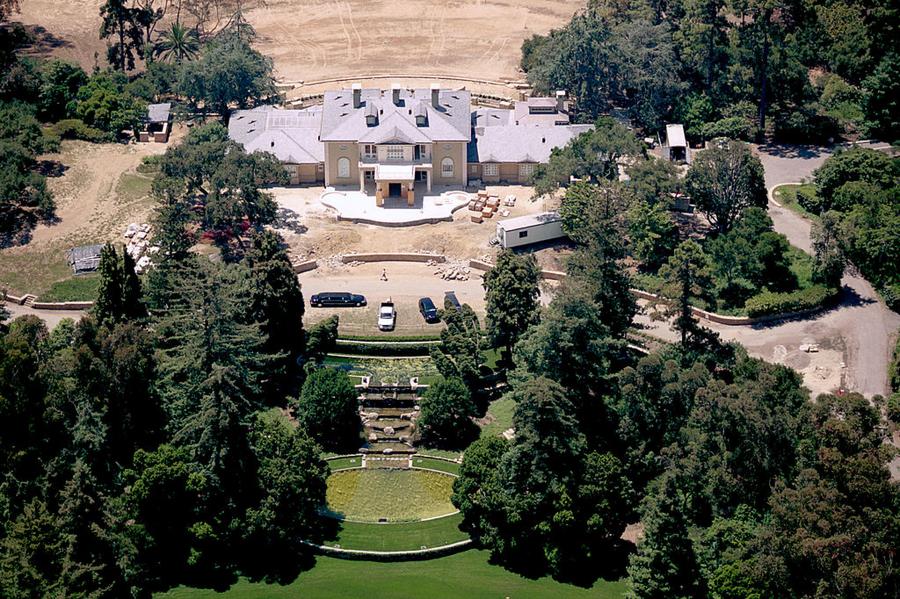
Arguably, her most impressive real estate asset is a 23,000-square-foot mansion in Montecito, California (near Santa Barbara), which she purchased in 2001 for $50 million. Today, this home is worth at least $90 million. In 2016, she purchased a 23-acre farm estate, also in Montecito, for $29 million. She owns 63 acres in Montecito.
Jason Kirk/Getty Images
Oprah owns a 41-acre estate on Orcas Island in Washington State that she purchased for $8.275 million in 2018. In 2014, she spent $14 million for a home in Telluride, Colorado. Oprah bought her first property in Maui in 2002. Over the year, she has spent as much as $60 million to piece together 163 acres. She spent $32 million in one transaction alone to buy the property next door.

Oprah Winfrey's Maui estate Via Getty
In total, Oprah owns at least $200 million worth of real estate in the United States.
Oprah Net Worth 2019: $3.5 billion
Today, when you add it all up, Oprah is worth at least $3.5 billion, perhaps as much as $4 billion. The only entertainment people who have more money are Steven Spielberg, with $8 billion, and George Lucas with $8.5 billion. What's the common thread with all three? At some point, all three made the transition from paid employee to OWNER of what they were producing.
Be it Star Wars, Amblin Entertainment, or the appropriately titled OWN Network, if you want to be wealthy as opposed to merely rich, you must be an owner. A valuable lesson Oprah has proven true 3.5 billion times over.
/2021/04/richest-celebrities.jpg)
/2013/08/GettyImages-499557130.jpg)
/2017/03/ow.jpg)
/2019/06/GettyImages-539136848.jpg)
/2015/10/22.jpg)
/2016/06/Byron-Allen.jpg)
/2022/10/Felix-Baumgartner.png)
/2015/09/GettyImages-483593016.jpg)
/2020/06/john-oliver.jpg)
:strip_exif()/2020/06/taylor.png)
/2019/01/GettyImages-490454810.jpg)
/2020/10/Dana-Carvey-1.jpg)
/2018/06/Mike-Lindell.jpg)
/2020/02/paul-anka.jpg)
/2009/11/Steve-Carell-1.jpg)
/2021/07/jerry-west.jpg)
/2009/09/Jon-Stewart.jpg)
/2009/11/Seth-Meyers.jpg)
/2014/07/brenda-lee.jpg)
:strip_exif()/2020/03/carmen-electra.png)
/2015/01/Bobby-Darin.jpg)
/2015/07/Rick-Barry.png)
/2022/11/Connie-Francis.png)