
The ongoing Musk v. Altman trial is currently spilling some of Silicon Valley's most tightly guarded financial secrets. This week on the stand, OpenAI co-founder Greg Brockman was forced to admit that he owns an equity stake in the company worth a staggering $30 billion. Furthermore, Greg admitted that he did not pay a single cent for his shares. Now, if you're thinking – why would a founder pay for shares? That would normally be a valid point. But OpenAI is not a normal company. At its founding, OpenAI was a 501(c)(3) nonprofit. It was never supposed to make anyone millions, let alone billions, in personal wealth.
And Greg isn't the only OpenAI exec who currently has a net worth larger than the GDP of Jamaica. Former Chief Scientist Ilya Sutskever is sitting on a legacy stake in OpenAI worth somewhere between $30 billion and $35 billion.
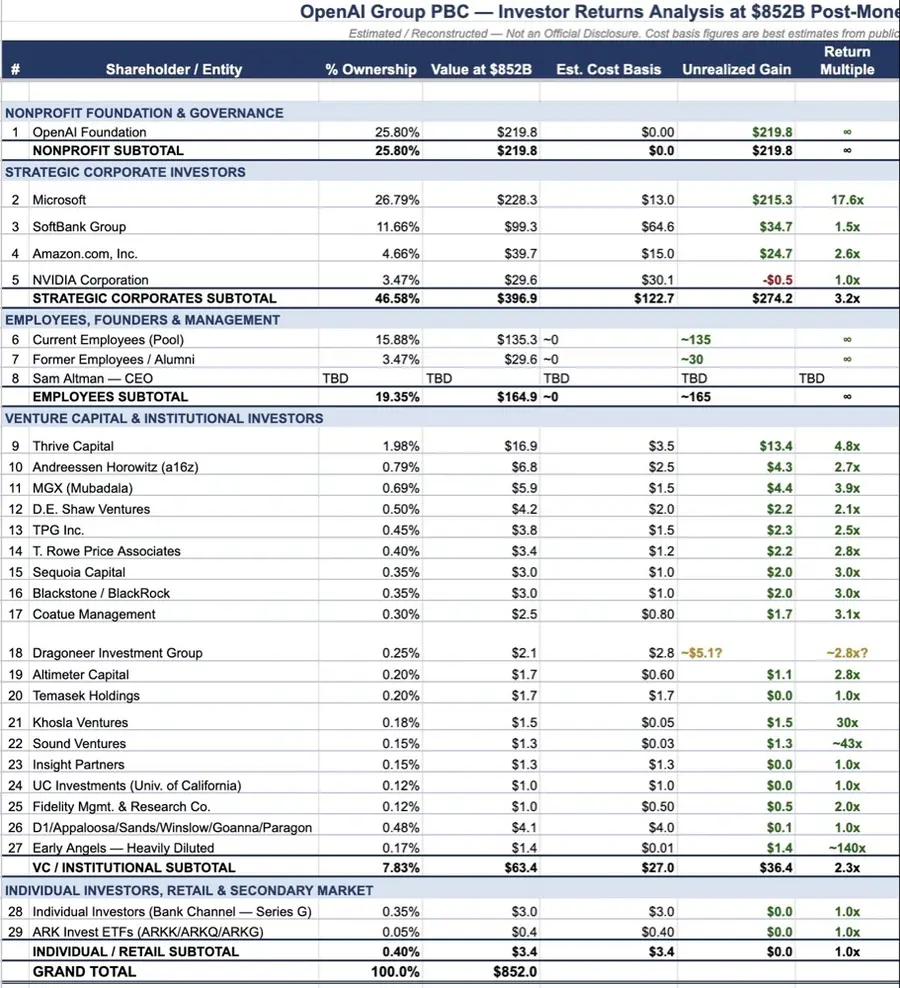
If you want to see just how much money is sloshing around OpenAI right now, take a look at the highly detailed OpenAI cap table that leaked a few weeks ago (screenshot below). The numbers are almost difficult to comprehend.
Ashton Kutcher's VC company, Sound Ventures (row 22), turned a $30 million early investment into a $1.3 billion stake (an absurd 43x return). Even more wildly, the collective pool of current and former employees currently controls roughly $165 billion worth of equity (rows 6 and 7) in the cap table:
Given that two of his co-founders (Ilya and Greg) both own around $30 billion worth of OpenAI equity, you might naturally assume that Sam Altman—the controversial CEO and the most powerful public-facing figure in the AI world—must own a massive chunk of the pie. You would expect him to hold certainly as much, if not more, than Ilya and Greg. Probably more. Certainly way, way, way more than Ashton Kutcher.
And yet, in reality, Sam Altman's current equity stake in OpenAI is exactly… ZERO percent.
You can see this on row 8 of the cap table, where next to "Sam Altman – CEO," the lines for his equity percent and current value both say "TBD."
Sam Altman is the CEO of OpenAI. He is the most prominent public-facing executive of the company and the AI revolution in general. He's a lightning rod for hate, admiration, lawsuits, and even death threats that have manifested in at least one attempt to burn his SF mansion down with a Molotov cocktail. And with all that, he does not own a single share of the $852 billion company he actually runs???!!! What is going on here?
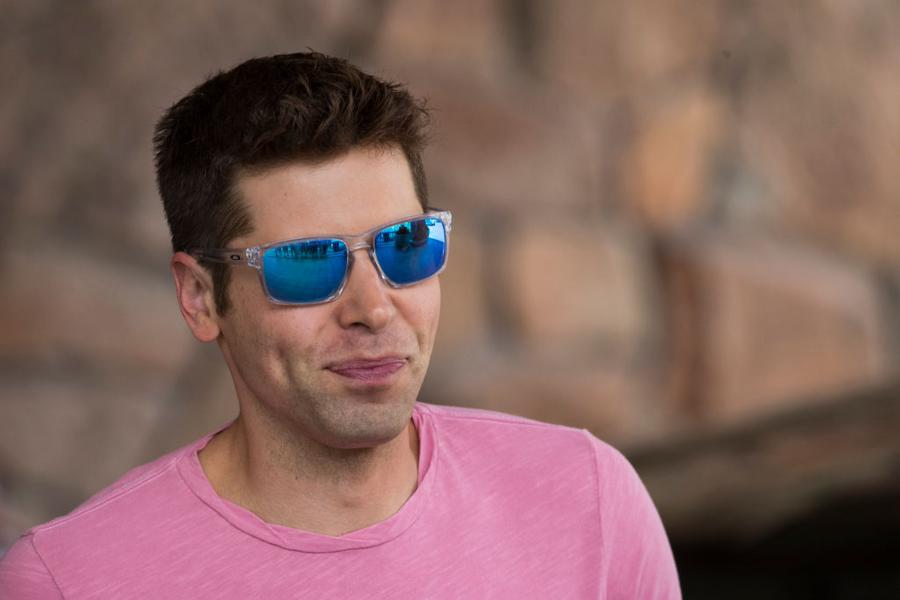
(Photo by Drew Angerer/Getty Images)
The Accidental Trillion-Dollar Rocket Ship
As we stated previously, OpenAI was founded in 2015 as a 501(c)(3) nonprofit. The company's stated mission was to build Artificial General Intelligence safely for the benefit of humanity. At the time, Altman—already incredibly wealthy from his tenure at Y Combinator—might have truly never intended to own any equity. He wanted to project the image of the "neutral steward," a philosophical leader whose decisions weren't corrupted by a desire for shareholder returns.
But then the AI revolution exploded.
As we now know thanks to Greg Brockman's explosive diary entries revealed during the trial, the founders quickly realized they were strapped to a trillion-dollar rocket ship. The non-profit structure couldn't attract the capital needed to buy the compute power required to win the AI race. So, they engineered a massive, unprecedented transition from a pure non-profit into a capped-profit entity, and eventually the powerhouse it is today.
As the company's valuation skyrocketed into the hundreds of billions, it was relatively easy for slightly lower-profile executives like Brockman and Sutskever to quietly secure massive equity stakes. It might have even been seen as necessary to prevent them from jumping ship to a rival.
But Sam Altman is the face of the operation. If Altman were to suddenly award himself $30 billion to $50 billion in equity, how would that have gone over with the board? Or with outside investors?
More importantly, it would have handed Elon Musk a smoking gun in court. Musk's entire legal argument rests on the premise that OpenAI was a charitable endeavor hijacked by a few insiders, and that this staggering wealth either shouldn't exist or rightfully belongs to the original non-profit foundation. If Altman took a multi-billion-dollar payout right now, he would be validating Musk's worst accusations in front of a judge.
"TBD"
That brings us directly back to row 8 of the leaked cap table. As you recall, it doesn't say Sam Altman owns zero percent forever. It says his stake is "TBD"—To Be Determined.
The prevailing theory in Silicon Valley is that Altman and the OpenAI board—which he controls with an absolute iron grip following the failed coup of 2023—are simply biding their time. The moment the gavel falls, and the Musk v. Altman trial is settled (assuming it goes in Altman's favor), the legal heat and public scrutiny will dissipate. At that point, you can fully expect the board to suddenly "determine" that Sam Altman is owed a massive, retroactive founders grant. Maybe they will tie the grant towards a goal like successfully navigating OpenAI through an IPO process that results in the company having a market cap north of some massive number… like $1 trillion. That's my prediction.
Sam is a Billionaire Outside of OpenAI
Altman is a billionaire independent of OpenAI, with a net worth of well over $2 billion spread across hundreds of venture investments. Many of these investments directly intersect with OpenAI's massive gravitational pull, effectively allowing him to build immense wealth off the back of OpenAI's success without officially taking equity:
Reddit: Altman is one of the largest individual shareholders in Reddit, having invested heavily in the platform years ago. He currently owns approximately 12.2 million shares—a stake now valued at over $1.2 billion following the company's recent post-IPO market surges. Crucially, OpenAI recently struck major data-licensing deals with Reddit to train its AI models. The more powerful OpenAI gets, the more Reddit data it needs to buy, directly inflating Altman's billion-dollar portfolio.
Energy & Compute: As OpenAI's energy and computing bottlenecks skyrocket, Altman's personal investments are perfectly positioned to become the primary, highly lucrative vendors solving those exact problems.
Helion Energy: Altman has personally poured $350 million into this nuclear fusion startup and serves as its board chair. He also just participated in a massive $425 million funding round that pushed Helion's valuation to $5.4 billion. If OpenAI achieves AGI, it will require an unprecedented amount of electricity—power that Altman's company is gearing up to sell them.
Rain AI: Altman is a massive backer of Rain AI, a startup building brain-inspired neuromorphic chips meant to rival Nvidia. He personally invested millions into the company and recently led a $150 million funding round. Most tellingly, while Altman was running OpenAI, the company signed a $51 million letter of intent to purchase those exact chips from Rain AI.
Sam Altman doesn't need OpenAI equity to get rich today; he already built the ecosystem around it. By keeping his name off the cap table with a mysterious "TBD," he gets to play the selfless visionary while quietly funneling the financial momentum of the AI revolution into his own ventures. And when the legal dust finally settles, that "TBD" will likely make him one of the wealthiest people on the planet.
What Happens If Musk Wins This Trial?
If the jury sides with Elon Musk, the fallout won't just be a localized Silicon Valley scandal—it will be an extinction-level event for the greatest concentration of paper wealth in modern history.
Musk's core legal demand is staggering: he wants the court to undo OpenAI's transition to a capped-profit structure and legally redirect up to $134 billion in damages back to the original non-profit foundation. If Judge Yvonne Gonzalez Rogers enforces that remedy, the current cap table essentially goes up in smoke.
Here is what that doomsday scenario looks like:
The Valuation Plummets: An open-source, purely non-profit AI company stripped of its commercial rights is not worth $852 billion. If the court rules that the core intellectual property belongs to the 501(c)(3) and cannot be commercialized, the company's valuation will crash overnight.
The IPO is Dead: OpenAI is reportedly gearing up for an initial public offering later this year at a $1 trillion valuation. Non-profits cannot go public. A Musk victory instantly kills the most highly anticipated IPO of the decade.
The Equity Evaporates: That $165 billion employee pool? Greg Brockman's $30 billion? Ashton Kutcher's 43x return? Gone. If the for-profit subsidiary is unwound or its assets are seized by the non-profit, those shares become virtually worthless—or at the very least, permanently trapped in a legal black hole of endless appeals. Microsoft and other massive venture capitalists would lose their shirts.
For Sam Altman, losing this trial doesn't just mean losing his job or his "TBD" equity—it means watching the greatest wealth-creation engine of the 21st century burn to the ground. And the man holding the match will be the one who helped him build it.
/2025/02/missing_profile.jpg)
/2024/09/Screenshot-2024-09-03-145414.jpg)
/2014/03/allen.jpg)
/2015/08/GettyImages-454824690.jpg)
/2026/05/angelina-jolie-house.png)
:strip_exif()/2009/09/P-Diddy.jpg)
/2020/06/taylor.png)
/2020/02/Angelina-Jolie.png)
/2019/04/rr.jpg)
/2019/10/denzel-washington-1.jpg)
/2020/01/lopez3.jpg)
/2020/04/Megan-Fox.jpg)
/2017/02/GettyImages-528215436.jpg)
:strip_exif()/2015/09/GettyImages-476575299.jpg)
/2009/09/Jennifer-Aniston.jpg)
/2009/09/Brad-Pitt.jpg)
/2018/03/GettyImages-821622848.jpg)
/2009/11/George-Clooney.jpg)
/2019/11/GettyImages-1094653148.jpg)
/2009/09/Cristiano-Ronaldo.jpg)