One of the very first articles we ever published on CelebrityNetWorth.com was a ranking of the richest people of all time, adjusted for inflation. We've updated that article and published several more detailed and focused versions over the years. And whenever we publish a new version, or an old one goes viral on Twitter or Facebook (which still happens surprisingly often), we inevitably receive an email asking the same question: "WHAT ABOUT KING SOLOMON?!!"
Sometimes the reader adds a helpful "You IDIOTS!" or "READ THE BIBLE!" Occasionally, we get both. The objection is always the same: The Bible describes Solomon as a king of unmatched wealth, so how could we possibly leave him off a list of the richest people who ever lived?
In my experience, replying to an angry feedback email rarely improves anyone's day. And politely explaining that historians still debate Solomon's existence, the size of his kingdom, and the extent of his fortune seems especially unlikely to win over someone who may already be considering whether I should be burned for heresy. So, generally, I leave those emails alone.
But let's do something fun today. Let's set our skepticism aside for a moment and give Solomon's claim to the crown a proper hearing. Let's follow the gold, explore the stories of his extraordinary kingdom, and see what happens when we try to translate biblical wealth into modern dollars.
Along the way, we'll encounter a queen who arrived with tons of gold, a royal court where silver barely deserved a second glance, and a fortune that has somehow acquired a $3 trillion price tag. And we'll try to answer, once and for eternity: Forget Elon Musk. Was King Solomon really the richest person who ever lived?

A King Who Asked For Wisdom
For someone whose fortune would inspire arguments thousands of years later, Solomon's story begins with a surprising detail: When given the opportunity to ask for anything, he didn't ask for money. According to the biblical account, his extraordinary wealth was a bonus.
Solomon had succeeded his father, David, as king of Israel, with his reign traditionally placed in the 10th century BC. Faced with the responsibility of governing a kingdom, he asked God for wisdom. God was pleased that the new king had chosen understanding over riches, long life, or the destruction of his enemies. Solomon would receive the wisdom he requested, along with wealth and honor on a scale that would make him legendary.
The descriptions of his riches are spectacular. First Kings describes a great ivory throne overlaid with gold, golden drinking vessels, and hundreds of gold shields. Silver is so abundant in Jerusalem that the text compares it to stones. Ships bring precious metals and exotic cargo, while visitors arrive with valuable gifts.
Even the Queen of Sheba's contribution is staggering: 120 talents of gold, alongside her spices and precious stones. Using a common estimate of 75 pounds per talent, that one royal gift would weigh about 9,000 pounds. This is diplomacy conducted on a scale that requires a caravan.
The picture is of a ruler at the center of an immensely prosperous court, with wealth arriving through trade, tribute, and relationships with other rulers. It's easy to understand why Solomon became an enduring symbol of riches. Long before anyone could imagine a billionaire's yacht, readers could picture a king drinking from gold cups in a city overflowing with silver.

Hulton Archive/Getty Images
Does The Bible Actually Say He Was The Richest Ever?
The argument has a real basis in the text. First Kings 10:23 describes Solomon as surpassing the other kings of the earth in wealth and wisdom. Earlier, in 1 Kings 3:13, God's promise concerns Solomon's unequaled riches and honor among the kings of his lifetime.
But another passage goes further. In 2 Chronicles 1:12, God promises Solomon riches, wealth, and honor unmatched by the kings before him, adding, in the King James Version, "neither shall there any after thee have the like."
That is why simply telling readers the Bible only calls Solomon the richest king of his own time doesn't fully answer their objection. Chronicles explicitly looks forward as well as backward. Someone who reads that promise as establishing Solomon's unmatched wealth has a clear reason for doing so.
What these passages do not supply is a dollar valuation. They establish Solomon's extraordinary standing within the biblical account. Getting from that account to a $3 trillion personal fortune requires a separate set of assumptions about gold, ownership, spending, and the value of wealth across thousands of years.
The Number Behind The Fortune: 666 Talents Of Gold
The most useful number appears in 1 Kings 10:14, which describes 666 talents of gold coming to Solomon in a year. The following verse lists additional sources of revenue. Here, at last, is something that seems possible to put into a calculator.
A talent was a unit of weight, and its size varied across ancient societies. Using the common biblical estimate of 75 pounds, 666 talents works out to almost 50,000 pounds of gold: about 25 U.S. tons, or 22.7 metric tonnes. In the troy ounces used to price precious metals, that is about 728,000 ounces.
For a simple illustration, use a gold price of $3,000 per troy ounce. This is a round-number assumption, not a live market quote. At that price, the gold described in the passage would be worth about $2.2 billion.
First Kings gives Solomon a 40-year reign. Multiply that annual amount by 40, and the result is about $87 billion at the same assumed gold price. The arithmetic is straightforward; the historical assumptions are much less secure. It assumes that the same quantity arrived every year for four decades and that every ounce accumulated without being spent or given away.
How Does That Become $3 Trillion?
The Bible never assigns Solomon a trillion-dollar fortune. Figures like $2 trillion and $3 trillion are modern estimates, and their usefulness depends entirely on how they were calculated.
Consider the often-repeated claim that he possessed 500 tons of gold. Even interpreting that as 500 metric tonnes, the metal would be worth about $48 billion at our illustrative $3,000 gold price. To turn that pile into $3 trillion, you need something beyond its bullion value: an estimate of its ancient purchasing power, additional assets, or another economic comparison. The weight alone does not produce the headline.
And buying power is where the exercise gets complicated. Gold that buys a certain amount of labor or farmland in one society will not necessarily buy the same amount in another. A king's command of workers, agricultural production, and tribute cannot be converted into dollars simply by pricing the metal in his treasury.
There is also no continuous consumer-price index stretching from Solomon's Jerusalem to the present. Pricing ancient gold at a modern gold price is one exercise. Estimating the modern equivalent of an ancient ruler's economic power is another. Both can be interesting, but they can produce dramatically different answers.
When we compare the fortunes of John D. Rockefeller and Andrew Carnegie, we can start with documented businesses, ownership stakes, and transactions. The adjustment to modern dollars still requires choices, but there is an identifiable fortune to adjust. With Solomon, we are trying to reconstruct the fortune itself before we can even begin the conversion.
What About King Solomon's Mines?
For many people, Solomon's name conjures an image of a lost entrance in a remote landscape, with unimaginable treasure waiting underground. H. Rider Haggard helped popularize that image with his 1885 adventure novel "King Solomon's Mines," which sends Allan Quatermain into Africa in search of a missing man and ancient riches.
The biblical account describes gold arriving from a place called Ophir. It does not provide a map to a single lost mine containing Solomon's personal fortune. Over time, biblical descriptions, adventure fiction, and the appeal of buried treasure have become tangled together in the popular imagination.
There are, however, real ancient mines worth discussing. In the Timna Valley in southern Israel, archaeologists have investigated extensive copper-production sites. Research led by Tel Aviv University's Erez Ben-Yosef dated material from a major smelting camp to the 10th century BC, the period traditionally associated with Solomon.
The finds reveal sophisticated production and trade, with evidence pointing to local operators, likely early Edomites. They make the economic world of that period more tangible. They do not establish that Solomon personally owned the mines, and these were copper operations, not the discovery of a trillion-dollar gold hoard.
That is the value of archaeology here: it can reveal industries, trade networks, and societies that help us understand the setting. Identifying their owners and calculating a particular king's share of the proceeds are much harder tasks.
What Can Historians Establish?
Solomon's kingdom remains a subject of serious historical debate. Archaeologists disagree about the dates and royal patrons of monumental structures associated with him, including remains at sites such as Megiddo, Hazor, and Gezer. No generally accepted contemporary inscription naming Solomon has settled those questions.
Some scholars see the biblical account as preserving substantial historical information about a powerful ruler. Others envision a smaller kingdom whose achievements were expanded in later writing. The surviving biblical narratives took shape centuries after the period they describe, complicating efforts to distinguish early records from later interpretation.
None of this justifies declaring that Solomon certainly never existed. It does mean that establishing the scale of his kingdom, much less the contents of his personal treasury, requires evidence we do not currently have. A discovery can strengthen the case for a prosperous 10th-century society without proving every detail of its most famous king's wealth.
Then Why Include Mansa Musa?
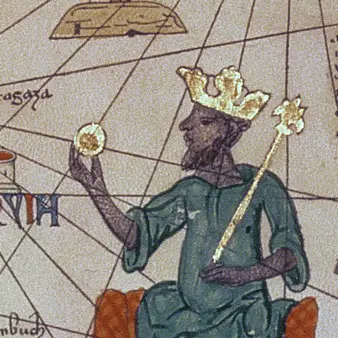
This is the obvious follow-up, and it's a reasonable one. Our list of the richest people of all time includes ancient and medieval rulers, most famously Mansa Musa of the Mali Empire, who we rank very highly with a net worth of $400 billion.
Musa's wealth has support outside a single religious narrative. The medieval writer al-Umari collected accounts from people in Cairo who had encountered him during his famous pilgrimage. Those accounts help establish the extraordinary impression made by his gold and spending. They still do not establish a precise modern net worth.
Comparing rulers across centuries involves more uncertainty than valuing a documented stockholding. Including them does not make the uncertainty disappear, and the same scrutiny should apply to everyone on the list.
Solomon presents an especially difficult combination: debate over the scale of the kingdom, limited independent evidence for his personal wealth, and no dependable way to turn the biblical descriptions into a total fortune. Assigning him $3 trillion would make the ranking look more complete without making it more reliable.
A Fortune Without A Price Tag
There is a revealing final turn in the biblical story. After Solomon dies, his subjects ask his son Rehoboam to lighten the burden imposed by his father. Rehoboam refuses, and the kingdom divides. The narrative that gives us the magnificent court also gives us people who paid a heavy price to sustain it.
That makes Solomon's wealth more interesting than a number on a list. His story contains the splendor of a royal visit, the power of international trade, the cost of monumental ambition, and the fragility of what one ruler leaves behind.
Was he the richest person who ever lived? The Bible gives readers a basis for believing his wealth was unsurpassed. The historical evidence does not give us a reliable dollar figure or a way to rank him against every fortune that followed. Leaving Solomon unranked is an acknowledgment that we cannot responsibly price his fortune. The gold cups, the astonished queen, and the kingdom remembered for its abundance explain why people keep asking.