
/2018/11/jo.jpg)
/2022/12/GettyImages-1341554748.jpg)
/2021/06/mackth.jpg)
/2014/01/CNW-Man-12.png)
:strip_exif()/2020/06/taylor.png)
John Overdeck and David Siegel have run a hedge fund called Two Sigma for over two decades. Today they manage $60 BILLION in assets. According to wikipedia's list of the world's largest hedge funds, they are the seventh largest hedge fund in the world. BUT Wikipedia assumes Two Sigma's assets under management are $40 billion, when in fact the current number is $60 billion. If we use $60 billion, Two Sigma is the third-largest hedge fund in the world, and the second-largest hedge fund in America.
As you might correctly guess, John and David are both multi-billionaires. They are the only owners of Two Sigma, and they have equal voting power over all company decisions.
There's just one problem: They hate each other.
Actually two problems.
Not only do they hate each other and can no longer communicate over basic firm functions, John Overdeck is now going through a divorce, which has thrown another wrench into their already very messy lives.
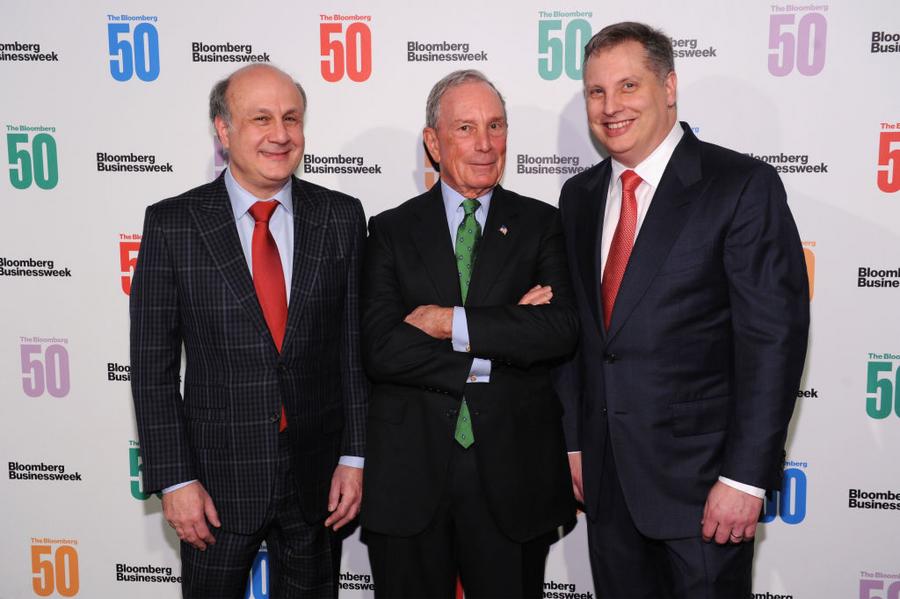
David Siegel, Michael Bloomberg, and John Overdeck (Photo by Craig Barritt/Getty Images for Bloomberg)
How do you split a $60 billion hedge fund?
John Overdeck is a math genius. Math is in his blood. His father was a senior mathematician for the NSA. His mother was a director at Computer Sciences Corporation, a pioneer in the IT field. In 1986, when he was 17, John won a silver medal at the International Math Olympiad. He earned a degree in math and statistics at Stanford before enrolling in Stanford's graduate school to earn a Ph.D in… get this… math.
John never got that Ph.D from Stanford. In the 1990s he was recruited away from school to join a recently-launched math-focused hedge fund called D.E. Shaw. At D.E. Shaw, John quickly rose to the position of managing director of risk management.
More importantly, while he was at D.E. Shaw John caught the attention of the firm's youngest Senior Vice President, a 30-year-old fellow math nerd named Jeffrey Preston Bezos.
Jeff had recently married his research assistant, the future MacKenzie Scott, and in 1994 Mr. and Mrs. Bezos quit the hedge fund and drove across country in a Volvo to Seattle, where he planned to launch an e-commerce business. Jeff wrote the business plan while MacKenzie drove. The business was originally called "Cadabra." Cadabra soon was renamed Amazon.com.
One of the first people Jeff recruited to join him in Seattle was John Overdeck. John's title said Vice President, but he was really a Jeff Bezos's technical assistant.
John worked at Amazon for two crucial years, from roughly 1995 to 1997. I couldn't figure out exactly when he joined or when he left, but considering Amazon went public in May of 1997, it's probably safe to assume that John worked through the IPO, made a small fortune and decided to take a few years off to enjoy his riches.
FYI, on the IPO date, Jeff Bezos ended the day with a net worth of $120 million. A year later he was a billionaire. By late 1999 Bezos was worth $10 billion. After the dotcom bubble exploded in 2001 Bezos' net worth crashed all the way back down to $2 billion.
That same year John and another D.E. Shaw alum named David Siegel, decided to launch a hedge fund. They called it Two Sigma. There was actually a third founder named Mark Picard, but he retired in 2006.
Two Sigma
Right out of the gate Two Sigma raised over $100 million from investors including Jeff Bezos.
In its first decade of operation, Two Sigma returned an average of 30% per year to its investors. This was significantly higher than the average return generated by the average hedge fund in the same time period.
Two Sigma's success was due to its use of cutting-edge technology and its focus on quantitative analysis. The firm employed hundreds of mathematicians, physicists, and computer scientists to develop trading algorithms that could exploit market inefficiencies.
As we stated previously, Two Sigma is the third-largest hedge fund in the world today with $60 billion under management. John and David's former firm, D.E. Shaw, manages around $50 billion.
And, as we stated previously, despite all their success, today John and David hate each other.
Over the years John and David have clashed plenty of times over everything from succession planning, promotions and investment decisions. That's not abnormal. What is abnormal is when the animosity between the owners gets so bad that the fund is forced to make an SEC disclosure that basically says "our founders hate each other, they're unable to make basic decisions together and that might turn into a risk for investors."
John and David haven't appeared at event together in years. The photo above with Michael Bloomberg is from 2017. It's the most-recent photo of them together I could find in Getty. Insiders claim they frequently "snipe" at each other during meetings in front of subordinates.
The friction is making it difficult "to retain or attract employees (including very senior employees) and could continue to impact the ability of employees to fully implement key research, engineering, or corporate business initiatives."
John and David each have equal voting rights (one vote per person). They are apparently stalemating on every single decision, big or small. There's no mechanism for breaking the stalemate. And that's a huge problem considering what is going on in John's personal life.
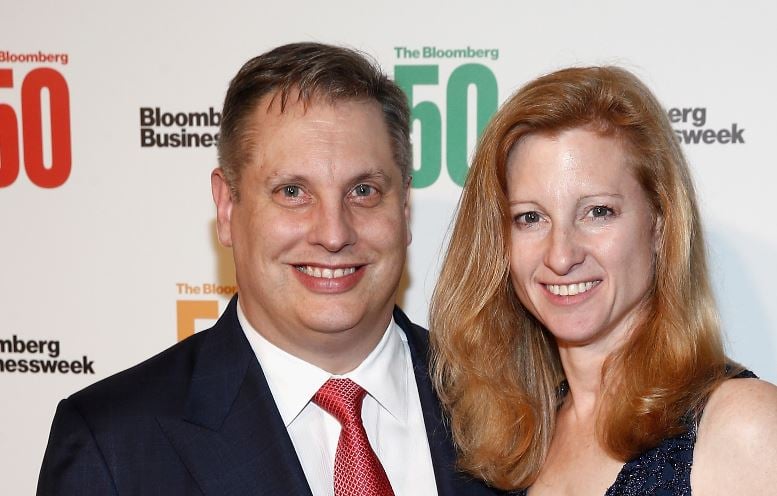
John and Laura Overdeck via Getty
John's Divorce
In 2002 John married Laura Anne Bilodeau. In 2011 John and Laura established the Overdeck Family Foundation which primarily focuses on STEM education charities and research. Guess what the "M" in "STEM" stands for… MATH.
In 2012 Laura founded a non-profit called Bedtime Math, a free website and app with the goal of making "math a fun part of kids' everyday lives, as beloved as the bedtime story."
Unfortunately that love of math is not helping David, John and Laura figure out how to split Two Sigma.
Their equity stakes in Two Sigma have given both John and David a net worth of $7 billion. John is one of the richest people in New Jersey.
Unfortunately, having a net worth of $7 billion that is largely based on the equity value of a private company doesn't mean you have billions in liquid cash lying around to payout a divorce settlement. And that's where a new conflict has arisen.
After 20 years of marriage, WITH NO PRENUP, John and Laura are divorcing. Common sense would say that Laura is entitled to a payout of $3-3.5 billion. John can't give her that payout without selling part of his stake in Two Sigma. He doesn't want to do this because selling some of his equity would give David majority ownership, and therefore full control. And in another twist, David doesn't even want to be in control. He wants to retire, but he DOESN'T want John to be in charge.
This all adds up to a serious quagmire that won't be easily solved, no matter how much you love math.
/2018/11/jo.jpg)
/2021/06/mackth.jpg)
/2010/08/James-Simons-1.jpg)
/2021/10/GettyImages-1178614043.jpg)
/2021/09/GettyImages-1187201824.jpg)
/2015/06/GettyImages-56546690.jpg)
/2022/06/joey-chestnut.png)
/2012/09/Takeru-Kobayashi-1.jpg)
/2019/03/Karol-G.jpg)
/2011/03/Rickie-Fowler-1.jpg)
/2016/06/GettyImages-494820822.jpg)
/2009/11/Sigourney-Weaver.jpg)
/2010/05/Carla-Gugino-1.jpg)
/2025/05/Aryna-Sabalenka.jpg)
/2014/04/Keith-David.jpg)
/2019/04/Kathy-Griffin.jpg)
/2010/12/virginia-madsen.jpg)