
If you were to scan a list of the 20 richest people in the world, I'm willing to bet the average person would recognize nearly every name.
You'd see Elon Musk, Jeff Bezos, Bill Gates, Warren Buffett. Even someone who doesn't follow business or finance would have a rough idea of how those people made their money, where they're from, and why they're famous.
And then there's Amancio Ortega.
With a net worth of $142 billion, Ortega currently ranks as the 15th richest person on earth. And, believe it or not, that's actually low compared to where he ranked over much of the last two decades. From roughly 2000 through 2017, he was consistently one of the three richest people in the world, typically trailing only Gates or Buffett. And get this – For a brief stretch in 2015, Amancio was actually the #1 richest person on earth. Today, Bill Gates is the 16th richest person on earth with a net worth of $105 billion.
Let's be honest. Before opening this article, would you have been able to pick Amancio Ortega out of a lineup?
Do you know what country he's from?
Do you have any idea how he built one of the largest fortunes in modern history?
Don't feel too bad about not being able to recognize him. For decades, nobody in the press could either. Until 1999—when his company was already a global behemoth preparing to go public—there was no publicly available photograph of Amancio Ortega. He was a complete ghost. He has never granted a single official media interview in his entire life, nor does he attend award ceremonies. When Inditex finally went public in 2001, he was so overwhelmed by the brief media exposure that he reportedly went into his office, closed the door, and cried.
Based on his name (and wow, this is a little racist of you), I bet you thought he was a Mexican billionaire who made his fortune from a conglomerate empire owning a bunch of telecom, media and construction assets in Latin America. That's incorrect.
First off, Amancio is Spanish. And secondly, his fortune comes from owning the majority of a very simple asset. An asset that may have produced something you are wearing right this minute. And it all started with bathrobes…
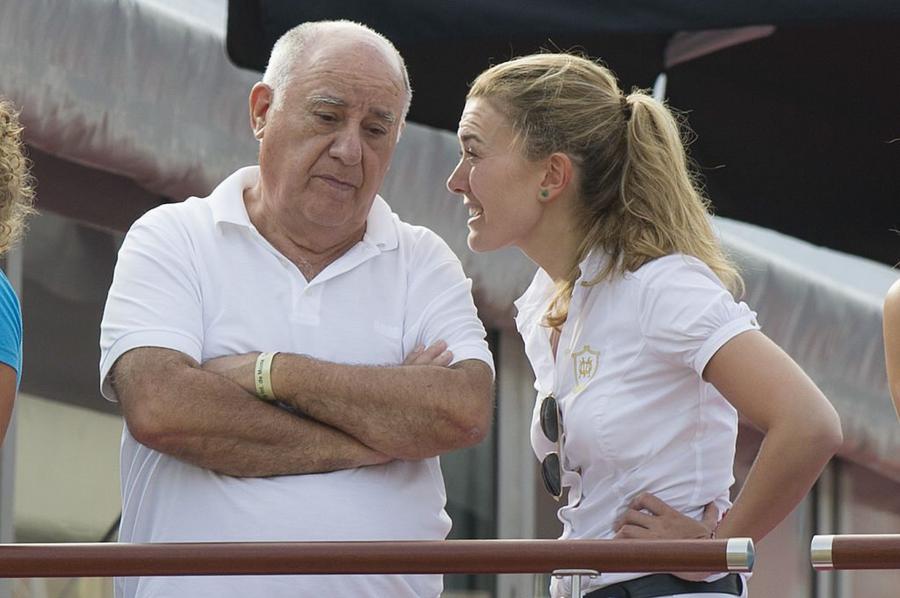
Pascal Le Segretain/Getty Images
An Empire Built From Bathrobes
Amancio Ortega didn't start out as a mogul. He didn't go to business school. He didn't come from money. He was the son of a railway worker in northwest Spain who dropped out of school at 14 and got a job as a delivery boy for a local shirtmaker. That job turned into an informal apprenticeship. He learned how garments were cut, stitched, priced, and sold. More importantly, he learned where the inefficiencies were.
It's worth pausing here for a second, because Rosalía Mera is not some footnote in this story.
After the couple divorced in 1986, Mera retained a roughly 7% stake in the business. That stake would eventually make her the richest self-made woman in the world, with a fortune north of $6 billion. Tragically, she died suddenly of a stroke in 2013 while on vacation. Their personal life was also marked by challenges, including raising their son Marcos, who was born with severe cerebral palsy, something that inspired Mera to dedicate much of her wealth to supporting people with disabilities.
Back in the 1960s and 70s, however, they were just two scrappy entrepreneurs building something from nothing.
That small operation evolved into a company called Confecciones GOA, which began producing larger volumes of clothing at lower costs.
By 1975, the Ortegas made a pivotal leap. Instead of just manufacturing for other brands, they opened their own retail store in A Coruña. They called it "Zorba," a reference to the classic 1964 Anthony Quinn movie "Zorba the Greek." Unfortunately, they soon learned that there was a bar just two blocks away called Zorba. So Amancio and Rosalia slightly rearranged the letters and came up with…
Zara
Here's where things get interesting.
At the time, the fashion industry worked on a rigid calendar. Designers created collections months in advance. Manufacturers produced inventory in bulk. Retailers guessed what would sell, placed huge orders, and hoped they got it right. If they didn't, they were stuck discounting unsold inventory.
Ortega flipped that entire model on its head.
Instead of predicting trends, Zara reacted to them. Store managers sent real-time feedback about what customers were buying. Designers would sketch new items immediately. Factories, many of them owned or tightly controlled by Ortega, could turn those designs into finished garments in a matter of weeks. Sometimes even days.
This system, later dubbed "fast fashion," meant Zara could constantly refresh its inventory. Customers quickly learned that if they liked something, they needed to buy it immediately, because it might be gone next week. That created urgency, reduced overproduction, and kept stores feeling new every time you walked in.
By the mid-1980s, Ortega formalized the structure by creating Inditex, a parent company that would oversee Zara and future brands. Over the next few decades, Inditex expanded aggressively across Europe, then into the United States, Asia, and beyond. Zara became the flagship, but Ortega added other brands like "Massimo Dutti," "Pull&Bear," and "Bershka" to target different demographics.
In 2001, Ortega took Inditex public. The IPO valued the company at billions and instantly made him one of the richest people in Spain.
Amazingly, the man who built the largest fast fashion empire on earth… does not wear Zara.
He wears the same outfit every single day. A blue blazer, a white shirt, and gray trousers. And despite being worth over $140 billion, he doesn't dine in some executive penthouse. He eats lunch in the company cafeteria, sitting with employees, chatting with designers, fabric buyers, and seamstresses like he's just another guy on the team.
Today, Zara operates 7,400 stores and generates around $50 billion per year in revenue. It's the largest retail company on earth. Amanio owns 59% of Inditex, which has a market cap of around $166 billion as of this writing. A 59% stake in a $166 billion company equals almost exactly $100 billion in paper net worth. So what accounts for the other $42 billion of his current $142 billion net worth? Well, a large portion of that difference comes from something most people have never associated with Amancio Ortega at all…
The $10 Million Per Day Problem
When Inditex went public in 2001, Ortega didn't just become wildly rich overnight. He also unlocked a steady, massive stream of cash in the form of annual dividends.
In a recent year, Ortega collected roughly €3.2 billion in cash payouts from Inditex. That's about $3.5 billion.
Inditex pays dividends twice a year, typically in May and November. That's $1.75 billlion twice per year. That's $300 million per month. That's $10 million per day.
The Hidden Genius: Taxes
As awesome as that sounds, earning massive dividends actually creates a problem for Amancio.
Spain imposes a wealth tax that effectively penalizes billionaires for sitting on large amounts of idle cash. On December 31st each year, the government essentially takes a snapshot of your wealth and taxes it accordingly.
So what do you do if you're Amancio Ortega and you're receiving billions in cash every year? You convert that cash into active business assets.
Real estate qualifies. Infrastructure qualifies. Operating companies qualify. Idle cash does not.
Through his holding company, Pontegadea, Ortega has spent the last two decades quietly assembling what is now the largest private real estate portfolio on the planet.
We're talking about more than 200 properties across roughly a dozen countries, worth an estimated $25 billion.
And here's the key difference between Ortega and almost every other real estate investor: He doesn't borrow money. He doesn't flip properties. And he almost never sells. He pays cash. He buys the best asset in a given market. And then he holds it… basically forever.
Buying Like an Art Collector
If you look at Ortega's acquisition history, a pattern emerges very quickly.
He targets irreplaceable, "best-in-class" properties in major global cities. Think flagship retail locations, iconic office towers, and massive complexes leased to blue-chip tenants.
A few examples:
- A 43-story skyscraper in Madrid
- A landmark office building overlooking Green Park in London
- The Troy Block office complex in Seattle, leased to Amazon
- Toronto's gold-glass Royal Bank Plaza, purchased for roughly $916 million
- A massive Vancouver office hub leased to Amazon, which he bought for around $850 million
In just one recent year, Ortega spent more than $3 billion acquiring properties across multiple continents, including office buildings, hotels, industrial assets, and even a major stake in a British port operator.
And he's not slowing down.
The result?
More money kept. More money reinvested. More assets acquired.
And the cycle continues.
Amancio Ortega isn't just the guy behind "Zara." He's arguably the most powerful landlord on earth.
He owns office towers in major cities. Luxury retail space on the most expensive shopping streets in the world. Logistics hubs leased to the biggest companies on the planet.
Which brings us back to the original question.
If you were standing in a room with the 20 richest people on earth… would you recognize him now?
/2020/03/amancio.jpg)
/2020/03/Jeff-Bezos.jpg)
/2016/02/GettyImages-488162724.jpg)
/2016/02/mark.jpg)
/2014/03/richest.jpg)
/2026/04/frank-lope.png)
:strip_exif()/2009/09/P-Diddy.jpg)
/2018/03/GettyImages-821622848.jpg)
/2019/10/denzel-washington-1.jpg)
/2017/02/GettyImages-528215436.jpg)
/2009/09/Brad-Pitt.jpg)
/2009/11/George-Clooney.jpg)
/2020/02/Angelina-Jolie.png)
/2009/09/Cristiano-Ronaldo.jpg)
/2009/09/Jennifer-Aniston.jpg)
:strip_exif()/2015/09/GettyImages-476575299.jpg)
/2020/06/taylor.png)
/2019/11/GettyImages-1094653148.jpg)
/2020/04/Megan-Fox.jpg)
/2020/01/lopez3.jpg)
/2019/04/rr.jpg)