
When Celebrity Net Worth first began tracking Jay-Z's net worth on September 9, 2009, we estimated his net worth at $300 million. He was three months shy of his 40th birthday.
By that point, he had already achieved the kind of financial milestones most artists only dream of. He had built and sold his clothing line, Rocawear, to Iconix Brand Group for $204 million in cash. He had finished a highly lucrative run as the President of Def Jam Recordings (where he signed Rihanna). He had scooped up an (extremely small) ownership stake in the New Jersey Nets, and just a year prior, he had signed a historic $150 million touring and entertainment pact with Live Nation to launch his own powerhouse agency, Roc Nation. Oh, and the day before we published that initial estimate, he had just dropped his eleventh studio album, "The Blueprint 3."
Back in 2009, the idea of any musician, let alone a rapper, ending up with a net worth of $300 million would have been the ultimate finish line. 40 years old, $300 million. It couldn't possibly get better or bigger than that.
For Jay-Z, this was just the seed money and the starting point.
Over the next decade, his fortune wouldn't just grow; it would completely explode, catapulting him into a financial stratosphere previously reserved for Wall Street hedge fund managers and tech founders.
Today, we're going to tell you the story of how three masterstroke investments:
- A champagne boycott
- A bitter cognac street fight
- And a struggling streaming platform
Took Jay-Z from a $300 million celebrity into a multi-billionaire business mogul…
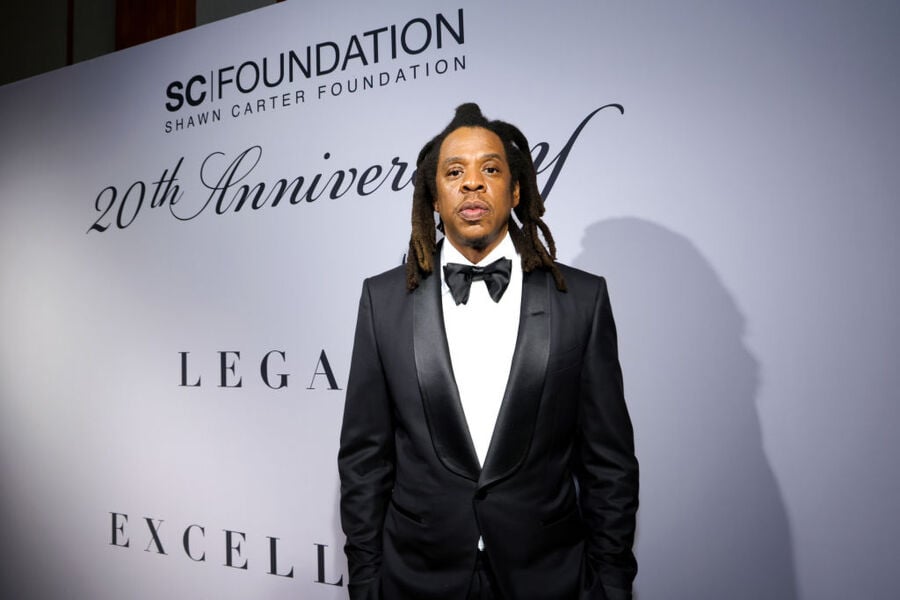
(Kevin Mazur/Getty Images for Roc Nation)
Getting Revenge on Cristal
In the early 2000s, Cristal Champagne was the undisputed king of hip-hop nightlife. It was the ultimate status symbol, aggressively name-dropped in tracks and popped in VIP sections across the globe.
Cristal has been privately owned by a French company called Louis Roederer since the late 1800s. In May 2006, Louis Roederer's managing director, Frederic Rouzaud, gave an interview with The Economist for an article that was eventually titled "Bubbles and Bling." Frederic had JUST taken over the top job a few months earlier after his father stepped down.
In the article, the interviewer sets up a question by saying:
"Today, the most high-profile consumers of Cristal are rap artists, whose taste for swigging bubbly in clubs is less a sign of a refined palate than a passion for a 'bling-bling' lifestyle that includes ten-carat diamond studs, chunky gold jewelry, pimped up Caddies and sensuous women. In his number one hit "Hard Knock Life", Jay-Z raps, "Let's sip the Cris and get pissy-pissy". Cristal has been so visible at Mr. Combs's concerts that onlookers have wondered whether the venerable champagne house was sponsoring the event."
The interview then asks Frederic whether "an association between Cristal and the bling lifestyle could actually hurt the brand…"
To which Frederic replies:
"That's a good question, but what can we do? We can't forbid people from buying it. I'm sure Dom Pérignon or Krug would be delighted to have their business."
In my opinion, that's a rather innocuous reply. He never actually says he doesn't want rappers to buy or sing about Cristal. He simply answers the question honestly. What is he going to do about it? He's being earnest. If the association with bling is causing damage, he can't stop it. If he tried, rappers would simply switch to other high-end brands.
Unfortunately, that's not how the rap community, Jay-Z in particular, interpreted Frederic's reply.
Upon hearing about the interview, Jay-Z immediately called for a total boycott of Cristal. He removed the brand from all of his sports bars and would no longer feature it in his videos. He encouraged all other hip hop artists to follow his lead.
In October 2006, just five months after that infamous Economist article came out, Jay-Z released the music video for his hit song "Show Me What You Got." In a now-iconic scene, Jay-Z is offered a bottle of Cristal and waves it away in disgust. A moment later, a waiter returns with a silver briefcase, which, when opened, reveals a mysterious, metallic gold bottle featuring a pewter Ace of Spades logo.
That brand behind this new "Ace of Spades" champagne was Armand de Brignac.
What the public didn't know at the time was that Jay-Z had secretly acquired a 50% financial stake in the relatively unknown high-end champagne before dropping the video. Over the next decade, he weaponized his cultural influence to make Armand de Brignac the new gold standard of luxury nightlife. By 2014, he quietly bought out the remaining 50% from Sovereign Brands, becoming the sole owner.
The ultimate payout came in February 2021. Jay-Z sold a 50% stake in the brand to LVMH's Moët Hennessy. The deal valued Armand de Brignac at well over $600 million, handing Jay-Z a cash windfall of roughly $315 million while allowing him to retain half the company and tap into the sheer power of LVMH's global distribution network. It was a masterclass in revenge capitalism.
If you're hoping that Cristal went bankrupt because everyone stopped buying their champagne, I have some disappointing news. In 2012, the global sales manager for the brand reported to The Globe and Mail that Cristal "never suffered because of the boycott" and production doubled between 2004 and 2010 alone.
The Multi-Billion-Dollar D'Ussé Drama
If the champagne deal was smooth and strategic, his cognac venture turned into a full-blown financial brawl.
In 2012, Jay-Z partnered with Bacardi to launch D'Ussé as a true 50/50 joint venture. Jay handled branding and cultural cachet. Bacardi handled production and global distribution. It was a rare deal where the celebrity wasn't just the face. He was an equal owner.
And it worked.
D'Ussé quickly became one of the fastest-growing premium cognacs in the world, fueled by relentless promotion and strong double-digit growth.
Then the relationship unraveled.
By late 2022, the two sides were locked in a bitter dispute over what the brand was actually worth. At one point, Jay offered to sell his entire 50% stake at a $3 billion valuation, implying a $1.5 billion payday for himself. Bacardi pushed back hard, claiming they had previously agreed to a valuation closer to $1.5 billion total.
Jay fired back with a lawsuit, accusing Bacardi of deliberately mismanaging the brand to suppress its value and force a cheaper buyout.
After months of legal sparring, a deal was finally reached in February 2023.
Bacardi purchased 25.1% of Jay-Z's stake, increasing its ownership to 75.1%, while Jay retained a 24.9% minority position. Crucially, the transaction was based on the full $3 billion valuation Jay had been pushing for.
Selling roughly half his stake at that valuation delivered an estimated $750 million cash windfall.
And he didn't walk away empty-handed.
At that same $3 billion valuation, his remaining 24.9% stake was still worth roughly another $750 million on paper.
That single deal didn't just boost his net worth. It cemented his status as a true "multi" billionaire.
The Tidal Flip
While liquor acquisitions built the foundation of his billionaire status, his foray into the tech world proved he was essentially operating his own private equity firm.
In early 2015, Jay-Z spent roughly $56 million to acquire Aspiro, a Norwegian tech company that operated a struggling music streaming service called Tidal. He rebranded it as an artist-first, high-fidelity alternative to Spotify, bringing in a massive roster of mega-stars to serve as minority stakeholders.
For years, Tidal struggled. It burned through cash, faced constant executive turnover, and failed to gain significant market share against tech behemoths like Apple and Spotify. Many industry analysts wrote it off as a vanity project failure.
Then, in March 2021—just weeks after closing the LVMH champagne deal—Jay-Z pulled off a financial miracle. He sold an 80% majority stake in Tidal to Jack Dorsey's financial tech company, Square (now Block Inc.). Square paid just over $302 million for the stake.
Jay-Z had taken a distressed asset he bought for $56 million, successfully kept it afloat on cultural relevance alone, and flipped it for a massive exit while securing a seat on Square's board of directors.
In hindsight, this deal has not aged well for Jack Dorsey and Square. In the five years since the deal was consummated, Square's stock price has fallen 75%. And with the benefit of hindsight, a lot of people are now wondering how spending $302 million on a struggling music startup benefited a digital payment company.
The Billionaire Blueprint
If you look at the math across just these three deals, the scale of his pivots becomes staggering. He took a champagne boycott, a joint-venture cognac, and a $56 million distressed streaming app and turned them into over $1.3 billion in pure cash exits, while still holding hundreds of millions of dollars in remaining equity across those brands.
When you zoom out and look at his empire today, his actual music catalog—the iconic albums, the stadium anthems, the Grammys—makes up less than 4% of his total net worth. The music was just the marketing engine to build the cultural leverage he needed to walk into boardrooms and dictate his own terms.
To put his financial ascent into perspective: there are currently around 735 billionaires in the United States, and less than 15 of them (around 2%) are Black. Jay-Z didn't just force his way into one of the most exclusive wealth brackets on the planet; he completely re-engineered the way modern entertainers get there.
/2019/04/Jay-Z.jpg)
/2014/01/2-1.jpg)
/2012/04/GettyImages-52977528.jpg)
/2015/03/damon-dash.jpg)
/2024/09/GettyImages-130236268.jpg)
/2024/02/naples.jpg)
/2019/04/rr.jpg)
/2019/10/denzel-washington-1.jpg)
/2009/09/Brad-Pitt.jpg)
/2020/06/taylor.png)
/2020/01/lopez3.jpg)
:strip_exif()/2015/09/GettyImages-476575299.jpg)
/2020/02/Angelina-Jolie.png)
:strip_exif()/2009/09/P-Diddy.jpg)
/2009/09/Cristiano-Ronaldo.jpg)
/2009/11/George-Clooney.jpg)
/2017/02/GettyImages-528215436.jpg)
/2020/04/Megan-Fox.jpg)
/2018/03/GettyImages-821622848.jpg)
/2009/09/Jennifer-Aniston.jpg)
/2019/11/GettyImages-1094653148.jpg)