
Yesterday, we told the unlikely story of how Kenny G was introduced to Starbucks visionary Howard Schultz in the mid-1980s, well before the coffee company went public. That timely introduction led to Kenny making a pre-IPO investment into the chain that, assuming he held onto his shares, grew into an absolute fortune.
As it turns out, about a decade later, Howard Schultz would help a completely different kind of celebrity on his path toward unimaginable riches.
When Earvin "Magic" Johnson abruptly retired from the NBA in 1991, his career earnings from his playing contracts totaled roughly $40 million (which is the equivalent of roughly $93 million today after adjusting for inflation). He was just 32 years old.
By that point, he had already achieved the kind of milestones most athletes only dream of. He had won five NBA championships with the "Showtime" Los Angeles Lakers, secured three MVP awards, and established himself as the greatest point guard in basketball history.
Back in the early 1990s, the idea of a professional athlete earning $40 million would have been the ultimate finish line. You buy a nice mansion in Florida, play golf every day, sign a few autograph deals, and comfortably live off the interest. It couldn't possibly get better or bigger than that.
But for Magic Johnson, that NBA salary was just the seed money and the starting point.
Over the next three decades, his fortune wouldn't just grow; it would completely explode, catapulting him into a financial stratosphere. And ya, you may know that he owns a chain of movie theaters. You probably know he's a minority owner of the LA Dodgers. But I bet you had no idea that Magic's real windfall is built on an extremely boring side business: Ownership of a massive insurance company you've definitely never heard of…
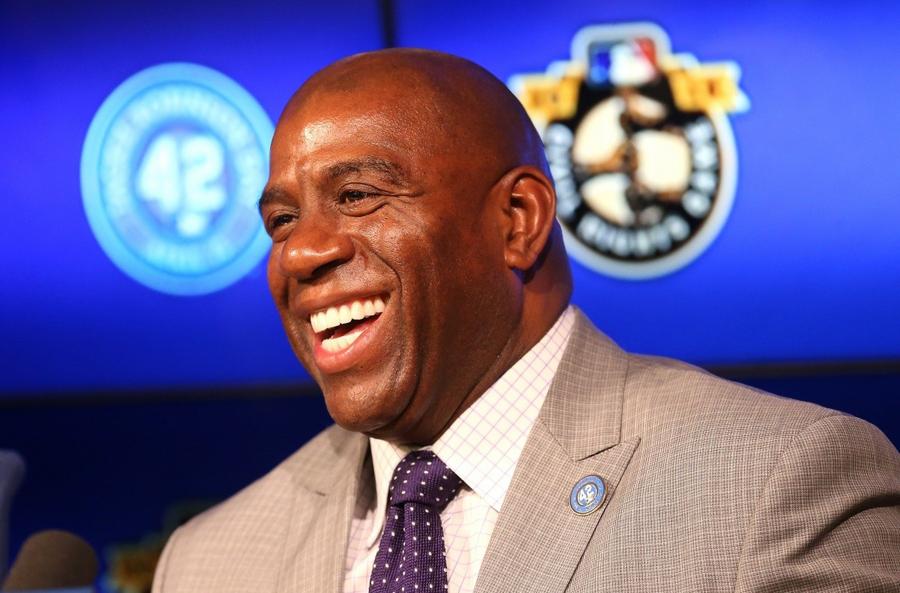
Stephen Dunn/Getty Images
The Theater That Changed Everything
When Magic entered the business world in the early 1990s, corporate America largely ignored inner-city and minority neighborhoods. The prevailing assumption was simple: there wasn't enough disposable income to support premium brands.
Magic knew that assumption was dead wrong. He just needed to prove it.
In 1995, he partnered with Sony Pictures to launch Magic Johnson Theaters. His first location opened in Baldwin Hills, a neighborhood in South Los Angeles that major theater chains had long abandoned. Instead of cutting corners, Magic went the opposite direction. He built a premium, state-of-the-art multiplex and positioned it as a safe, high-quality entertainment destination for the community.
The result was immediate and undeniable. The Baldwin Hills theater became one of the highest-grossing movie theaters in the entire country.
Magic now had something far more valuable than a theory. He had proof.
All he needed was the right partner.
The Starbucks Joint Venture
That partner was Howard Schultz.
Schultz had built Starbucks into a rapidly expanding national brand, but he was famously protective of its structure. The company did not franchise its stores.
Magic wasn't interested in being a franchisee anyway.
He proposed a 50/50 joint venture called Urban Coffee Opportunities. He would fund half the expansion into underserved urban markets. Starbucks would provide the infrastructure, systems, and brand.
To seal the deal, Magic invited Schultz to Baldwin Hills on the opening night of "Waiting to Exhale." He wanted him to see the crowds, the energy, and the lines for himself.
It worked.
Once the stores opened, Magic made one critical adjustment: he localized the experience.
As he later explained:
"We'll pay $3 for a coffee, but we don't know what a scone is."
Scones came off the menu. Sweet potato pie, peach cobbler, and pecan pie went in. The in-store music shifted from acoustic to R&B and hip-hop. Seating areas were expanded to encourage gathering.
The changes worked.
Magic's urban Starbucks locations consistently outperformed traditional stores on a per-customer basis. Over time, he built the joint venture to 125 locations nationwide.
The First Major Exit
Then came the first major cash-out.
Roughly a decade after launching the partnership, Magic sold his 50% stake back to Starbucks. The exact price was never disclosed, but estimates put his payday at around $100 million.
That wasn't his only liquidity event.
Back in 1994, Lakers owner Jerry Buss had allowed Magic to purchase a 5% stake in the team for $10 million. As NBA valuations surged, that stake became significantly more valuable. In 2010, the same year he exited Starbucks, Magic sold his Lakers stake to Patrick Soon-Shiong for an estimated $50–$60 million.
Building a $150 Million War Chest
Suddenly, Magic had roughly $150 million in cash.
Now came the second act.
Turning Cash Into Ownership
In 2012, he joined the Guggenheim Baseball Management group to purchase the Los Angeles Dodgers for a then-record $2 billion. Magic personally invested around $50 million. Today, the Dodgers are worth more than $5 billion.
He followed that move by systematically acquiring stakes across major sports: the WNBA's Los Angeles Sparks, MLS's Los Angeles FC, and eventually the NFL's Washington Commanders as part of Josh Harris's ownership group in a record-setting $6.05 billion deal.
The Sports Empire
Today, athlete ownership is common.
In the early 2010s, it wasn't.
Magic helped pioneer that transition from player to owner, using liquidity from earlier exits to buy into appreciating assets.
The Quiet Billion-Dollar Engine
Then came the move that quietly became the foundation of his fortune.
In 2015, Magic Johnson Enterprises acquired a 60% controlling stake in EquiTrust Life Insurance.
It wasn't flashy. It didn't generate headlines. But it was a cash machine.
At the time of the acquisition, EquiTrust managed roughly $16 billion in assets. Over the next decade, that number grew to approximately $27 billion, with annual revenue approaching $2.6 billion.
Because Magic owns 60% of the company, EquiTrust now represents the single largest driver of his net worth. Estimates suggest his stake alone is worth between $800 million and $1 billion.
Connecting The Dots
When you zoom out, the pattern becomes clear.
- He used a $40 million basketball career to fund movie theaters.
- He used those theaters to secure a Starbucks joint venture.
- He used that exit, along with his Lakers stake, to build a $150 million war chest.
- He used that cash to buy into professional sports franchises.
- And he ultimately anchored everything with a majority stake in a massive insurance company.
Today, Celebrity Net Worth estimates Magic Johnson's net worth at $1.6 billion.
Only a handful of athletes in history have reached billionaire status, including Michael Jordan, LeBron James, and Tiger Woods.
Magic's path stands out because it wasn't built on a single brand or licensing deal.
It was built step by step. Deal by deal. Exit by exit.
His playing career may have ended in 1991.
But in hindsight, that was just day one of his real career.
/2019/10/Kenny-G.jpg)
/2013/03/Shock-G.jpg)
/2026/04/kenny-g-starbucks.jpg)
/2019/12/GettyImages-510341972.jpg)
/2011/11/kate.jpg)
/2020/07/randy-jackson-1.jpg)
/2009/11/George-Clooney.jpg)
/2017/02/GettyImages-528215436.jpg)
/2019/04/rr.jpg)
/2009/09/Brad-Pitt.jpg)
/2019/10/denzel-washington-1.jpg)
/2020/01/lopez3.jpg)
/2019/11/GettyImages-1094653148.jpg)
/2020/06/taylor.png)
:strip_exif()/2009/09/P-Diddy.jpg)
/2020/02/Angelina-Jolie.png)
/2009/09/Cristiano-Ronaldo.jpg)
/2018/03/GettyImages-821622848.jpg)
/2020/04/Megan-Fox.jpg)
:strip_exif()/2015/09/GettyImages-476575299.jpg)
/2009/09/Jennifer-Aniston.jpg)