
Over the weekend, Iran's powerful Assembly of Experts selected Mojtaba Khamenei as the country's new Supreme Leader, replacing his father, Ayatollah Ali Khamenei, who was killed in a U.S.-Israeli military strike one week ago.
The appointment marked a historic moment for the Islamic Republic. For the first time since the 1979 revolution toppled the Shah, the country's highest religious and political authority effectively passed from father to son.
On paper, the role of Supreme Leader is supposed to embody spiritual devotion and ideological purity. The position carries immense political power, but no official salary, and its occupant is expected to project a life of religious humility and austerity.
So you might be surprised to learn that, according to investigative reporting and intelligence assessments, the 56-year-old Mojtaba Khamenei controls a vast private fortune built quietly through offshore companies, luxury real estate, and international financial networks.
In other words, while the public image of a revolutionary cleric might suggest a modest life of prayer and scholarship, Mojtaba Khamenei is widely alleged to be a multi-billionaire with assets scattered across some of the most expensive real estate markets in the world.
Oh. And you might ALSO be surprised to learn that Mojtaba isn't the only secret billionaire in the family. His late father, Ayatollah Ali Khamenei, was long alleged to control a vast economic empire through an obscure organization called Setad, a conglomerate originally created to manage properties seized after the 1979 revolution. Over the decades, Setad evolved into one of the most powerful and opaque financial institutions in the Middle East, with holdings spanning real estate, banking, telecommunications, energy, and pharmaceuticals. A 2013 investigation estimated the group controlled at least $95 billion in assets, and some analysts later suggested the broader network tied to the Supreme Leader's office could be worth closer to $200 billion.
So, when Mojtaba Khamenei ascended to the highest office in Iran, he didn't just inherit political authority over the Islamic Republic. He may also have inherited influence over one of the largest financial empires on the planet…
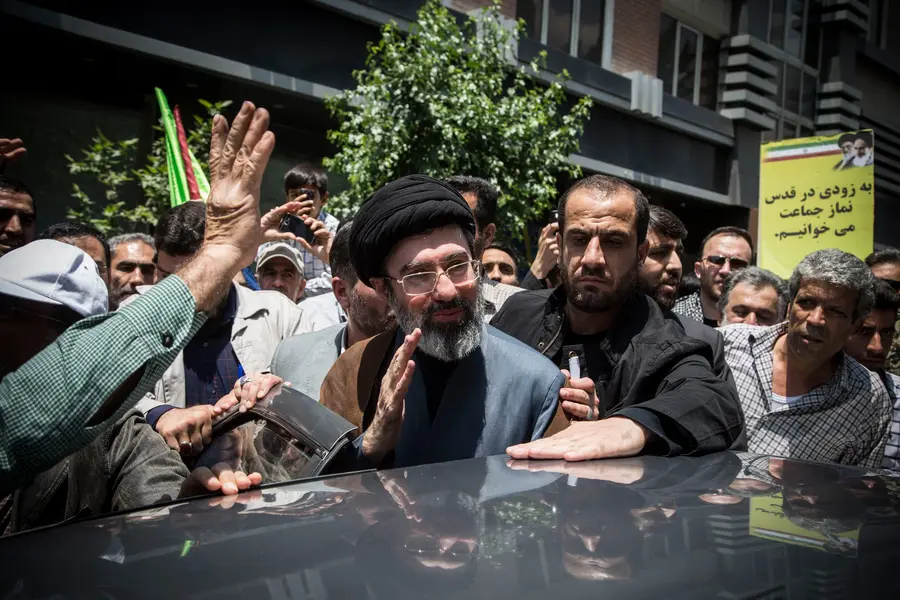
(Photo by Rouzbeh Fouladi / Middle East Images via AFP)
A Note on Sources
Much of what is publicly known about Mojtaba Khamenei's alleged financial network comes from a year-long investigation published by Bloomberg in early 2026. The reporting was based on interviews with individuals familiar with the deals, property records, corporate filings, and confidential financial documents reviewed by journalists. The investigation also cited assessments from Western intelligence agencies that have tracked financial networks tied to Iran's ruling elite. Because many of the assets are held through shell companies, intermediaries, and offshore jurisdictions, definitive ownership is difficult to prove. Mojtaba Khamenei did not respond to requests for comment from Bloomberg, and individuals linked to the transactions have denied that the assets are connected to him.
The London Mansions
One of the most visible pieces of Mojtaba Khamenei's alleged fortune can be found thousands of miles from Tehran on a quiet, tree-lined street in North London known as The Bishops Avenue.
Often nicknamed "Billionaire's Row," the street is famous for its sprawling gated mansions owned by oligarchs, foreign royalty, and global tycoons. According to property records and investigative reporting, several homes along the avenue are tied to a network of companies and intermediaries connected to Mojtaba Khamenei's financial circle.
One property reportedly purchased in 2014 cost roughly £33.7 million, or around $45 million at the time. Other homes in the same network are held through offshore entities registered in jurisdictions such as the Isle of Man and the Caribbean.
Altogether, investigators believe the London real estate tied to the network exceeds £100 million in value ($134 million USD).
The homes themselves are rarely occupied. Like many properties on The Bishops Avenue, they sit largely empty behind high hedges and security gates, serving less as residences and more as safe places to park enormous amounts of wealth.
A Web of Shell Companies
The properties themselves are only the most visible part of a much larger financial network.
Investigators say the assets connected to Mojtaba Khamenei are typically held through layers of shell companies, offshore entities, and trusted intermediaries. This structure makes it extremely difficult to trace the ultimate owner of the money or the properties involved.
Many of the companies linked to the network are registered in jurisdictions known for secrecy and light financial disclosure rules, including St. Kitts and Nevis, the Isle of Man, and the United Arab Emirates.
Funds connected to the network have reportedly moved through banks in Switzerland, Liechtenstein, and the UAE before being used to purchase real estate and business interests across Europe and the Middle East.
This type of structure is common among wealthy individuals attempting to conceal ownership of assets, but it also plays a crucial role in helping Iranian elites move money internationally despite decades of sanctions.
The Man in the Middle and the "Personal ATM"
As reported by Bloomberg, the center of many of these transactions is Iranian businessman Ali Ansari, a construction magnate who built a sprawling domestic empire, including the enormous Iran Mall complex in Tehran. While Ansari projects the image of a self-made tycoon, his financial trajectory took a dark turn in late 2025 with the spectacular collapse of Ayandeh Bank, a private lender he co-founded.
The bank's failure left millions of ordinary Iranians' savings in limbo, sparking widespread protests across the country. Investigative reporting and intelligence assessments suggest the bank functioned for years as a "personal ATM" for the regime's inner circle. Investigators believe that while the bank was defaulting on its obligations to domestic depositors, it was simultaneously being used to funnel capital out of Iran to fund the very overseas acquisitions tied to Mojtaba Khamenei.
British authorities sanctioned Ansari in 2025, describing him as a key figure in the financial networks supporting the Revolutionary Guard. These sanctions further highlighted his role as a primary conduit for Mojtaba's international investments; companies connected to Ansari appear repeatedly in the ownership structures of the London mansions and European hotels. In several cases, firms controlled by Ansari or his associates are listed as the official owners of properties that investigators say ultimately trace back to Mojtaba's private fortune.
By linking the collapse of Ayandeh Bank to these global property deals, a clear and devastating pattern emerges: the wealth used to park assets in the safety of North London or the UAE appears to be directly stripped from the savings of the Iranian middle class. Ansari has consistently denied any financial relationship with the younger Khamenei.
From Oil Money To Global Real Estate
Much of the money flowing through the network is believed to originate from Iranian oil sales.
Because Iran has faced decades of international sanctions over its nuclear program and regional policies, large portions of the country's oil trade operate through informal channels involving intermediaries, traders, and front companies.
Investigators believe profits from those transactions have been routed through offshore financial structures before eventually landing in Western property markets and hospitality investments.
Assets linked to the network reportedly include luxury villas in Dubai, five-star hotels in Frankfurt and Mallorca, and high-end properties in cities like Paris and Toronto.
Taken together, analysts believe the overseas holdings connected to Mojtaba Khamenei likely equate to a $3 billion personal fortune for the new Supreme Leader. And that's BEFORE he takes control of the empire he's presumably about to inherit from his late father…
Like Father, Like Son
The allegations surrounding Mojtaba's wealth echo long-running claims about the financial power associated with the office of Iran's Supreme Leader.
For decades, Mojtaba's father, Ayatollah Ali Khamenei, was believed to oversee a massive economic empire centered around an organization known as Setad, short for "Headquarters for Executing the Order of the Imam." Originally created in 1989 to manage properties seized after the Iranian Revolution, Setad evolved into a sprawling conglomerate with stakes across banking, telecommunications, pharmaceuticals, and real estate.
A 2013 investigation estimated Setad controlled assets worth at least $95 billion. Some analysts and U.S. officials later suggested the broader network of companies under the Supreme Leader's authority could be worth closer to $200 billion.
Iranian officials have consistently denied those characterizations, insisting that Setad's assets are held for charitable and public purposes rather than personal enrichment.
Still, critics say the structure effectively places enormous financial resources under the control of whoever holds the office of Supreme Leader.
A New Leader, The Same Questions
Now that Mojtaba Khamenei occupies that office, those questions are only growing louder.
His elevation to Supreme Leader gives him ultimate authority over Iran's military, judiciary, intelligence services, and foreign policy. It also places him at the center of a political and financial system that critics say operates largely outside public oversight.
At the same time, the allegations surrounding his own overseas investment network add another layer of intrigue to the story.
Iran's Islamic Revolution was fueled in part by anger at the wealth and corruption of the Shah's ruling family. The clerical regime that replaced the monarchy promised a government rooted in religious virtue and economic justice.
Nearly half a century later, Iran's new Supreme Leader is a man whose family name has become associated with one of the most powerful and secretive financial networks in the Middle East.
And if the investigations into Mojtaba Khamenei's global assets are accurate, the Islamic Republic may now be led by a cleric whose personal wealth spans from Tehran to London, Dubai, Frankfurt, Mallorca, and beyond.
/2014/08/GettyImages-88576746.jpg)
/2026/03/Mojtaba-Khamenei.png)
/2026/03/GettyImages-2257293713.jpg)
/2024/08/david.jpg)
/2026/03/GettyImages-2263277652.jpg)
/2026/03/mark-zuckerberg-indian-creek.png)
/2009/11/George-Clooney.jpg)
/2009/09/Jennifer-Aniston.jpg)
/2019/04/rr.jpg)
/2020/02/Angelina-Jolie.png)
/2009/09/Brad-Pitt.jpg)
/2019/11/GettyImages-1094653148.jpg)
/2017/02/GettyImages-528215436.jpg)
/2018/03/GettyImages-821622848.jpg)
/2020/06/taylor.png)
/2020/04/Megan-Fox.jpg)
:strip_exif()/2015/09/GettyImages-476575299.jpg)
/2019/10/denzel-washington-1.jpg)
:strip_exif()/2009/09/P-Diddy.jpg)
/2020/01/lopez3.jpg)
/2009/09/Cristiano-Ronaldo.jpg)