
On August 9, 2011, Apple surpassed Exxon to become the world's most valuable company for the first time. Apple's then-record-setting market cap was $351 billion. Apple remained the world's most valuable company, uninterrupted, for the next 12 years, five months, and one day… until Thursday, January 11, 2024.
On Thursday, Microsoft knocked Apple off as the world's most valuable company. At Friday's closing prices, Microsoft's $2.887 trillion market cap slightly edged Apple's $2.874 trillion market cap.
At this market cap level, in a slightly alternate reality (where he ignored Warren Buffett's advice), Bill Gates just became the world's first trillionaire.
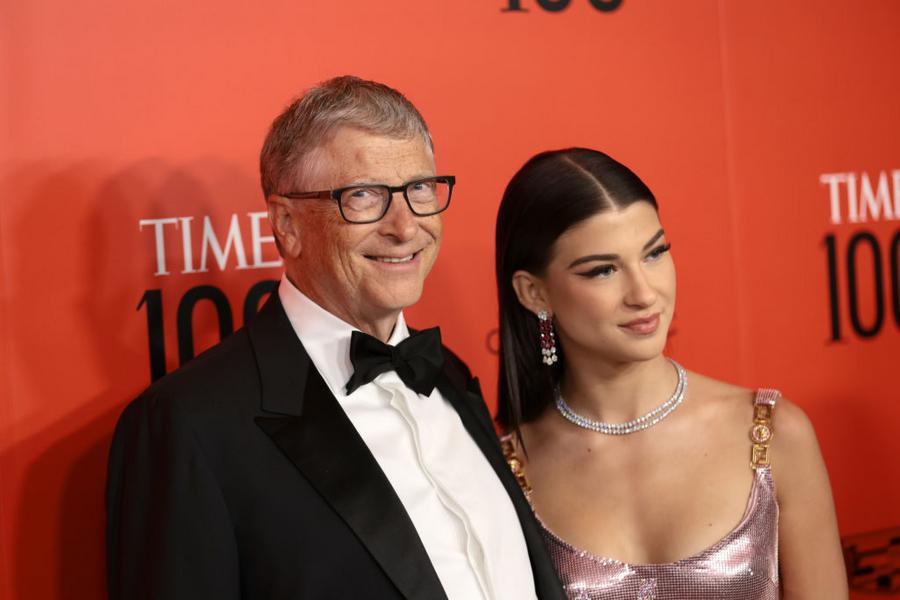
Bill Gates and Phoebe Gates (Photo by Dimitrios Kambouris/Getty Images for TIME)
Going Back In Time
Microsoft went public on March 13, 1986. On the day of the IPO, Bill Gates owned 45% of the company's equity. At the end of its first day as a public company, Microsoft's market cap was $780 million. Therefore, Bill ended the first day of trading with a paper net worth of $350 million.
Funnily enough, Bill was vacationing in Australia on the day of the public offering, arguably the most important financial day of his life. When he returned, his big splurge as a newly-minuted hundred millionaire was to pay off the mortgage on his Seattle house. Roughly a year after going public, Bill became a billionaire for the first time as Microsoft's share price continued to flourish. He was 31.
A Chance Meeting
Today, Bill Gates and Warren Buffett seem like they have been friends forever. But that's not the case. The two billionaires met for the first time in 1991 at a Fourth of July barbecue held at Bill's parents' house in Seattle. Warren happened to be in Seattle to meet with a friend, and that friend happened to know Bill's parents. She offered to make an introduction and literally drove Warren over to Bill's parents' house so the two moguls could shake hands in person.
Bill was wary about meeting Warren. As he would later explain:
"I didn't even want to meet Warren because I thought, 'Hey, this guy buys and sells things, and so he found imperfections in terms of markets — that's not value added to society, that's a zero-sum game that is almost parasitic."
His attitude quickly changed after Warren peppered him with "amazingly good questions that nobody had ever asked." They hit it off, and a lifelong friendship and future mutual devotion to philanthropy was born.
Considering Warren's business philosophies, it's very likely that one of those "amazingly good questions" he posed to Bill was something along the lines of "how are you planning to diversify your net worth?"
Warren Buffett became a billionaire thanks to his diversified investment holding company, Berkshire Hathaway. Berkshire Hathaway has a market cap today of $800 billion. In addition to owning the majority of dozens of companies like GEICO, Fruit of the Loom, and See's Candy, Berkshire also owns large stakes in hundreds of publicly traded and private companies. This diversified strategy has led to a 19% average annual compound gain for Berkshire's shareholders since 1965. Diversification is a fool-proof strategy against risk. Or, to quote the Oracle of Omaha directly; "Diversification is protection against ignorance."
In July 1991, Bill Gates' net worth would have been around $2.5 billion. Nearly 100% of his net worth came from his stake in Microsoft.
Following Warren's advice, Bill began to diversify. He established his own private investment firm, Cascade Investments, and funded it with billions of dollars generated by the sale of his Microsoft shares. By 2000, when he retired as CEO, Bill Gates' stake in Microsoft had shrunk to 14%.
Today, Bill Gates owns a little less than 1.4% of Microsoft, roughly 103 million shares. He isn't the company's largest individual shareholder. That honor belongs to his successor, Steve Ballmer, who owns around 4%.
Microsoft's stock closed at $388 on Friday. So Bill's 103 million shares are worth just under $40 billion. That $40 billion constitutes around 1/3 of Bill's current $138 billion net worth. The remainder of his fortune comes thanks to his diversified investments controlled by Cascade. Through Cascade, Bill owns hundreds (potentially thousands) of significant stakes in public and private companies. He is also the majority owner of the Four Seasons Hotel and Resorts chain and is the largest private owner of farmland in the United States.
One could argue that following Warren Buffett's diversification advice was very wise for Bill Gates. Microsoft has had many ups and downs over the decades, but his diversified fortune allowed him to stay the richest person in the world pretty much uninterrupted between 1997 and 2008.
But what if he had ignored Warren's advice?
World's First Trillionaire
As we stated earlier, on the day Microsoft went public, March 13, 1986, Bill Gates owned 45% of the company's equity. It's only natural that he would have sold off some of that equity over time. Perhaps with share sales to give himself some liquid wealth, he would have reduced his stake to 40% or 35%. Let's use 35%. If Bill Gates still owned 35% of Microsoft, at its current $2.887 billion market cap, that stake would be worth:
$1,010,000,000,000
Aka
$1.01 trillion
And if that's not mind-blowing enough, if he still owned 35% of Microsoft, thanks to the company's $3-per-share dividend, every year Bill would receive around $9 billion every year in dividend payments.
THERE'S NO WAY!!
I can hear the skeptics now: "There's no way Bill Gates would have ever maintained such a huge ownership stake in Microsoft…" To those skeptics, I offer the following counterpoint: Larry Ellison
Larry Ellison is the founder and CEO of Oracle. Oracle went public on March 12, 1986. That's one day before Microsoft's IPO. On the day of the IPO, Larry owned 39% of Oracle's equity. After various share buybacks and personal purchases over the decades, today Larry owns… 42% of Oracle.
Oracle's current market cap is $293 billion. Larry's 42% stake equates to $123 billion in paper wealth. Larry has at least $10 billion worth of his shares pledged as collateral, bringing his net worth down to $113 billion. Larry also owns 1.4% of Tesla. That stake is worth around $9 billion. Taking into account various other assets and debts, today Larry Ellison's net worth is $123 billion. And depending on how you slice it, pretty close to 99% of his fortune comes from his Oracle stake. So, if Oracle's market cap were to grow to $2.381 trillion, Larry would be a trillionaire.
By the way. One of the assets Larry Ellison acquired through his wealth is the Hawaiian island of Lanai. Larry bought Lanai in 2012 for $300 million. With the purchase, he also acquired the island's primary attraction, the Four Seasons Resort Lanai (he has since built a second Four Seasons on the island). If you'll recall, Bill Gates owns the majority of the Four Seasons corporation. How does that work? Four Seasons doesn't actually own any of its hotels; it operates them on behalf of owners such as Larry. So Larry and Bill are partners in a way. And in a fun twist, when Bill married his now ex-wife Melinda Gates in 1994, they rented out the entire Manele Bay Hotel… which in 2005 was renamed… the Four Seasons Resort Lanai! One final fun fact: To prevent helicopter paparazzis from ruining his wedding, Bill rented all the helicopters on both Lanai AND Maui for his entire wedding weekend 🙂
Could Steve Jobs Have Become A Trillionaire?
With Apple sitting at a still-impressive (but second place) $2.874 trillion, would Steve Jobs be a trillionaire today if he was alive? The short answer is no. Not by a long shot.
At the time of his death, Steve Jobs net worth was $10.2 billion. Counterintuitively, 80% of his net worth came from Disney stock he received from the sale of Pixar. Thanks to some twisting and turning circumstances, Apple stock only represented around $2 billion of his fortune.
When Apple went public in December 1980, Steve Jobs owned 20% of the company's equity. Steve was ousted in an infamous boardroom coup in 1985. In anger he immediately sold all but a single share in the company, earning pre-tax windfall of $100 million. He kept a single share so he could continue receiving annual reports and attend shareholder meetings, if he had the desire. When he was brought back as CEO in 1997, Steve owned essentially zero shares of the company he founded. To motivate and attract him, he was richly rewarded with many Apple shares and options. At the time of his death in 2011 he owned 5.5 million shares of Apple, less than 1% of the total outstanding shares.
If Steve kept his 20% stake, it would have been worth $400 billion in August 2020 when the company first crossed the $2 trillion market cap mark. Apple's market cap has been above $3 trillion on several occasions, as recently as last month. A 20% stake of $3 trillion would be worth $600 billion. For this hypothetical Steve Jobs to become a trillionaire, Apple's market cap would need to be $5 trillion.
How about Elon Musk???
Back in January 2021, I wrote an article that did the math to calculate what it would take for Elon Musk to become a trillionaire. The math is still pretty much the same because Tesla's share price is not terribly different today vs January 2021. And since this article is already 1,500 words, if you'd like to know the answer click the following link: What would it take for Elon Musk to become a Trillionaire?
/2009/09/Bill-Gates.jpg)
/2015/03/1999-e1426899091591.jpg)
/2019/04/GettyImages-499436010.jpg)
/2019/04/GettyImages-948065808.jpg)
/2013/05/GettyImages-490330532.jpg)
/2020/09/GettyImages-1151703682.jpg)
/2023/05/Gary-Numan.jpg)
/2020/10/neil-young.jpg)
/2014/09/Jarvis-Cocker.jpg)
:strip_exif()/2020/06/taylor.png)
/2020/03/lyl.jpg)
/2021/01/Daryl-Hannah.jpg)
/2010/12/John-Fogerty.jpg)
/2022/03/Stephen-Stills.jpg)
/2021/09/sydney-sweeney.jpg)
/2015/05/jh.jpg)
/2024/05/Ilia-Topuria.jpg)
/2020/02/buffer.png)
/2020/01/oscar2.jpg)
/2014/03/Deontay-Wilder-1.jpg)
/2020/01/Bruce-Buffer.jpg)
/2018/01/jm2.jpg)
/2009/10/Jerry-Bruckheimer.jpg)