
April 1 is a very special day in the business world. Fifty years ago today, April 1, 1976, Apple was founded by Steve Jobs, Steve Wozniak, and Ronald Wayne. On April 1, 2004, Google introduced Gmail. On this day in 2016, Tesla unveiled the Model 3. And (yes, this is slightly out of chronological order), on April 1, 1999, Mark Cuban sold his early dotcom streaming pioneer company, Broadcast.com, to Yahoo for $5.7 billion.
The reason I mentioned Mark Cuban last is that there's actually a bit more to the story. While Mark sold Broadcast on April 1, 1999, what happened six months later would go down as arguably the greatest Wall Street Trade of all time.
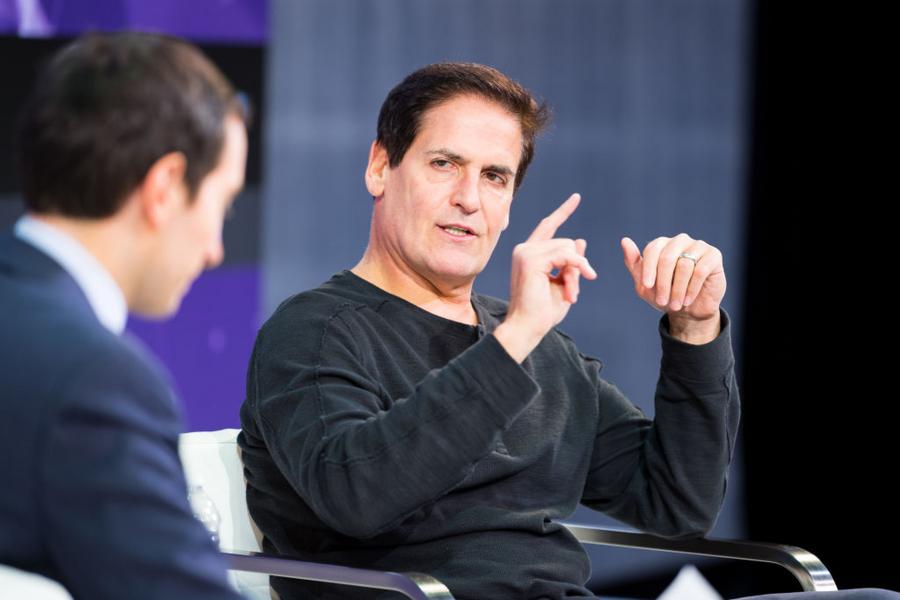
Michael Cohen/Getty Images
The Hustle Before the Billions
Long before he was a household name, Cuban was a relentless grinder. At 12 years old, he sold boxes of garbage bags door-to-door just to buy a pair of expensive basketball sneakers. He skipped his senior year of high school, tended bar, taught disco dancing, and eventually found his way into the tech world.
In the 1980s, he built a software integration company called MicroSolutions. He sold this company to CompuServe in 1990, walking away with $2 million. That's the same as around $5 million today. For most people, cashing a $2 million check would be the finish line. For Cuban, it was just the buy-in for a much bigger game.
The Broadcast.com Bonanza
The idea that made Mark Cuban a billionaire didn't start in a high-tech lab; it started with a simple, frustrating problem. In 1994, Cuban and his college buddy, Todd Wagner, realized there was no good way to listen to out-of-market Indiana University basketball games from Dallas, Texas.
Through a mutual connection, they invested in a startup that was trying to put radio on the web. Armed with a Packard Bell 486 computer set up in a spare bedroom, they figured out how to digitize the audio signal from local sports games and broadcast it globally over the internet. They called the company AudioNet and officially launched it in 1995.
By 1998, they had scaled the business to broadcast corporate events, radio stations, and major sports. They changed the company name to Broadcast.com.
In the frothy dotcom period of the late 1990s, you didn't need much more than a business plan to go public so in July 1998, Broadcast.com had its IPO. Shares were initially set to be priced at $18. By the end of the day, the stock was trading at $62.75, giving the company a $1 billion market cap. Over 100 Broadcast employees became instant paper millionaires. Mark's 25% stake gave him a $250 million paper net worth.
The Mania of 1999
If the IPO was a home run, the next eight months were a launch into deep space. Broadcast.com's stock price surged over 1,000% as dot-com mania took over Wall Street. By March of 1999, the company's market cap had swelled to around $4 billion, giving Mark a paper net worth of $1 billion.
But the real payday came on April 1, 1999—exactly 27 years ago today. At the absolute euphoric peak of the tech bubble, internet giant Yahoo announced it was buying Broadcast.com for a staggering $5.7 billion. But here's the catch: Yahoo agreed to buy Broadcast 100% in stock. No cash. Yahoo agreed to pay $130 per share—a 50% premium over where Broadcast.com was trading just weeks prior.
To modern investors, the math behind this deal looks like utter lunacy. At the time of the buyout, Broadcast.com was generating just $22 million in annual revenue while operating at a $16 million net loss. Why on earth would Yahoo pay $5.7 billion for a company bleeding cash?
Because in 1999, traditional financial metrics like Price-to-Earnings ratios were thrown out the window. Wall Street wasn't valuing companies based on profits; they were valuing them based on "eyeballs," "stickiness," and "mindshare."
Yahoo was in a vicious, high-stakes arms race with America Online (AOL) and Microsoft (MSN) to become the dominant "portal" of the internet. Yahoo believed that whoever owned audio and video streaming would own the future of the web. They viewed Broadcast.com as the YouTube and Spotify of its day. Furthermore, Yahoo didn't actually have to pay $5.7 billion in hard cash. Their own stock had surged 264% over the previous 12 months. Yahoo simply used its hyper-inflated stock as monopoly money to buy Broadcast.com's "eyeballs."
The buyout handed Cuban 14.6 million shares of Yahoo stock. At the time the deal was announced, Yahoo was trading at $95 a share, so he instantly had a paper net worth of roughly $1.4 billion.
Sweating Out The Six-Month Lockup
There was just one massive catch. Cuban couldn't sell a single share for six months.
This is fairly standard. When executives sell a company for stock, they are hit with a strict legal "lockup" period to prevent them from immediately dumping their shares and tanking the stock price. Cuban was legally prohibited from selling or hedging a single share of his Yahoo stock for six excruciating months.
He looked around at the broader tech landscape—where companies like Webvan and Pets.com were burning through cash with no path to profitability—and realized the market was completely detached from reality. A catastrophic correction was looming. If the bubble burst before his six-month lockup expired, his $1.4 billion would evaporate into thin air.
To survive that six-month waiting period without losing his mind, he took almost every penny of liquid cash he had at the time and bought put options on a tech index just to give himself some kind of temporary insurance.
The Masterstroke: The "Zero-Cost Collar"
Soon after the deal was closed, Cuban picked up the phone, called Goldman Sachs, and structured an incredibly sophisticated options trade known as a zero-cost collar.
Instead of waiting and hoping the market held up, Cuban built a financial fortress around his stock. Here is exactly how he did it:
The Floor (Downside Protection): He bought "put options" with an $85 strike price. This acted as an insurance policy. No matter how low Yahoo's stock crashed, he was guaranteed the right to sell his shares for at least $85.
The Ceiling (Capped Upside): Buying that much insurance for 14.6 million shares is astronomically expensive. To pay for it, Cuban simultaneously sold "call options" with a $205 strike price. This meant if Yahoo skyrocketed past $205, he would be forced to sell his shares at $205, missing out on any extra profit.
The Magic (Cost = $0): The premiums he collected from selling the $205 calls perfectly canceled out the cost of buying the $85 puts. The entire massive insurance policy cost him absolutely nothing out of pocket.
To put that in plain English, imagine this scenario:
Let's say you own a house that is currently worth $1.4 million. You are terrified the housing market in your neighborhood is about to completely crash. You want to buy an ironclad insurance policy guaranteeing you can always sell your house for at least $850,000, no matter how bad things get.
Pretend that insurance policy costs $100,000.
Net, you go out and find a wealthy investor and make a deal:
"If you pay for my $100,000 insurance policy today, I promise that if my house suddenly shoots up in value past $2 million, I will cap my profits at $2 million and you get to keep every single penny above that."
The investor agrees. You just got your disaster insurance completely for free.
If the neighborhood burns down and property values drop to zero, you still walk away with your guaranteed $850,000. If the neighborhood becomes the hottest zip code on earth and the house is suddenly worth $10 million, you still only get $2 million. You willingly traded away your chance to win the lottery in exchange for a 100% guarantee that you wouldn't go bankrupt.
In Mark's real-life example, the neighborhood burned down. But not right away!
The Crash
In January 2000, the market was still soaring. Yahoo's stock hit $237 a share. At that level, his 14.6 million shares were worth $3.4 billion. For a brief, agonizing moment, Cuban's hedge looked like a premature mistake because his profits were capped.
Then came March 2000.
Just three months later the dot-com bubble burst with historic violence. Internet companies were wiped off the map overnight. By 2002, Yahoo's stock had plummeted from its $237 peak down to a dismal $13 a share. At that price, his 14.6 million shares would have been worth around $190 million.
Had Cuban simply held his stock like so many other tech founders did, he would have lost 86% of his wealth. Because of his brilliant $85 safety net, he retained over $1 billion in liquid wealth while the rest of Silicon Valley burned.
The Legacy
Cuban took that preserved cash and built a staggering empire. He bought the Dallas Mavericks in 2000 for $285 million, transforming them into a championship franchise before selling his majority stake in 2023 at a $3.5 billion valuation. He became the undisputed star of Shark Tank, revolutionized prescription drug pricing with Cost Plus Drugs, and amassed a current net worth of $6.5 billion.
A lot of people got rich on paper during the dot-com boom. But Mark Cuban became a permanent billionaire because he knew the most important rule in the casino: It doesn't matter how many chips you have on the table; it only matters what you can cash out at the cage.
/2009/09/Steve-Jobs.jpg)
/2009/10/Steve-Wozniak.jpg)
/2010/09/Steve-Young-1.jpg)
/2020/01/laurene.jpg)
/2015/11/Steve-Harvey.jpg)
/2021/09/steve-mcqueen.jpg)
/2019/11/GettyImages-1094653148.jpg)
:strip_exif()/2015/09/GettyImages-476575299.jpg)
/2018/03/GettyImages-821622848.jpg)
/2009/09/Cristiano-Ronaldo.jpg)
/2017/02/GettyImages-528215436.jpg)
/2020/04/Megan-Fox.jpg)
/2019/04/rr.jpg)
/2009/09/Brad-Pitt.jpg)
/2009/11/George-Clooney.jpg)
/2020/02/Angelina-Jolie.png)
/2009/09/Jennifer-Aniston.jpg)
/2019/10/denzel-washington-1.jpg)
/2020/01/lopez3.jpg)
:strip_exif()/2009/09/P-Diddy.jpg)
/2020/06/taylor.png)