
/2014/08/Richard-Nixon.jpg)
/2023/08/Lyndon-B.-Johnson.jpg)
/2020/08/george-bush.jpg)
/2019/10/jimmy-carter-1.jpg)
/2022/05/bob-woodward.png)
/2014/07/Gerald-Ford-1.jpg)
/2018/03/GettyImages-821622848.jpg)
/2020/02/Angelina-Jolie.png)
:strip_exif()/2015/09/GettyImages-476575299.jpg)
/2009/09/Jennifer-Aniston.jpg)
/2009/09/Brad-Pitt.jpg)
/2009/11/George-Clooney.jpg)
/2017/02/GettyImages-528215436.jpg)
/2009/09/Cristiano-Ronaldo.jpg)
/2019/10/denzel-washington-1.jpg)
/2020/01/lopez3.jpg)
/2019/04/rr.jpg)
What Was Richard Nixon's Net Worth?
Richard Nixon was an American politician who had a net worth of $7 million at the time of his death in 1994. That's the same as $15 million today after adjusting for inflation.
Richard Nixon was the 37th president of the United States, a position he held from 1969 to 1974. Many significant events occurred during his time in the White House, including the end of the Vietnam War, the first manned landing on the moon, and the establishment of the Environmental Protection Agency. Famously, Nixon's second term ended early following the Watergate scandal, when he became the only US president to resign from office.
Nixon was elected to the House of Representatives in 1946 and reelected in 1948. In 1950, he was elected to the Senate. Richard was Dwight D. Eisenhower's running mate in the 1952 election. He served as vice president for eight years and narrowly lost to John F. Kennedy for President in 1960. During his Presidential term, he ended the U.S. involvement in the Vietnam War in 1973. He visited the People's Republic of China in 1972 and opened up communications. Nixon also initiated the Anti-Ballistic Missile Treaty with the Soviet Union. He fought cancer and illegal drugs, enforced desegregation, implemented environmental reforms, and reformed healthcare and welfare. Richard was re-elected by a large margin in 1972. His second term resulted in the Watergate scandal. In lieu of being impeached, he resigned from office and was pardoned by his successor, Gerald Ford. Nixon authored nine books and traveled the world during his retirement.
Net Worth Analysis
Richard Nixon's financial life was a rollercoaster of massive scandals, near-bankruptcy, and a highly lucrative late-life comeback. At the time of his death in 1994, he had an estimated net worth of $7 million (equal to roughly $15 million today). However, getting to that number involved some of the most controversial financial maneuvering in presidential history.
The "I Am Not a Crook" Tax Scandal
While most people associate Nixon's famous phrase, "I am not a crook," with the Watergate break-in, he was actually talking about his personal finances. In 1973, it was revealed that despite earning a $200,000 presidential salary, Nixon paid only $792 in federal income taxes in 1970, and $878 in 1971. He achieved this by exploiting a tax loophole, claiming a massive $576,000 deduction for donating his vice-presidential papers to the National Archives.
The public uproar over his tax avoidance forced Nixon to take the unprecedented step of voluntarily releasing his tax returns and submitting to a public audit. The IRS ultimately ruled that his massive deductions were invalid and ordered him to pay a staggering $476,431 in back taxes and interest.
Near-Bankruptcy and the David Frost Rescue
When Nixon resigned in 1974, he was facing crushing legal bills and financial ruin. By 1975, he reportedly had as little as $500 in his bank account. His financial salvation arrived in the form of British broadcaster David Frost, who paid Nixon an unprecedented $600,000 for a series of exclusive televised interviews in 1977. That's the same as around $3.2 million today. This massive injection of cash rescued Nixon from bankruptcy and funded his post-presidency lifestyle.
The 1983 Co-Op Declaration
We know exactly what Nixon was worth in the early 1980s because of a rare financial disclosure. In October 1983, Nixon submitted a signed, confidential "Personal Financial Information" document to a New York City co-op board where he was attempting to buy an apartment. In that document, he explicitly declared his net worth at exactly $4,277,000 (comprised of $27,000 in cash, $3 million in stocks and securities, and $1.25 million in real estate). That's the same as being worth $14 million today.
Over the final 11 years of his life, he received a steady presidential pension, published several lucrative, best-selling books, and enjoyed the massive bull market of the 1980s and early 1990s on his $3 million stock portfolio. This organic growth safely pushed his net worth from $4.2 million in 1983 to the $7 million mark by the time of his death in 1994.
Real Estate
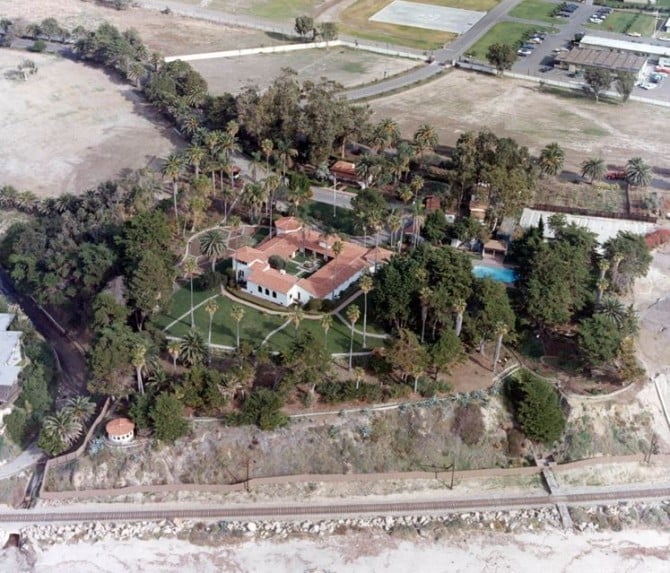
A significant portion of Nixon's wealth—and controversy—was tied to real estate. In 1969, Richard paid $1.4 million (the equivalent of $11 million today) for a stunning 26-acre oceanfront estate in San Clemente, California, known as La Casa Pacifica. The purchase immediately raised eyebrows when it was revealed Nixon only put $100,000 down, securing a controversial $450,000 loan from his close friend, industrialist Robert Abplanalp, to help finance the property.
The estate became a massive political liability in 1974 when a House committee discovered that $1.7 million in federal taxpayer money had been spent to upgrade it and his Key Biscayne, Florida, property. While much of the money went to Secret Service security infrastructure, opponents seized on frivolous taxpayer expenses, including $100,000 spent just on landscaping and shrubbery.
Nixon ultimately sold the San Clemente property in 1980 to Gavin Herbert, the billionaire co-founder of the pharmaceutical company Allergan. Because it was a private, off-market transaction, the exact sale price remains completely undisclosed. Herbert and his partners subdivided the surrounding 20 acres into a gated luxury community called Cotton Point Estates, but Herbert kept Nixon's 5.5-acre main residence intact for himself. Since 2015, Herbert has repeatedly listed and delisted the historic home, with asking prices fluctuating between $57.5 million and $75 million. Here's an aerial photo and video tour of the home:
Via Public Domain
Early Life and Education
Richard Milhous Nixon was born on January 9, 1913, in Yorba Linda, California. He was the son of Quaker parents, Hannah and Francis. He had four brothers named Harold, Donald, Arthur, and Edward. Nixon grew up poor on his family ranch, which ultimately failed in 1922. Subsequently, the family moved to Whittier. There, Richard attended East Whittier Elementary School. As a teen, he went to Fullerton Union High School, where he played junior varsity football and participated on the debate team. Nixon graduated from Whittier High School. He went on to attend Whittier College, where he played basketball and continued his prowess as a great debater. Richard graduated with a BA in history in 1934 and then went to the Duke University School of Law, from which he graduated in 1937.
Career Beginnings and Military Service
After being admitted to the California bar in 1937, Nixon started practicing with the Whittier law firm Wingert and Bewley. The next year, he opened his own branch in La Habra. Later, after moving to Washington, D.C., in 1942, Richard landed a job at the Office of Price Administration. However, dissatisfied with his role, he decided to join the US Navy. Nixon was first assigned as an aide to the commander of the Naval Air Station Ottumwa, and then to Marine Aircraft Group 25 and the South Pacific Combat Air Transport Command. He was eventually promoted to lieutenant and later to lieutenant commander. Richard was relieved of active duty in 1946; seven years after that, he was promoted to commander in the US Naval Reserve.
Start of Political Career
In 1946, Nixon was elected to the House of Representatives. He first achieved national recognition two years later, when his work on the Alger Hiss spy case cemented his already solid reputation as a leading anti-Communist. With this newfound attention, Richard was elected to the Senate in 1950. He went on to become the running mate of Republican presidential nominee Dwight D. Eisenhower, for whom he served eight years as vice president.
First Presidential and Gubernatorial Runs
Nixon launched his first campaign for US president in 1960. Due in large part to the debut of televised debates, which had the effect of highlighting his shabby appearance, he narrowly lost to John F. Kennedy. Two years later, Richard ran for California governor, but lost to incumbent Pat Brown.
Presidential Election and First Term
In 1968, Nixon made another run for the presidency. During that turbulent period in the United States, he represented himself as a beacon of stability, appealing to socially conservative people who disliked the era's countercultural movement. Ultimately, Richard won the presidency, beating Hubert Humphrey and George Wallace in a close race.
During his first term, Nixon made great efforts to establish diplomatic relations with China. He also visited South Vietnam and began to withdraw American troops from the war. However, Richard also authorized attacks on Laos and Cambodia. In 1973, American involvement in Vietnam officially ended, as did the military draft. Among his other achievements, Nixon ended the Anti-Ballistic Missile Treaty with the USSR, enforced desegregation of Southern schools, created the Environmental Protection Agency, and launched a concerted effort to find a cure for cancer.
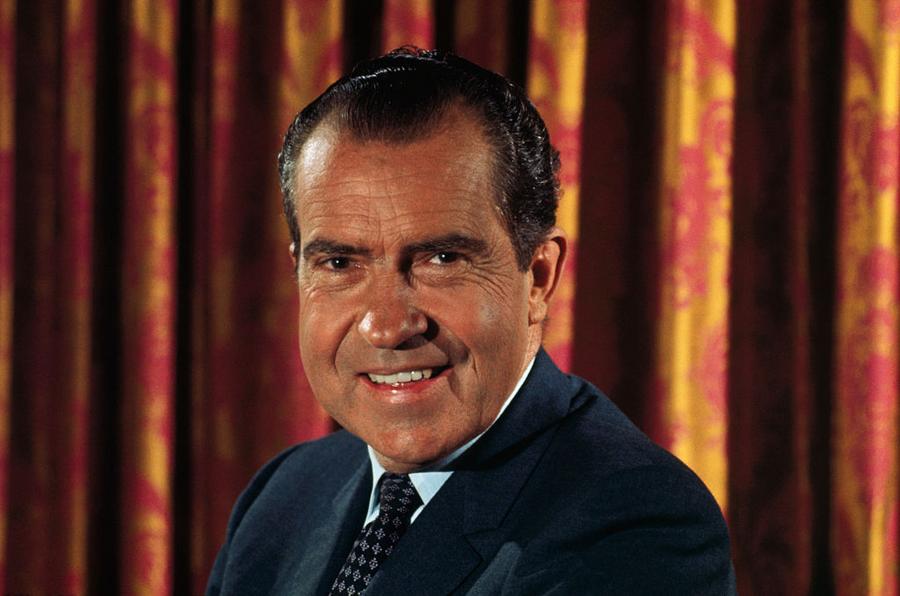
Los Angeles, California: Nixon press conference at the Century Plaza Hotel. Via Getty
Second Term and Watergate
In 1972, Nixon beat George McGovern and was reelected in one of the largest landslide victories in the nation's history. At the beginning of his second term, he ordered an airlift to resupply losses incurred by Israel in the Yom Kippur War, which resulted in an oil crisis in the United States.
Nixon's second term was ultimately cut short by the Watergate scandal. Earlier in 1972, before his reelection, he had ordered five men to break into the Democratic Party headquarters at the Watergate complex to sabotage his opponents. Richard had also used a clandestine taping system to record his conversations in the Oval Office. By late 1973, with more information coming out about the scandal thanks to reporters Carl Bernstein and Bob Woodward, Nixon had lost most of his political support. On August 9, 1974, facing the inevitability of an impeachment and removal from office, he resigned as president.
Later Years
Following Watergate and his resignation, Nixon was eventually issued a pardon by his successor, Gerald Ford. He went on to live for nearly 20 years in retirement, during which time he wrote ten books, including his memoirs, and went on a series of international trips to rehabilitate his image as an elder statesman.
Personal Life and Death
In 1940, Richard married high school teacher Pat Ryan. They had two daughters, Tricia and Julie. The two remained together until Pat's death from lung cancer in 1993. A year later, Nixon suffered a major stroke at his New Jersey home; after being taken to the hospital, he went into a deep coma. He passed away on April 22, 1994, at the age of 81. Richard and Pat are interred on the grounds of the Nixon Library.
/2014/08/Richard-Nixon.jpg)
/2014/07/Gerald-Ford-1.jpg)
/2015/04/a-e1428246744470.jpg)
/2023/08/Lyndon-B.-Johnson.jpg)
/2020/08/george-bush.jpg)
/2020/02/bob-dole.png)
/2018/02/gw.jpg)
/2020/06/taylor.png)