
/2014/08/Che-Guevara.png)
/2020/01/Fidel-Castro.jpg)
/2014/07/GettyImages-675441970.jpg)
/2014/12/GettyImages-459962770.jpg)
/2015/01/Celia-Cruz.jpg)
/2020/06/taylor.png)
/2009/09/Cristiano-Ronaldo.jpg)
:strip_exif()/2009/09/P-Diddy.jpg)
/2018/03/GettyImages-821622848.jpg)
/2020/01/lopez3.jpg)
/2020/04/Megan-Fox.jpg)
/2009/09/Brad-Pitt.jpg)
/2019/11/GettyImages-1094653148.jpg)
/2009/11/George-Clooney.jpg)
/2017/02/GettyImages-528215436.jpg)
/2020/02/Angelina-Jolie.png)
/2019/04/rr.jpg)
What Was Che Guevara's Net Worth?
Che Guevara was an Argentine revolutionary, physician, author, diplomat, and military theorist who had a net worth of $50 thousand at the time of his death in 1967. Che Guevara played a major part in the Cuban Revolution. His image is often used as a counterculture symbol of rebellion in popular culture. Che traveled throughout South America as a medical student, and what he saw led him to get involved in Guatemala's social reforms. In Mexico City, Guevara met Raúl and Fidel Castro and joined their 26th of July Movement. He played a crucial role in a two-year guerrilla campaign to overthrow Cuban dictator Fulgencio Batista. Che served in the new Cuban government, worked as the Minister of Industries, helped head a literacy campaign, was the national bank president for Cuba's armed forces, trained militia forces, and brought Soviet nuclear-armed ballistic missiles to Cuba.
As a writer, Guevara composed a seminal manual on guerrilla warfare and a best-selling memoir. He left Cuba in 1965 and tried to lead revolutions in Congo-Kinshasa and Bolivia. He was named by Time magazine as one of the 100 most influential people of the 20th century. The Maryland Institute College of Art named a photo of Che titled "Guerrillero Heroico" the "most famous photograph in the world." Guevara was captured by CIA-assisted Bolivian forces and summarily executed on October 9, 1967, at the age of 39. In 2008, his life was turned into a two-part film from director Steven Soderbergh, starring Benicio del Toro as Guevara. The first part, "The Argentine," details his involvement with the Cuban revolution and Fidel Castro, while the second part, titled "Guerrilla," deals with his time as a guerrilla fighter in Bolivia.
Early Life
Che Guevara was born Ernesto Guevara on May 14, 1928, in Rosario, Santa Fe, Argentina. He was the son of Celia de la Serna y Llosa and Ernesto Guevara Lynch, and he grew up with four younger siblings in an upper-class family. His family has Irish, Spanish, and Basque ancestry. Che's family had leftist leanings, and during his youth, he developed an "affinity for the poor." His father sometimes hosted Spanish Civil War veterans at the family's home. Though Guevara had asthma, he excelled in several sports, including football, shooting, swimming, and rugby. Che's father taught him how to play chess, and by the age of 12, he had begun competing in local tournaments. He was raised in a home that had more than 3,000 books, and he enjoyed reading, eventually becoming interested in Latin American writers such as Ciro Alegría, Rubén Darío, and Horacio Quiroga. In school, Guevara's favorite subjects were political science, philosophy, sociology, engineering, math, archeology, and history.
In 1948, Che began studying medicine at the University of Buenos Aires. He had a "hunger to explore the world," so he embarked on two road trips: a 2,800-mile trip through northern Argentina's rural provinces on a bicycle with a small engine (1950) and a 5,000-mile motorcycle trip through part of South America (1951). His account of the journeys was published posthumously in the 1995 book "The Motorcycle Diaries." Between the two trips, Guevara worked as a nurse on Argentina's merchant marine freighters. After returning to the University of Buenos Aires, he earned his medical degree in mid-1953.
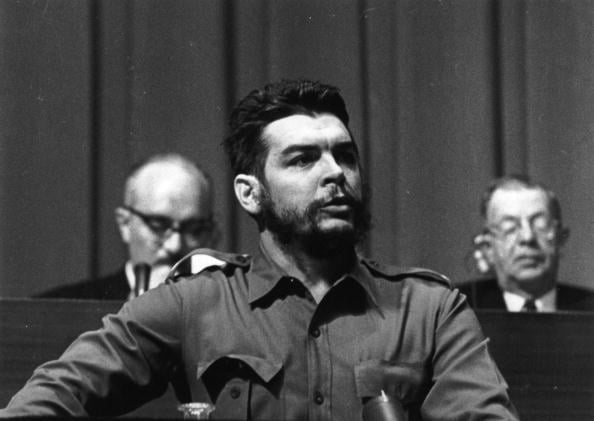
Getty Images
Political Career
Che went to Mexico in 1954, and he met revolutionary leader Fidel Castro, who was planning to overthrow Cuban dictator Fulgencio Batista's government. Guevara joined the 26th of July Movement and was instrumental in the guerrilla war against Batista. In 1959, Castro overthrew Batista, and Guevara became the president of the National Bank of Cuba. He then served as the Minister of Industries from 1961 to1965 and was in charge of the nationalization of industry as well as plans for land distribution. Che traveled around the world, establishing relationships with other countries (particularly the Soviet Union), and he was heavily involved during the Cuban Missile Crisis and the Bay of Pigs invasion. He wrote a manual on guerrilla warfare and gave a 1964 speech to the United Nations in which he condemned South Africa's apartheid and U.S. foreign policy. Guevara left Cuba in 1965 to spread revolution in different areas of the developing world, and he went to Africa to try to train rebel forces in guerrilla warfare. His efforts were unsuccessful, and he returned to Cuba in 1966. Che then went to Bolivia to lead forces that were rebelling against René Barrientos Ortuño's government, and with help from the U.S., he was captured by the Bolivian government.
Personal Life
Che was married to Hilda Gadea from 1955 to 1959. Later in 1959, he married Aleida March, and they remained together until his death in 1967. March was a member of the 26th of July Movement, and she published the book "Remembering Che: My Life with Che Guevara" in 2012. Guevara had one child from his first marriage and four children from his marriage to March.
Capture and Death
On October 7, 1967, an informant told the Bolivian Special Forces where Guevara's guerrilla encampment was located. The following morning, 180 soldiers surrounded the area and advanced into the Yuro ravine. A battle ensued, and after Che was wounded, he was captured and taken to a dilapidated La Higuera schoolhouse. On October 9th, his execution was ordered by Bolivian President René Barrientos, reportedly to prevent the possibility of Guevara escaping from prison. Shortly before his execution, a Bolivian soldier asked him if he was thinking about his immortality, and Che responded, "No, I'm thinking about the immortality of the revolution." Sergeant Mario Terán shot Guevara in the arms and legs before firing a fatal shot to his chest. Che was 39 years old at the time of his death.
On October 15th, Fidel Castro called for three days of public mourning in Cuba. On October 18th, he addressed one million mourners at Havana's Plaza de la Revolución, stating, "Those who believe his death is the defeat of his ideas, the defeat of his tactics, the defeat of his guerrilla conceptions, and the defeat of his thesis are mistaken. Because that man who fell as a mortal man, as a man who was exposed many times to bullets, as a soldier, as a leader, is a thousand times more capable than those who killed him with a stroke of luck." Guevara was laid to rest in a secret location, but after that location was discovered in 1997, his remains were exhumed and reburied in Cuba.
/2014/08/Che-Guevara.png)
/2020/01/Fidel-Castro.jpg)
/2014/07/GettyImages-675441970.jpg)
/2019/06/Andres-Manuel-Lopez.jpg)
/2010/02/Robert-Mugabe.jpg)
/2013/01/Meles-Zenawi.jpg)
/2011/02/Saddam-Hussein-1.jpg)
/2015/06/Mahatma-Gandhi-1.jpg)
/2019/10/denzel-washington-1.jpg)
:strip_exif()/2015/09/GettyImages-476575299.jpg)
/2009/09/Jennifer-Aniston.jpg)